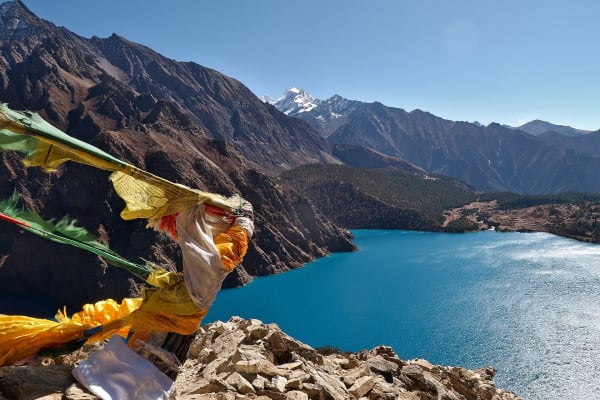
Phoksundo Lake sits at 3,611 m in Shey Phoksundo National Park in Dolpo, and it is the deepest lake in Nepal at around 145 m. Its colour is a saturated turquoise that photographs look manipulated — the result of glacial flour suspended in water with almost no organic matter. The village of Ringmo on its shore is a Bon and Buddhist settlement of flat-roofed houses and a chorten row.
Getting there involves a flight to Juphal, a walk up the Phoksundo Khola, and a famous traverse on a narrow path cut into a cliff high above the water — the scene used in the film Himalaya (Caravan), which was shot in Dolpo. It is the most accessible way into Dolpo country, and at USD 20 per week in permits it is far cheaper than Upper Dolpo.
The Trek at a Glance
| Duration | 14 days from Kathmandu |
| Highest point | About 4,040 m on the ridge above the lake |
| The lake | Phoksundo, 3,611 m, around 145 m deep |
| Difficulty | Moderate — remote, with a famous cliff traverse |
| Access | Flight Kathmandu–Nepalgunj–Juphal |
| Permits | Lower Dolpo restricted permit (USD 20 per week) and Shey Phoksundo National Park |
| Best seasons | May to October, including the monsoon |
| Accommodation | Basic lodges, homestays and some camping |
We run it as a 14-day Shey Phoksundo Lake trek, with the 17-day Lower Dolpo trek and the 26-day Upper Dolpo trek as the longer routes through the same region.
The Route
Flying in
Kathmandu to Nepalgunj in the Terai, then a 35-minute flight to Juphal (2,475 m) above the Thuli Bheri valley. Both legs are weather-dependent and Juphal is a small strip, so spare days matter. From Juphal it is a short walk down to Dunai, the district headquarters.
Up the Phoksundo Khola
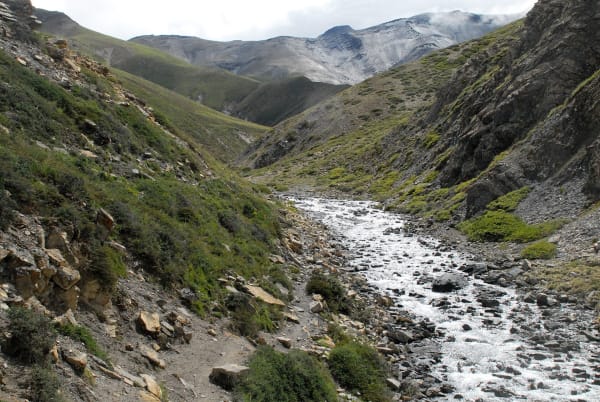
West from Dunai into the Suli Gad gorge, through Chhepka and Jharana Hotel, climbing gradually through blue pine and juniper forest with the river below. This is good walking in a valley that sees very few people, and the national park protects snow leopard and blue sheep habitat throughout.
The waterfall and the cliff path
Above Jharana, Nepal's highest waterfall drops around 167 m from the lake's outflow. The trail then climbs steeply to a ridge at about 4,040 m — the Ringmo cliff path, a narrow ledge cut into rock high above the water, with a sheer drop to the lake on one side. It is safe in dry weather and genuinely exposed, and it is the image most people know Dolpo by.
Ringmo and the lake
Ringmo village sits at the lake's southern end, with a Bon monastery, Tshowa Gompa, on a promontory above the water — Bon being the pre-Buddhist Tibetan religion that survives in Dolpo more strongly than anywhere else. Spend two nights: the walk along the lake's western shore and up toward the Kang La is superb, and the colour of the water changes through the day.
Out
Back down the gorge to Dunai and Juphal. Longer itineraries continue over the Kang La into Upper Dolpo, or east toward Dho Tarap on the Lower Dolpo circuit.
Why Dolpo Is Different
- Bon religion. Dolpo holds one of the largest surviving Bon communities anywhere — a pre-Buddhist Tibetan tradition with its own monasteries, texts and practices, including counter-clockwise circumambulation, which is the opposite of Buddhist practice. Watch which way people walk around a chorten.
- Rain shadow. Dolpo sits behind the Dhaulagiri range, so it is dry through the monsoon. May to October is the season, which is the reverse of most of Nepal.
- Remoteness. Two flights from Kathmandu and then several days from a road. There is no quick exit.
- Snow leopard country. Shey Phoksundo National Park is the most important snow leopard habitat in Nepal. Sightings are extremely rare; tracks and kills are not.
- Yak caravans. The salt trade over the Tibetan passes still operates in a reduced form, and you will meet caravans on the trail.
Peter Matthiessen's The Snow Leopard and Eric Valli's film Himalaya were both made here, and both capture something accurate about the place: it is the part of Nepal that feels least connected to the rest of it.
Practicalities
- Permits: the Lower Dolpo restricted permit at USD 20 per week, plus Shey Phoksundo National Park entry at NPR 3,000. Two trekkers minimum with a licensed guide and registered agency.
- Flights: Kathmandu–Nepalgunj–Juphal, both weather-dependent, with limited frequency. Build two or three spare days at each end.
- Accommodation: basic lodges and homestays at Chhepka, Ringmo and Dunai; some itineraries camp. Bring a -10 °C bag at minimum.
- Food: simple and locally grown — potato, barley, buckwheat, dal bhat. Supplies are limited, and our crew carries what the villages cannot provide.
- Altitude: the maximum is about 4,040 m with gradual gain, so risk is low.
- The cliff path: exposed but not technical in dry weather. Anyone with a serious fear of heights should tell us before booking.
- Connectivity: almost none beyond Dunai.
Which Dolpo Trek to Choose
| Trek | Days | Permit | Best for |
|---|---|---|---|
| Shey Phoksundo Lake | 14 | USD 20 per week | The lake and the gorge, the shortest way into Dolpo |
| Lower Dolpo | 17 | USD 20 per week | The lake plus Dho Tarap and a pass circuit |
| Upper Dolpo | 26 | USD 500 for 10 days | Shey Gompa, the Crystal Mountain, and the remotest country in Nepal |
| Jomsom to Dolpo | 22 | Both areas | A traverse linking Mustang and Dolpo |
For most trekkers, Shey Phoksundo or Lower Dolpo is the right choice: the landscape, the Bon culture and the remoteness are all there, at a fraction of the Upper Dolpo permit cost. Upper Dolpo is for trekkers who want four weeks and the Shey Gompa pilgrimage — see our Upper Dolpo guide.