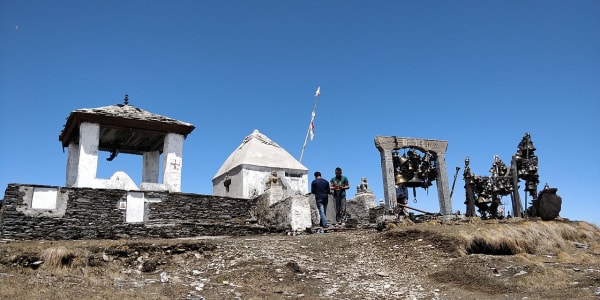
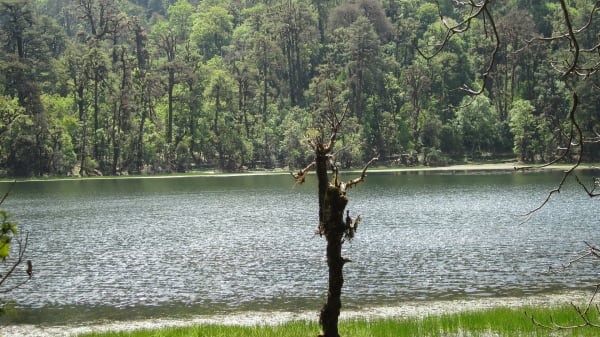
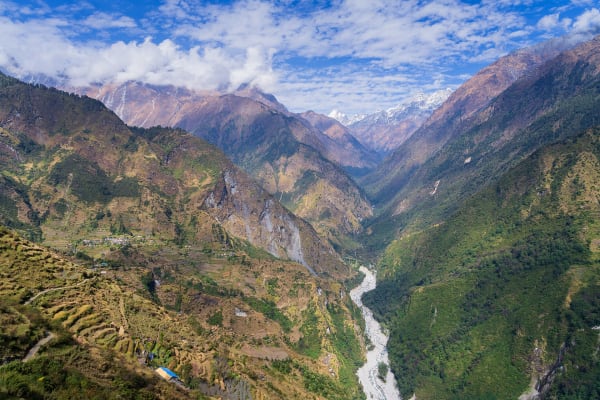
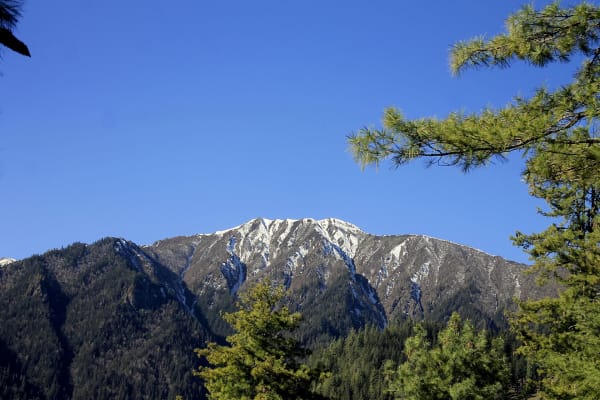
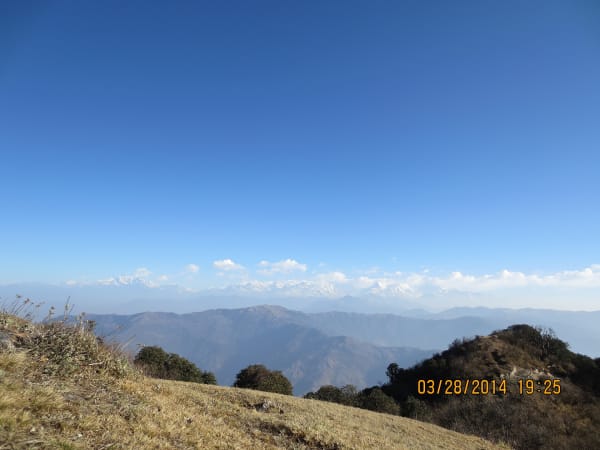
The Badimalika temple stands on open grassland at 4,214 m in Bajura district, one of the most important Hindu pilgrimage sites in western Nepal. For most of the year the shrine is alone on the ridge with nothing but grazing stock and weather around it. For one week each August, at Janai Purnima, tens of thousands of pilgrims walk up from across the far west and the ridge fills with people, drums and sacrifice.
Getting there means two flights and a jeep before you start walking: Kathmandu to Nepalgunj, Nepalgunj to Kolti, then a drive to Martadi. From there it is three days up through terraced Chhetri and Thakuri villages into oak and rhododendron forest and out onto high pasture, with the Saipal (7,031 m) range and the Api massif along the northern skyline.
There are no lodges. The group camps with a cook crew and stays in village households on the way in. Almost no foreign visitors come here at all.

The Trek at a Glance
| Duration | 13 days Kathmandu to Kathmandu, 6 of them walking |
| Highest point | Badimalika temple, 4,214 m |
| Difficulty | Moderate — short but steep, with rough trails |
| Best seasons | April to June, September to November |
| Accommodation | Tents and village households — there are no lodges |
| Access | Flights Kathmandu–Nepalgunj–Kolti, then jeep to Martadi |
| Permits | Local entry fees and trekking registration |
| Price | From USD 1,875 per person |
We run it as a 13-day trek with a contingency day built into the Kathmandu end, because the Kolti flight is the least reliable link in the chain.
The Route
Getting to Martadi
Three travel days: Kathmandu to Nepalgunj on the Terai plain, an early-morning flight to the airstrip at Kolti (1,600 m), then a jeep to Martadi at 1,500 m. The Kolti leg is small-aircraft flying into a hill airstrip and it is weather-dependent — which is exactly why there is a spare day at the end of the itinerary.
Martadi to Badimalika (1,500 m to 3,900 m)
Three walking days, gaining 2,400 m. The trail climbs from Martadi through Dahakot (2,100 m) and Ratapani (2,900 m), moving from terraced Chhetri and Thakuri farmland into thick oak and rhododendron and then out onto open pasture. The paths are pilgrim routes and working village trails — steep, direct, and unconcerned with switchbacks.
The temple and the ridge (4,214 m)
A full day at the top. The shrine itself is a simple stone structure hung with bells and trident offerings rather than a grand building, and the setting does the work: open grassland at 4,214 m with Saipal and the Api massif along the northern horizon and nothing else in any direction. The exploration day walks the ridge for the wider views.

The descent and flights out
Back down to Ratapani and Martadi in two days, then the jeep to Kolti and flights to Nepalgunj and Kathmandu. The contingency day sits at the Kathmandu end so a weather delay at Kolti does not cost you an international flight.
Janai Purnima: Should You Plan Around It?
Janai Purnima falls on the August full moon, and it transforms the trek completely. Tens of thousands of pilgrims converge on the ridge from across the far west, many walking for several days to get there, and the site fills with drums, singing and ritual sacrifice through the night.
Whether to aim for it depends entirely on what you want:
| Janai Purnima (August) | Rest of the season | |
|---|---|---|
| The site | Tens of thousands of pilgrims, all night ritual | Empty grassland and a solitary shrine |
| Weather | Monsoon — cloud, rain and mud on the approach | Clear mountain views from the ridge |
| Camping | Crowded, and finding ground is genuinely difficult | Pitch anywhere |
| What it is | One of the great religious gatherings of western Nepal | One of the emptiest high places in the country |
Our default is the clear-weather seasons. If you want the festival, it has to be booked well in advance and you accept monsoon conditions on the walk in — see the festival calendar for dates.
Difficulty and Conditions
Graded moderate. It is a short trek — six walking days — but the ascent is steep and quick, and the far west is a long way from help.
- 2,400 m of ascent over three days, which is faster than ideal. Your guide paces it deliberately and the exploration day at the top helps.
- Rough pilgrim trails, steep and direct, with loose ground in places.
- Camping at altitude — nights near the temple drop below freezing in the clear seasons.
- No lodges, shops or ATMs beyond Martadi.
- Remote medical access. Evacuation means a helicopter to Nepalgunj and is weather-dependent.
Read our altitude guide before this one; the gain rate is the main thing to manage.
What It Costs
The price is driven by the flights — two legs each way, including a small-aircraft hop to a hill airstrip — and by the camp crew, since there is nowhere to stay on the mountain.
| Group size | Price per person |
|---|---|
| 1 trekker | USD 2,000 |
| 2 to 4 | USD 1,975 |
| 5 to 7 | USD 1,950 |
| 8 to 10 | USD 1,925 |
| 11 to 14 | USD 1,900 |
| 15 and over | USD 1,875 |
Carry rupees from Kathmandu or Nepalgunj. There is no ATM at Martadi and nothing at all beyond it.
What Is Included
- Airport pickup and drop-off in Kathmandu.
- Kathmandu–Nepalgunj–Kolti return domestic flights with airport transfers.
- Private jeep transport between Kolti, Martadi and the trailhead.
- Hotel accommodation in Kathmandu, Nepalgunj and Martadi with breakfast.
- Two-person tents, mess tent, toilet tent and all group camping equipment, plus village accommodation where available.
- A cook and kitchen crew for the camping section.
- Three meals a day during the trek.
- Local entry fees and trekking registration.
- A licensed English-speaking guide, group map, first aid kit, and all government taxes and service charges.
What Is Not Included
- International flights and the Nepal entry visa fee.
- Travel insurance including emergency helicopter evacuation.
- Personal trekking equipment and clothing, including a bag rated to -10 °C or lower.
- Porter services, available at additional cost.
- Lunch and dinner in Kathmandu, Nepalgunj and Martadi.
- Snacks, bottled water, hot showers, Wi-Fi, charging and drinks.
- Laundry, phone calls, souvenirs and personal expenses.
- Tips for guides, drivers and support staff.
- Additional accommodation, transport or rescheduled flights caused by weather delays at Kolti or Nepalgunj, or anything else outside the itinerary.
That last exclusion is the one to take seriously here. The Kolti flight cancels often enough that you should budget for a night or two extra and keep several days between the trek and your international departure.