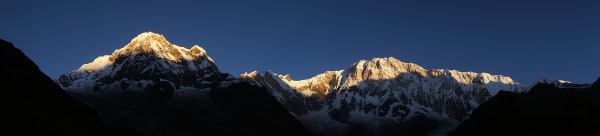
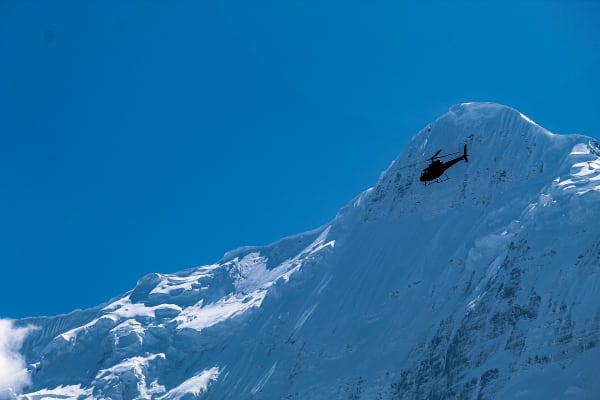
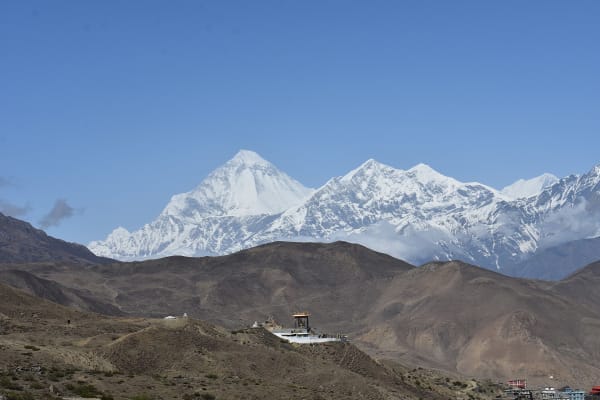
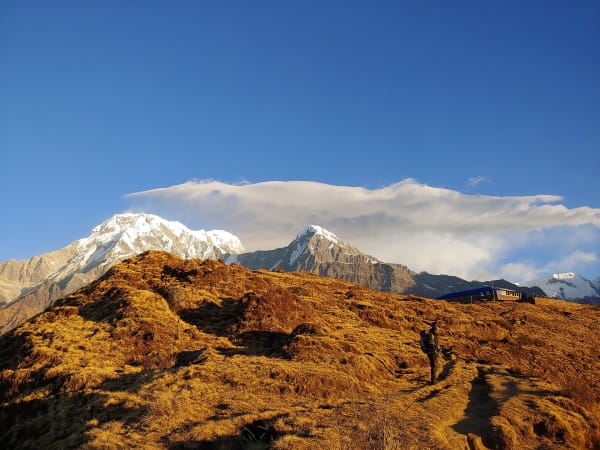
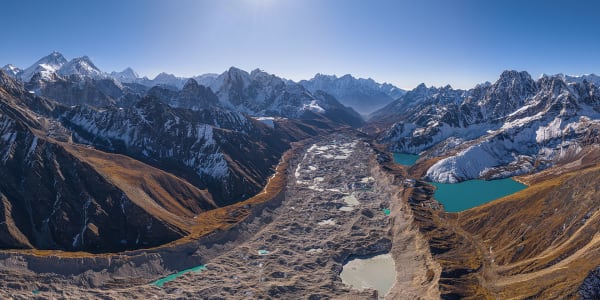
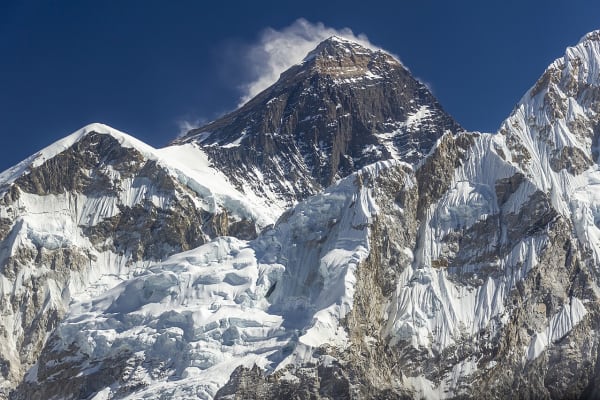
The Annapurna Sanctuary flight is the most underrated helicopter tour in Nepal. Where the Everest flight is a long, grand traverse up a broad valley, this one is tight and dramatic: twenty minutes from Pokhara up the Modi Khola gorge, with walls closing on both sides, and then the valley opens into the Sanctuary and you are inside a complete ring of peaks.
It lands at Annapurna Base Camp at 4,130 m with Annapurna I (8,091 m), Annapurna South, Hiunchuli, Gangapurna, Tent Peak and Machhapuchhre around you. Two hours door to door, at a considerably lower altitude and cost than the Everest tour.
The Tour at a Glance
| Duration | About 2 hours door to door from Pokhara |
| Flight time | 20–25 minutes each way |
| Landing | Annapurna Base Camp, 4,130 m |
| Time on the ground | 15–30 minutes, weather permitting |
| Departure | Early morning from Pokhara airport |
| Capacity | 5 passengers |
| Altitude risk | Lower than the Everest tour — 4,130 m rather than 5,500 m |
| Season | October to May; best on clear mornings October to December |
We run it as the Annapurna Base Camp Helicopter Tour, with broader Pokhara helicopter sightseeing and a fixed-wing mountain flight as alternatives from the same airport.
Why the Flight Is Better Than It Sounds
Three things distinguish it from the Everest tour.
The gorge. The Modi Khola between Chhomrong and Machhapuchhre Base Camp is a narrow, steep-sided corridor, and flying up it at low level with rock walls on both sides is genuinely thrilling in a way that crossing a broad glacial valley is not.
The arrival. The Sanctuary opens without warning, exactly as it does on foot — one moment a gorge, the next a complete 360-degree amphitheatre. Trekkers spend four days earning that moment; the helicopter gives you the same transition in twenty seconds, from above.
The proximity. At Annapurna Base Camp the peaks are close and overhead rather than distant. Annapurna South rises 3,000 m directly in front of you, and Machhapuchhre stands behind. Everest from Kala Patthar is more famous; this is more enveloping.
It is also lower, at 4,130 m rather than 5,500 m, which makes the altitude considerably more manageable for most passengers — and it is shorter and cheaper.
How the Morning Runs
- 6.00–6.30 a.m. Pickup from your Pokhara hotel and transfer to the airport. Briefing and weights.
- 7.00 a.m. Departure, climbing out over Phewa Lake with Sarangkot and the Annapurna skyline ahead.
- 7.05–7.20 a.m. Up the Modi Khola past Ghandruk, Chhomrong and Deurali, with the gorge narrowing and the lodge villages visible below.
- 7.25 a.m. Through the Sanctuary entrance past Machhapuchhre Base Camp, and the landing at Annapurna Base Camp at 4,130 m.
- Ground time. Fifteen to thirty minutes, weather and payload permitting, with the full ring of peaks around you and the glacier below.
- 8.00–8.30 a.m. Return flight to Pokhara and hotel drop-off, usually well before 9 a.m.
Some itineraries add a landing or low pass at Machhapuchhre Base Camp at 3,700 m, or a loop toward Dhaulagiri on the return. Ask when booking.
Annapurna or Everest by Helicopter?
| Annapurna Sanctuary | Everest Base Camp | |
|---|---|---|
| Departs from | Pokhara | Kathmandu |
| Duration | About 2 hours | 4–5 hours |
| Landing altitude | 4,130 m | Around 5,300–5,545 m |
| Altitude risk | Lower | Significant rapid ascent |
| The view | A 360° ring of peaks, close and overhead | Everest's summit pyramid and the Khumbu glacier |
| The flying | A tight gorge and a sudden opening | A long grand traverse up a broad valley |
| Cost | Lower | Higher |
| Breakfast stop | Not standard | Everest View Hotel at 3,880 m |
If you are in Pokhara and have a clear morning, this is the better-value flight and the easier one on your body. If Everest specifically is the point, take the Khumbu tour from Kathmandu. Our helicopter overview covers every route.
Practical Notes
- Go early. The Sanctuary clouds over from mid-morning in most seasons, and the gorge needs visibility. A 7 a.m. departure is not arbitrary.
- Dress for 4,130 m. Around -5 to 0 °C on the ground in the main seasons. A down jacket, hat and gloves, with lighter layers beneath for warm Pokhara.
- Sunglasses and sunscreen. Glacier glare is strong even on a short stop.
- Keep camera batteries warm. Cold drains them fast.
- Build a spare morning. Weather cancels flights, and the rebooking is to the next clear morning.
- Landing is weather dependent. A flyover instead of a landing is possible and operators say so in advance.
- Altitude. Lower than the Everest tour but still 4,130 m from 820 m in twenty minutes. Anyone with a heart or lung condition should take medical advice first.
One combination worth knowing: the flight pairs very well with a short Annapurna trek. Several of our guests walk Mardi Himal or Poon Hill and then take the Sanctuary flight on a spare morning, which gives them the valley at walking pace and the amphitheatre from the air. See our Pokhara treks guide.