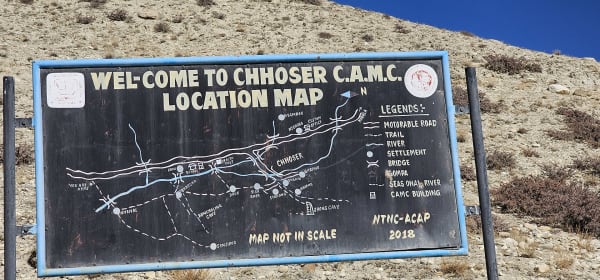
The Tsum Valley branches north-east off the Budhi Gandaki at Lokpa and runs toward the Tibetan border beneath Ganesh Himal and Sringi Himal. It was closed to outsiders until 2008, and it remains one of the most culturally intact valleys in Nepal — the people are Tsumba, of Tibetan origin, speaking their own dialect, with monasteries that have operated continuously for centuries.
Its most distinctive feature is a vow. The valley is a shyagya — a sacred place where, by community undertaking reaffirmed over generations and formally renewed in the last century, killing animals is forbidden. No hunting, no slaughter. It is the reason the wildlife here is unusually visible and the reason the valley feels different from the moment you enter it.
The Trek at a Glance
| Duration | 13 days as a standalone trek, or 20 days combined with the Manaslu Circuit |
| Highest point | About 3,700 m at Mu Gompa |
| Difficulty | Moderate — long gorge stages, no high pass |
| Access | Road from Kathmandu to Soti Khola or Machha Khola, 8–9 hours |
| Permits | Tsum Valley restricted permit (USD 40 per week Sep–Nov, USD 30 Dec–Aug) plus MCAP |
| Minimum group | Two trekkers with a registered agency and licensed guide |
| Best seasons | March to May, September to November |
| Accommodation | Basic lodges and homestays |
We run it as a 13-day Tsum Valley trek and as a 20-day combination with the Manaslu Circuit.
The Route and What You See
Up the Budhi Gandaki to Lokpa
The same gorge approach as the Manaslu Circuit — subtropical, humid, dramatic, with the restricted-area checkpoint at Jagat — as far as Lokpa, where the Tsum valley branches north-east and almost all trekkers carry straight on.
Lower Tsum: Chumling and Chhekampar
A climb into the valley proper, where the landscape opens and Ganesh Himal appears to the south-east. Villages here are farming settlements with mani walls, chortens and a gentle, worked-in feel. Chhekampar and Chhokangparo sit on a wide shelf with Ganesh Himal and Sringi Himal in view.
Milarepa's Cave
At Piren Phu, near Burgi village, two caves beneath a cliff hold shrines associated with the 11th-century Tibetan yogi Milarepa, with rock paintings, old murals and prayer flags. It is one of the most important Buddhist sites in this part of the Himalaya and almost no one visits it.
Upper Tsum: Rachen and Mu Gompa
Rachen Gompa is a large nunnery on the valley floor, founded in the early 20th century, with around a hundred nuns in residence. Mu Gompa at around 3,700 m is the highest and most remote monastery in the valley, close to the Tibetan border, with a small community of monks and a view back down the whole valley. Dephyudonma Gompa above it is older still. These are working monasteries, not monuments.
Back out, or on round Manaslu
Most itineraries return down the valley to Lokpa. If you are doing the combined trek, you rejoin the Budhi Gandaki and continue north to Samagaun and the Larke La.
The Shyagya Vow and the Wildlife
The prohibition on killing is the valley's defining feature and it is worth understanding properly. It is a community commitment rooted in Buddhist practice, renewed in the 1920s under the influence of a Tibetan lama and reaffirmed since, and it covers hunting, slaughter, and in places the felling of trees.
- Wildlife is visible in a way it is not elsewhere in Nepal — blue sheep, Himalayan tahr, and a notable number of birds, including Himalayan griffon and monal.
- Snow leopard is present in the upper valley, with camera-trap records, though sightings are vanishingly rare.
- Meat is not eaten in much of the valley, so the lodge menus are vegetarian. Do not ask for meat.
- Respect it. Do not kill insects in front of people, do not fish, and do not treat the vow as a curiosity.
This is also a valley where the monasteries are the centre of life rather than a trailside attraction. Ask before entering, remove shoes, walk clockwise, do not photograph during prayers, and leave a donation. Our responsible trekking guide covers the general etiquette.
Practicalities
- Permits: a Tsum Valley restricted permit at USD 40 per week in autumn or USD 30 in the off season, plus the MCAP. A licensed guide and two trekkers minimum. If you are combining with the Manaslu Circuit you need the Manaslu restricted permit as well, which is separate and more expensive.
- Accommodation: basic lodges and homestays. Clean and welcoming, with shared facilities and no showers higher up. Bring a sleeping bag rated to -10 °C.
- Food: vegetarian, simple, and largely grown locally — potato, barley, buckwheat, dal bhat, dhido.
- Altitude: maximum about 3,700 m with gradual gain. Low risk, and no pass.
- Season: spring and autumn. The gorge approach is wet and leech-ridden in the monsoon.
- Connectivity: patchy to non-existent in the upper valley. Tell people at home.
Tsum, Manaslu, or Both
| Option | Days | Best for |
|---|---|---|
| Tsum Valley alone | 13 | Culture and monasteries, no high pass, moderate difficulty |
| Manaslu Circuit alone | 15 | A full Himalayan circuit with a 5,106 m pass |
| Both combined | 20 | The best three weeks of teahouse trekking in Nepal |
| Larke Pass trek | 14 | The upper Manaslu valley and the pass, shorter gorge approach |
If you have the days and the fitness, do both. The combined route gives you the cultural depth of Tsum in the first week — by which point you are well acclimatised — and the circuit and the Larke La in the second and third. Very few treks in Nepal offer that combination of culture and high mountain ground.