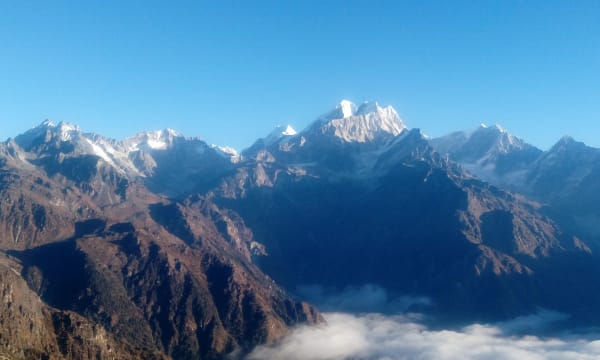
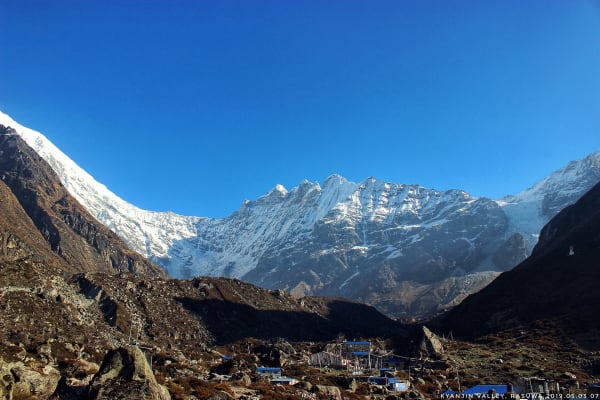
Tilman's Pass (5,350 m) crosses from the head of the Langtang valley to the lake basin at Panch Pokhari, and it is named for H. W. Tilman, the British mountaineer who explored the valley in 1949 on one of the first Western expeditions permitted into Nepal.
The approach is the classic Langtang walk — the gorge from Syabrubesi, the yak pastures at Kyanjin, an acclimatisation day for Tserko Ri — and then the trail simply runs out beyond Langshisa Kharka. From there the route is moraine, glacier and camp: no lodges, no trail markers, and a crossing that involves fixed rope on the steep ground either side of the pass.
It is one of the least travelled crossings in Nepal and one of the most committing routes that does not require a climbing permit.

The Trek at a Glance
| Duration | 15 days Kathmandu to Kathmandu |
| Highest point | Tilman's Pass, 5,350 m |
| Highest night | Tilman Base Camp, 4,900 m |
| Difficulty | Difficult — glaciated pass, crampons and fixed rope, six camping nights |
| Best seasons | April to May, October to November |
| Accommodation | Teahouses in Langtang, tents for six nights, lodges on the way out |
| Access | Road to Syabrubesi, out by road from Tempathang |
| Permits | Langtang National Park entry permit — no climbing permit needed |
| Price | From USD 2,050 per person |
We run it as a 15-day trek. If you have not crossed a technical pass before, the Ganja La is the better first step, and the Panch Pokhari trek reaches the lakes without any of the glacier ground.
The Route
Syabrubesi to Kyanjin Gompa (1,460 m to 3,870 m)
Three days up the Langtang valley through Lama Hotel and Mundu. The trail passes the site of the old Langtang village, which was destroyed entirely in an ice and rock avalanche in the 2015 earthquake with several hundred deaths; the memorial and the rebuilt village are on the way and your guide gives the site the time it deserves.
At Kyanjin Gompa there is an acclimatisation and training day — crampons, rope work and fixed-line technique, which matters because the pass is three days away and there is no second chance to learn it.
Kyanjin to Tilman Base Camp (3,870 m to 4,900 m)
East to Langshisa Kharka (4,080 m), the last grazing ground, and then the trail ends. A day of moraine and glacier travel leads to the base camp at 4,900 m — exposed, with no shelter, and routinely -15 °C overnight.
The crossing (5,350 m)
A pre-dawn start. The glacier is crevassed and the ground either side of the pass is steep enough that a slip matters, so the group moves roped with fixed line where your guide sets it. It is not a climb, but it is not a walk either. The descent leads to the Panch Pokhari base camp at 4,600 m.

Panch Pokhari and out (4,100 m to 1,800 m)
Panch Pokhari is a group of five lakes sacred to Hindus as a dwelling place of Shiva. Thousands of pilgrims walk up for the Janai Purnima festival in August; outside that week the basin is empty, with small shrines and shelters built for the festival rather than for trekkers. Then four days south through Nasempati, Kami Kharka and Tempathang to the road.
What Skills You Actually Need
This is the most technically demanding trek we run that does not need a climbing permit, and the honest answer about skills is: more than a trekker, less than a mountaineer.
- Comfortable in crampons, on a rope, and on a fixed line. The training day at Kyanjin covers technique, but it cannot manufacture experience.
- Previous high-altitude trekking experience is expected — this is not a first or second Himalayan trip.
- Crevassed glacier travel on the approach to and descent from the pass.
- Six nights in tents, from Langshisa Kharka through to the villages below Panch Pokhari, supported by a full cook and porter crew.
- A week with no mobile signal between Kyanjin Gompa and the villages below the lakes.
If your guide judges the pass uncrossable — snow, visibility, or the group's condition — the party retraces the Langtang valley and walks out to Syabrubesi. That adds days rather than costing the trip.
Tilman's Pass or the Ganja La?
| Tilman's Pass | Ganja La | |
|---|---|---|
| Height | 5,350 m | 5,130 m |
| Ground | Crevassed glacier, fixed rope both sides | Steep, loose, fixed rope on the descent |
| Camping nights | 6 | 3 |
| Days | 15 | 14 |
| Traffic | Almost none — an established route does not really exist | Rarely crossed, but a known line |
| From | USD 2,050 | USD 750 |
The Ganja La is shorter, lower, better known and much cheaper. Tilman's is higher, longer, glaciated and far less travelled. Read the Ganja La guide if you are weighing the two.
What It Costs
| Group size | Price per person |
|---|---|
| 1 trekker | USD 2,175 |
| 2 to 4 | USD 2,150 |
| 5 to 7 | USD 2,125 |
| 8 to 10 | USD 2,100 |
| 11 to 14 | USD 2,075 |
| 15 and over | USD 2,050 |
There are no ATMs on the route. Draw all your rupees in Kathmandu, and budget generously for tips — the crew on this route is large and the work is hard.
What Is Included
- Airport pickup and drop-off in Kathmandu.
- Private transport Kathmandu to Syabrubesi and Tempathang back to Kathmandu.
- Hotel accommodation in Kathmandu with breakfast.
- Teahouse accommodation in the Langtang valley and lodges or homestays on the way out.
- Two-person tents, mess tent, toilet tent and all group camping equipment for six nights.
- A cook and kitchen crew, and porters for group equipment.
- Group climbing equipment for the crossing — ropes, fixed line and crampons — plus a training day at Kyanjin Gompa.
- Three meals a day during the trek.
- Langtang National Park entry permit and trekking registration.
- A licensed English-speaking guide with Tilman's Pass experience, group map, first aid kit, and all taxes and service charges.
What Is Not Included
- International flights and the Nepal entry visa fee.
- Travel insurance including emergency helicopter evacuation above 5,400 m, which this route requires.
- Personal trekking equipment and clothing, including a bag rated to -20 °C, an insulated mat and crampon-compatible boots.
- Porter services for your personal duffel, available at additional cost.
- Lunch and dinner in Kathmandu.
- Snacks, bottled water, hot showers, Wi-Fi, charging and drinks.
- Laundry, phone calls, souvenirs and personal expenses.
- Tips for guides, crew and drivers.
- Extra accommodation or transport if the pass is not crossable, or anything else outside the itinerary.
At the high camp, boots, water bottles and batteries go inside the sleeping bag overnight. At -15 °C and below, anything left out is frozen by morning.