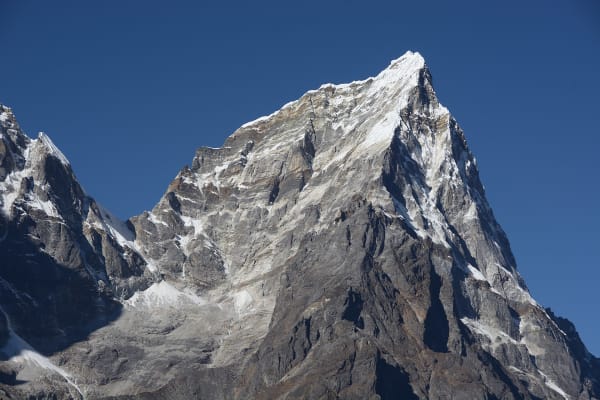
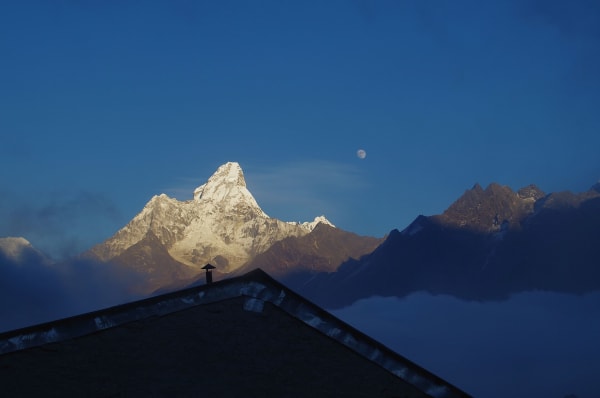
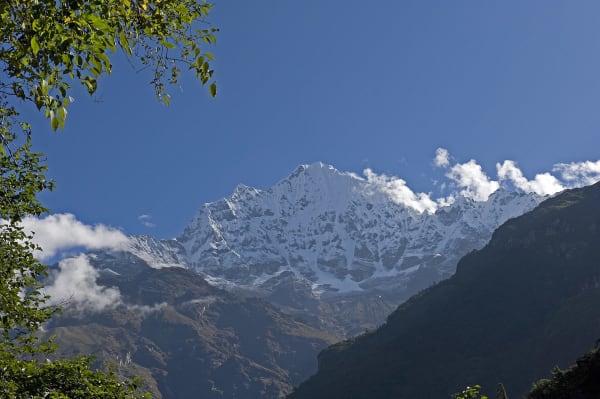
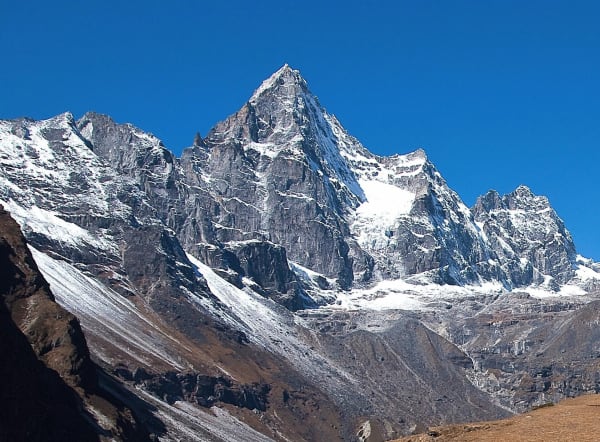
Thamserku (6,623 m) is the enormous fluted wall that stands over Namche Bazaar and Kyangjuma, and it is one of the least-climbed significant peaks in the Khumbu.
It was first ascended in 1964 by a New Zealand team led by Lyn Crawford, and in the sixty years since it has seen a tiny number of successful ascents — some seasons none at all. Almost everyone who looks at it decides it is a mountain to photograph rather than climb.
The reason is written on the face: steep flutings of snow and ice that hold indifferently, corniced ridges, and objective hazard that has to be timed rather than avoided. Graded TD-, this is the hardest climb in our catalogue below the 8,000 m peaks, and we run it as a full expedition. It is offered to experienced alpinists only, and we would rather turn away a booking than assemble a weak team on this face.

The Expedition at a Glance
| Summit | 6,623 m |
| Grade | TD- — steep unreliable flutings, corniced ridges, objective hazard |
| Duration | 23 days Kathmandu to Kathmandu |
| Camps | Base camp 4,600 m, Camp 1 5,600 m, high camp 6,100 m |
| Summit day | 12 to 18 hours from high camp |
| Summit success rate | Fewer than one departure in three |
| First ascent | 1964, New Zealand team led by Lyn Crawford |
| Price | From USD 8,500 per person |
We run it as a 23-day expedition. Cholatse is the grade below; Ama Dablam is the better-known technical objective in the same region.
The Route and the Camps
Lukla to base camp (2,840 m to 4,600 m)
Phakding, Namche with an acclimatisation day, then up to an approach camp at 4,200 m and base camp at 4,600 m on moraine below the glacier.
Assessment, load carry and rotation
An assessment and technical training day, an acclimatisation and load-carry day, then the rotation to Camp 1 at 5,600 m at the top of the approach face and back to base camp. Two rest and preparation days follow before the push.
The summit push (5,600 m to 6,623 m)
Base camp to Camp 1, Camp 1 to high camp at 6,100 m on cut platforms in the upper face, then the summit day: twelve to eighteen hours from high camp, with the abseil descent taking a large share of it. A turnaround time is set the night before and it is not negotiable.

The Hazards, and Why We Cancel Departures
- Unreliable snow on the flutings, which can be unprotectable — the defining problem of the route.
- Cornice collapse on the upper ridge.
- Avalanche risk after new snow.
- All three are managed by timing and by turning around, not by equipment.
We sometimes cancel departures, because the face is not always in condition and running an expedition onto unclimbable ground helps nobody. If our leader and Sherpa team judge the flutings unsafe before or during the trip, we say so.
Across recent departures fewer than one in three parties has summited. We will not quote a flattering number on a mountain like this.
What Experience We Accept
We ask for a climbing CV with routes and dates, and we read it.
- Alpine routes at D or above.
- Previous Himalayan climbing at 6,000 m.
- Steep ice at Scottish IV or V, or equivalent.
- Competence on abseil at the end of a very long day — the descent is where the risk concentrates.
You do not need to lead in the sense of taking the sharp end on new ground; our Sherpas fix the route ahead of the team. You need the movement competence of a climber who could lead at that grade, because a fixed line does not carry you up unreliable snow.
A private expedition is often the better arrangement — a rope of two or three climbers who already know each other is a stronger team on this ground than a group assembled from individual bookings.
What It Costs
| Group size | Price per person |
|---|---|
| 1 climber | USD 10,370 |
| 2 to 4 | USD 9,610 |
| 5 to 7 | USD 9,100 |
| 8 to 10 | USD 8,840 |
| 11 to 14 | USD 8,630 |
| 15 and over | USD 8,500 |
What Is Included
- Airport transfers, an expedition briefing, permit and equipment-check day in Kathmandu.
- Kathmandu–Lukla return flights.
- Hotel accommodation in Kathmandu with breakfast, and teahouses on the approach.
- Approach camp, base camp (4,600 m), Camp 1 (5,600 m) and high camp (6,100 m), with mess, kitchen, toilet and storage tents.
- A cook and kitchen crew, and all meals throughout the expedition.
- Expedition climbing permit, Sagarmatha National Park entry, the Khumbu municipality fee and liaison arrangements.
- An expedition leader, climbing Sherpas and high-altitude staff, with equipment, wages and insurance.
- Progressive rope fixing of the flutings and the upper ridge, laid in stages.
- An assessment and technical training day, a load-carry day, an acclimatisation rotation and two reserve days.
- Emergency oxygen at base camp, garbage deposit, summit certificate and all taxes.
What Is Not Included
- International flights and the Nepal entry visa fee.
- Expedition insurance covering technical mountaineering to 6,700 m, with helicopter evacuation and repatriation.
- Personal climbing equipment, including technical tools for steep unconsolidated ice.
- Personal clothing, double boots and a bag rated to -25 °C.
- Porter services for your personal duffel.
- Lunch and dinner in Kathmandu.
- Snacks, bottled water, hot showers, Wi-Fi, charging and drinks.
- Laundry, phone calls, souvenirs and personal expenses.
- Summit bonus and tips for the climbing Sherpas and high-altitude staff.
- Extra accommodation or transport caused by a cancelled Lukla flight, weather, a cancelled departure or an early descent.