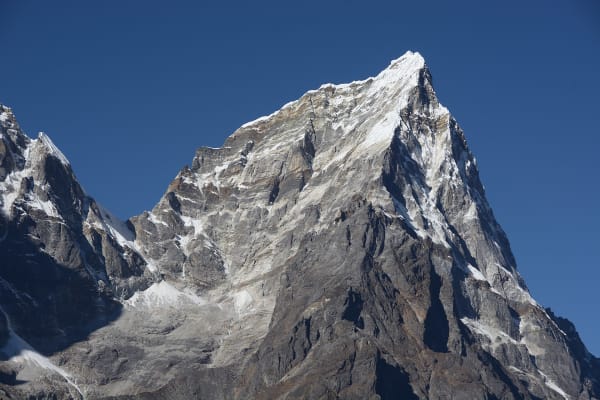
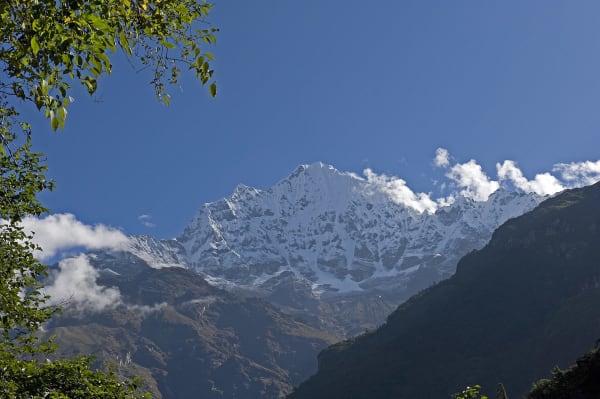
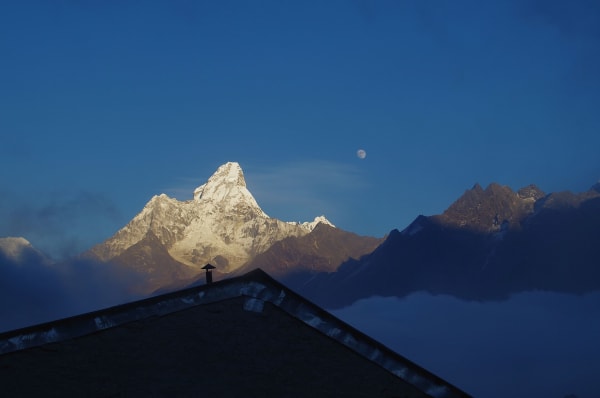
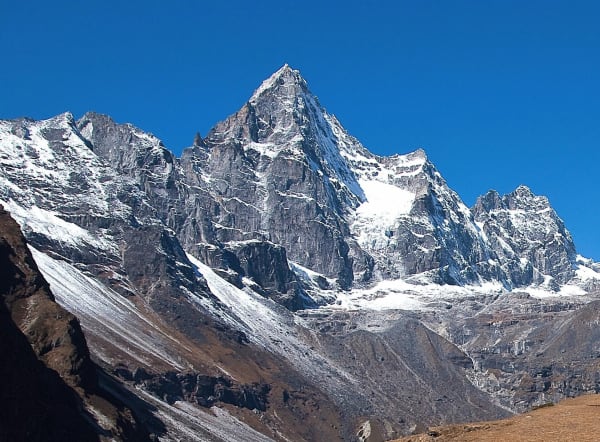
Cholatse (6,440 m) is the mountain that stops people on the trail to Everest Base Camp. Its north face rises 1,500 m above the Chola Tsho lake in a single sweep of ice and rock, and it has the kind of shape — sharp, symmetrical, unmistakable — that gets a peak onto book covers.
It was first climbed in 1982 by Vern Clevenger, Galen Rowell, John Roskelley and Bill O'Connor by the south-west ridge, which is the route this expedition follows.
It is a serious undertaking. Graded D, the south-west ridge gives sustained mixed climbing on rock and ice, a long committing crest, and a summit day measured in the low double figures of hours. We run it as a proper expedition — two camps above base, an acclimatisation rotation, progressive rope fixing and a reserve day — over twenty-four days, and we take only climbers with alpine experience at AD+ and above.

The Expedition at a Glance
| Summit | 6,440 m |
| Route | South-west ridge — the 1982 first-ascent line |
| Grade | D — sustained mixed rock and ice on a long committing crest |
| Duration | 24 days Kathmandu to Kathmandu |
| Camps | Base camp 4,900 m, Camp 1 5,500 m, high camp 5,900 m |
| Summit success rate | Around 40 to 50 percent |
| Who we take | Alpine experience at AD+ and above |
| Price | From USD 7,500 per person |
We run it as a 24-day expedition. Kusum Kanguru is the closest NMA-permit equivalent in difficulty, and Thamserku is the step above.
The Route
Lukla to Dzongla (2,840 m to 4,830 m)
The standard Khumbu acclimatisation ladder — Phakding, Namche, Tengboche, Dingboche with a Nangkartshang day — then up to Dzongla. Eight days before base camp, which the summit day needs.
Base camp, assessment and rotation (4,900 m to 5,500 m)
Base camp at 4,900 m on moraine below the peak, a few hours from Dzongla — a full expedition camp with mess, kitchen, toilet and storage tents. An assessment and training day, then the acclimatisation rotation: climb to Camp 1 at 5,500 m, sleep there, descend to base camp and rest for a day.
The summit push (5,500 m to 6,440 m)
Base camp to Camp 1, Camp 1 to high camp at 5,900 m, then the summit day on the south-west ridge. The steep ground is fixed by our Sherpas and climbed on a jumar; connecting sections are climbed as a roped pair with the Sherpa in front.
The summit ridge is continuously exposed, for hours. It is narrow, corniced on one side, and drops steeply on both. If exposure is something you manage rather than ignore, be honest with your guide at the assessment day.

Why Twenty-Four Days for a 6,440 m Peak
Because the structure is what makes it safe, and it is the first thing a cheaper quote cuts.
- An acclimatisation rotation to Camp 1 and back, so you arrive at the summit push already adapted to 5,500 m.
- A rest day at base camp between the rotation and the push.
- Progressive rope fixing by the Sherpas as the group moves up, rather than a single rushed effort.
- A reserve day to absorb one bad weather window.
- A full Khumbu approach rather than a helicopter shortcut to base camp.
Around 40 to 50 percent of our departures summit, which is honest for a grade D peak with a long committing ridge. Weather on the crest and time lost on the mixed ground are the two usual reasons.
What It Costs
| Group size | Price per person |
|---|---|
| 1 climber | USD 9,150 |
| 2 to 4 | USD 8,480 |
| 5 to 7 | USD 8,030 |
| 8 to 10 | USD 7,800 |
| 11 to 14 | USD 7,610 |
| 15 and over | USD 7,500 |
What Is Included
- Airport transfers, an expedition briefing, permit and equipment-check day in Kathmandu.
- Kathmandu–Lukla return flights.
- Hotel accommodation in Kathmandu with breakfast, and teahouses on the Khumbu approach.
- Full expedition base camp (4,900 m) with mess, kitchen, toilet and storage tents, plus Camp 1 (5,500 m) and high camp (5,900 m).
- A cook and kitchen crew, and all meals throughout the expedition.
- Expedition climbing permit, Sagarmatha National Park entry, the Khumbu municipality fee and liaison arrangements.
- An expedition leader, climbing Sherpas and high-altitude staff, with equipment, wages and insurance.
- Progressive rope fixing of the steep ground on the south-west ridge.
- An assessment and training day, an acclimatisation rotation to Camp 1, a rest day and a reserve day.
- Emergency oxygen at base camp, garbage deposit, summit certificate and all taxes.
What Is Not Included
- International flights and the Nepal entry visa fee.
- Expedition insurance covering technical mountaineering to 6,500 m, with helicopter evacuation and repatriation.
- Personal climbing equipment, including technical tools for sustained mixed ground.
- Personal clothing, double boots and a bag rated to -25 °C.
- Porter services for your personal duffel.
- Lunch and dinner in Kathmandu.
- Snacks, bottled water, hot showers, Wi-Fi, charging and drinks.
- Laundry, phone calls, souvenirs and personal expenses.
- Summit bonus and tips for the climbing Sherpas and staff.
- Extra accommodation or transport caused by a cancelled Lukla flight, weather or an early descent.