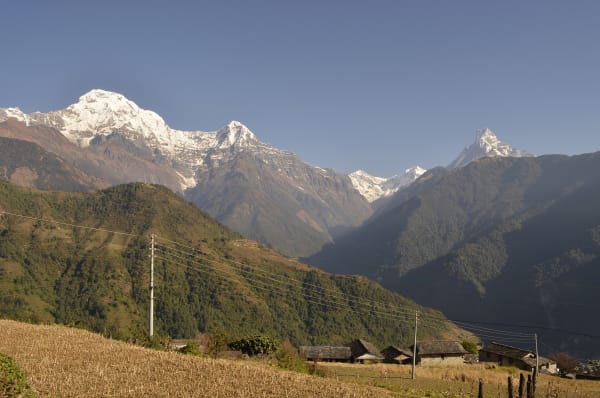
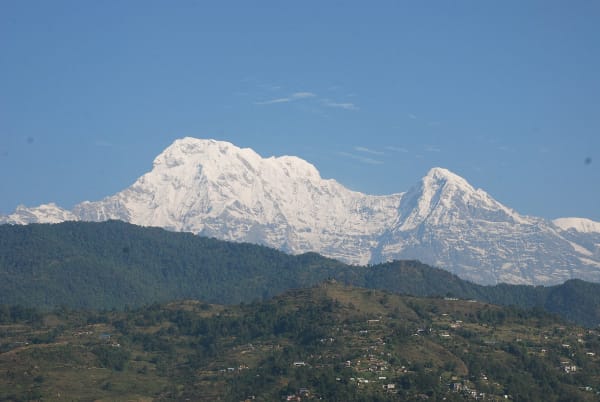
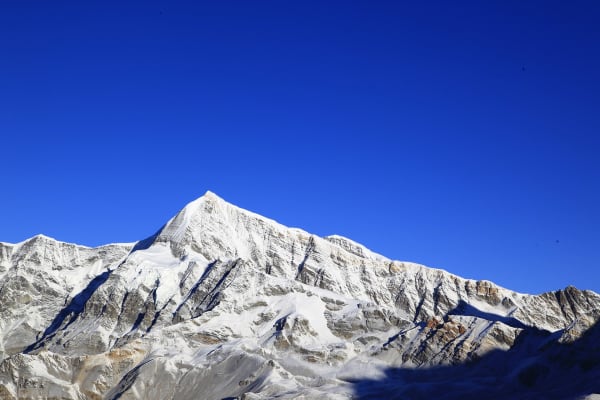
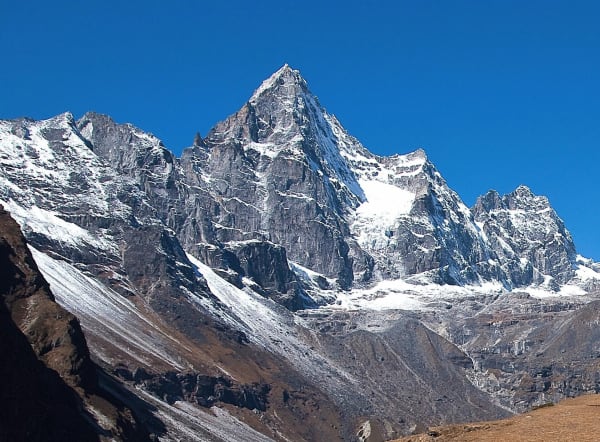
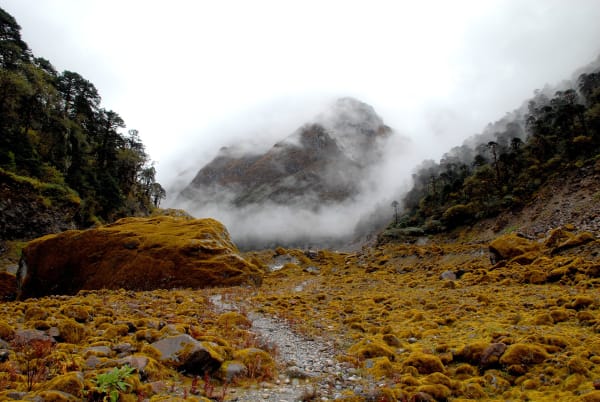
Singu Chuli (6,501 m) — Fluted Peak to the expeditions that named it — stands inside the Annapurna Sanctuary and is one of the hardest peaks on the Nepal Mountaineering Association's list.
It was first climbed in 1957 by Wilfrid Noyce and David Cox, and it has never become popular, because the fluted ice faces it is named for are steep, unreliable and genuinely difficult. Graded D, the route gives sustained ice at 50 to 60 degrees on ground where the snow quality decides everything, followed by a corniced summit ridge.
It is climbed from a base camp in the Sanctuary beneath the south face of Annapurna I, reached by one of the finest walks in Nepal — the Modi Khola gorge from Chomrong, into a glacial amphitheatre with no way out except the way you came in.
We sell it to experienced alpinists only.

The Climb at a Glance
| Summit | 6,501 m |
| Grade | D — sustained 50–60° ice flutings, corniced summit ridge |
| Duration | 21 days Kathmandu to Kathmandu |
| Base camp / high camp | 4,300 m / 5,300 m |
| Summit success rate | A quarter to a half of departures |
| Best seasons | April to May, October to November |
| First ascent | 1957, Wilfrid Noyce and David Cox |
| Price | From USD 4,650 per person |
We run it as a 21-day expedition for experienced alpinists. The two-peak trip with Tharpu Chuli pairs it with a much easier neighbour.
The Route
The Sanctuary approach (1,940 m to 4,130 m)
Drive to Pokhara and Siwai, then the classic Annapurna Base Camp walk: Ghandruk, Chomrong, Bamboo, Deurali, Machhapuchhre Base Camp and Annapurna Base Camp at 4,130 m. It is one of the finest approaches in Nepal — a deepening gorge that opens without warning into a glacial amphitheatre.
The section between Dovan and Deurali is genuine avalanche terrain after heavy snow, with two or three places your guide will cross quickly and without stopping.
Base camp, assessment and acclimatisation (4,300 m)
Base camp at 4,300 m on the glacier moraine a short distance beyond ABC. Two days there: a technical assessment and training day — which is exactly what it sounds like, and where a booking can end — and an acclimatisation day.
The flutings (5,300 m to 6,501 m)
A roped glacier crossing to high camp at 5,300 m, then the summit push. The flutings — the parallel runnels of snow and ice carved into the faces by wind and melt, which give the peak its ribbed appearance from the Sanctuary floor — run at 50 to 60 degrees and are fixed by our Sherpas. Then the corniced summit ridge.

Who We Will and Will Not Take
This is the peak we decline bookings for most often, and it is worth being direct about why.
- You cannot climb Singu Chuli as a first Himalayan peak. We will decline the booking.
- The natural progression is a 6,000 m trekking peak, then something at AD+ such as Kyajo Ri or Chulu East, and then this.
- You do not need to lead climb — the flutings are fixed by our Sherpas and climbed on a jumar. What you need is the movement competence of a climber who could lead at that grade, because ascending steep unreliable ice on a fixed line still demands it.
- Alpine experience outside Nepal counts, and we ask for a climbing CV at booking.
- A technical assessment day at base camp is part of the itinerary, and it is a real gate.
If that reads as discouraging, the Sanctuary has an easier answer: Tharpu Chuli, its neighbour, is 838 m lower, graded PD+, and shares the same base camp.
The 6,500 m Insurance Problem
Singu Chuli is 6,501 m. A great many mountaineering policies stop at exactly 6,500 m, which covers the entire route except the summit itself.
We have turned climbers away at the briefing over this. You need cover valid above 6,500 m, including helicopter evacuation and repatriation, confirmed in writing. One metre is not a rounding error when a claim is assessed.
See our insurance guide for the specific wording to look for.
What It Costs
| Group size | Price per person |
|---|---|
| 1 climber | USD 5,670 |
| 2 to 4 | USD 5,250 |
| 5 to 7 | USD 4,980 |
| 8 to 10 | USD 4,840 |
| 11 to 14 | USD 4,720 |
| 15 and over | USD 4,650 |
What Is Included
- Airport transfers in Kathmandu, plus a climbing briefing, permit and equipment-check day.
- Transport Kathmandu–Pokhara–Siwai and back.
- Hotel accommodation in Kathmandu and Pokhara with breakfast, and teahouses on the Sanctuary approach.
- Tented base camp (4,300 m) and high camp (5,300 m) with mess, kitchen and toilet tents, and a cook and kitchen crew.
- Three meals a day throughout.
- NMA climbing permit for Singu Chuli and the Annapurna Conservation Area Permit.
- A government-licensed climbing guide and one climbing Sherpa per two climbers above base camp.
- Group climbing equipment, and fixing of the flutings and the summit ridge by our Sherpas.
- A technical assessment and training day, plus two reserve days at base camp.
- Porter transport of group equipment, NMA garbage deposit, summit certificate and all taxes.
What Is Not Included
- International flights and the Nepal entry visa fee.
- Travel insurance valid above 6,500 m — see the section above.
- Personal climbing equipment, including technical tools appropriate to steep ice.
- Personal trekking equipment and clothing, including double boots and a sleeping bag.
- Porter services for your personal duffel.
- Lunch and dinner in Kathmandu and Pokhara.
- Snacks, bottled water, hot showers, Wi-Fi, charging and drinks.
- Laundry, phone calls, souvenirs and personal expenses.
- Tips for the guide, climbing Sherpas, porters and support staff.
- Extra accommodation or transport caused by weather or an early descent.