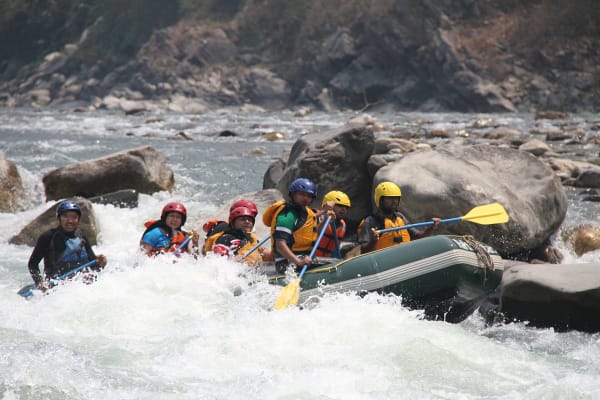
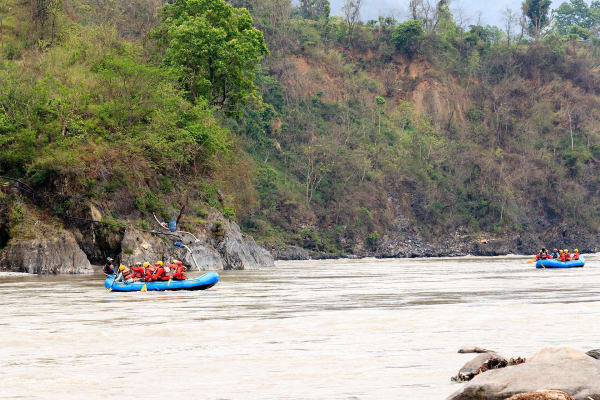
Nepal's rivers start as Himalayan snowmelt and drop several thousand metres to the Gangetic plain, which produces continuous whitewater over long distances through gorges nobody can reach by road. It is one of the world's best rafting and kayaking destinations, and it is significantly underused compared with the trekking.
Trips range from a two-hour taster to a week-long expedition camping on white sand beaches. Here is every river we run, and how to choose.
The Rivers Compared
| River | Days | Grade | Character |
|---|---|---|---|
| Trishuli, 1 day | 1 | III (III+ in high water) | The classic introduction — accessible from the Kathmandu–Pokhara highway |
| Trishuli, 2 days | 2 | III | The same river with an overnight beach camp |
| Seti, Pokhara | 1 | II–III | Warm, gentle, forested — the best family and beginner option |
| Kali Gandaki | 3 | III–IV | A deep gorge between Dhaulagiri and Annapurna, no road, continuous rapids |
| Marsyangdi | 4 | IV–V | Steep, continuous and technical — the hardest commercial river in Nepal |
| Bhote Koshi | 2 | IV–V | The steepest short run in the country, three hours from Kathmandu |
Grades follow the international I to VI whitewater scale: II is moving water with easy rapids, III has irregular waves and requires manoeuvring, IV is intense and demands precise handling, and V is long, violent and committing.
Choosing by What You Want
A first taste, or with children
The Seti near Pokhara — warm water, Class II to III, forested banks, and a half day. It is the gentlest option and genuinely enjoyable rather than a compromise. The one-day Trishuli is the other standard choice, and it slots directly into the Kathmandu–Pokhara drive.
The best three days on a river in Nepal
The Kali Gandaki, without much argument. It runs through a roadless gorge between two eight-thousanders, with continuous Class III to IV rapids, waterfalls entering from both sides, hot springs, and camping on sand beaches. Three days, no road contact, and the finest river scenery in the country.
Serious whitewater
The Marsyangdi — four days of steep, continuous, technical Class IV to V that demands a fit and attentive crew, and the Bhote Koshi, which packs a comparable gradient into a short run three hours from Kathmandu. Both require previous rafting experience and both are genuinely demanding.
A trip built around a river
The Kali Gandaki or the Marsyangdi as a standalone objective, or a Trishuli day slotted into a Kathmandu–Chitwan–Pokhara circuit. Rafting also combines well with a short Annapurna trek — see our Pokhara treks guide.
Season
| Season | Water level | Verdict |
|---|---|---|
| September – November | High after the monsoon, dropping steadily | The best of the year. Big water in September, ideal levels by October |
| December – February | Low and clear | Cold water and air, gentler rapids, good for beginners |
| March – May | Low, rising with early melt | Warm and pleasant, less powerful whitewater |
| June – August | Monsoon flood | Most commercial trips suspended. Rivers are dangerous, not exciting |
The window most people want is late September to November. September has the biggest water of the year, which pushes several rivers up a grade and is superb if you are experienced. By late October levels have settled into the classic range, and the weather is perfect.
In the monsoon the rivers are in flood with debris, and this is one of the few times we advise against an activity outright. It is also, incidentally, why monsoon visitors are better served by rain-shadow trekking.
Safety and What to Expect
- Equipment: a self-bailing raft, helmet, buoyancy aid, and a wetsuit on the colder rivers, all supplied. Do not accept a trip that does not provide a helmet and a properly fitting buoyancy aid.
- Safety kayaker. Any Class IV or V trip should have at least one safety kayaker accompanying the rafts. Ask.
- Briefing. You will be taught paddle commands, what to do if you fall out, and how to hold a throw line, before you get on the water. Pay attention — it is short and it matters.
- Swimming ability. Helpful but not strictly required on Class II and III with a buoyancy aid. On Class IV and V it matters.
- Camping. Multi-day trips camp on river beaches with tents, a kitchen and a toilet setup carried by the crew. It is comfortable and one of the best parts of the trip.
- What to bring: quick-dry clothing, a swimming costume, sandals with a heel strap or old trainers, sunscreen, a hat with a cord, and a dry bag for anything electronic. Leave valuables at the hotel.
- Insurance: whitewater rafting is excluded from some travel policies. Check the wording, particularly for Class IV and V.
One realistic note: people fall out of rafts, particularly on Class IV. It is part of the sport, the crew are trained for it, and with a buoyancy aid and the drill you were taught it is unpleasant rather than dangerous. Knowing that in advance makes it much less alarming when it happens.