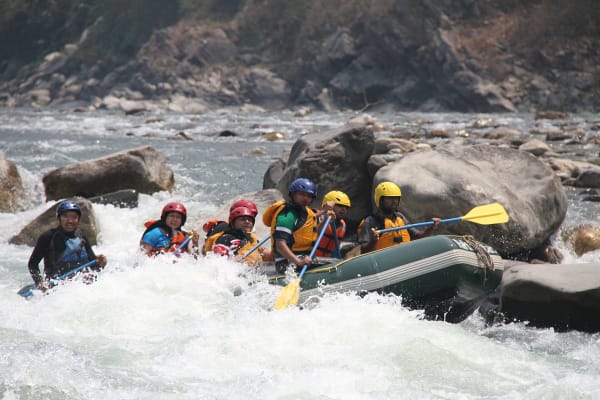
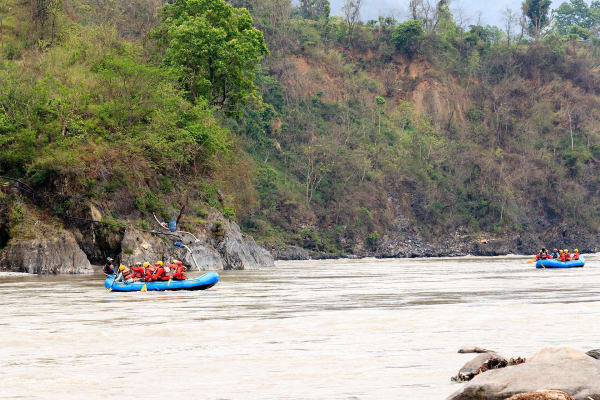
The Marsyangdi is the hardest river we run and the one experienced rafters come to Nepal for. It drops out of the Annapurna and Manaslu massifs at an average of ten metres per kilometre — roughly twice the gradient of the Kali Gandaki — and the result is four days of steep, technical, continuous class IV and IV+ whitewater with almost no flat water to recover in.
This is not a beginner's river and we do not sell it as one. Rapids come one after another with short pools between them, every significant drop is scouted from the bank, and swimmers are a real possibility rather than a joke.
In exchange you get the finest whitewater in Nepal, in a steep forested valley below Manaslu, camping on beaches, with a safety kayaker on the water at all times.

The Trip at a Glance
| Duration | 4 days, 3 nights |
| Put-in / take-out | Ngadi (900 m) to Bimalnagar (500 m) |
| Gradient | Around 10 m per kilometre |
| Grade | Class IV and IV+, continuous |
| Accommodation | Three nights of riverside camping in two-person tents |
| Difficulty | Challenging — previous whitewater experience required |
| Best season | October to December, March to April |
| Price | From USD 395 per person |
We run it as a 4-day expedition from Kathmandu or Pokhara. The Bhote Koshi is the shorter hard river; the Trishuli is where to start.
The Four Days
Day one: Ngadi and the first section
A drive from Kathmandu or Pokhara to the put-in at Ngadi (900 m), on the Annapurna Circuit road, then the first section of river with a full briefing and the guides reading how the group paddles before committing to harder water. First camp on a beach.
Day two: the continuous class IV+ day
The crux. Rapid after rapid with short pools between, and scouting from the bank before every significant drop. This is the day people come for and the day that decides how they feel about the trip.
Day three: the lower gorge
Still hard, in a steeper and more enclosed gorge, with the forest closing in on both sides. Third camp on the bank.
Day four: out to Bimalnagar
The river eases towards Bimalnagar (500 m) and the take-out, and the vehicle carries the group onward to Kathmandu or Pokhara.

Who Should Book It
We are deliberately restrictive about this trip, because the consequences of getting it wrong on day two are real.
- Previous class IV experience, or at minimum substantial class III with a strong paddling stroke.
- Confident swimming in moving water. Swims happen here.
- Good fitness — four days of continuous paddling with no rest water is physically demanding in a way that easier rivers are not.
- Senior guides who work this river specifically, plus a safety kayaker on the water at all times, are included as standard.
- Self-bailing rafts and splash tops throughout.
If any of that gives you pause, the Bhote Koshi is two days rather than four and a better first hard river.
What It Costs
| Group size | Price per person |
|---|---|
| 1 traveller | USD 555 |
| 2 to 4 | USD 490 |
| 5 to 7 | USD 450 |
| 8 to 10 | USD 425 |
| 11 to 14 | USD 410 |
| 15 and over | USD 395 |
What Is Included
- Private vehicle from Kathmandu or Pokhara to the put-in at Ngadi and from the Bimalnagar take-out at the end.
- Three nights of riverside camping in two-person tents with sleeping mats.
- All meals from the first day's lunch to the last day's breakfast, cooked on the riverbank.
- River permit and district rafting registration.
- Senior Nepal Rafting Association certified guides who work this river specifically, and a safety kayaker throughout.
- Self-bailing raft, paddle, helmet, life jacket and splash top.
- Waterproof dry bags and all camping and kitchen equipment.
- Filtered and treated drinking water throughout.
- All government taxes and service charges.
What Is Not Included
- Travel insurance covering class IV+ whitewater — check the grade limit specifically, not just whether rafting is listed.
- Meals in Kathmandu or Pokhara before and after the trip.
- Sleeping bag hire.
- Alcoholic drinks at camp.
- The photo and video package.
- Personal expenses such as laundry, phone calls and souvenirs.
- Tips for the guides, crew and driver.
- Any additional cost caused by roadblocks, weather or circumstances beyond our control.
When to Go
| Season | The river |
|---|---|
| October to November | Post-monsoon high water. The most powerful and the most serious conditions of the year. |
| December | Dropping, technical and clean. Cold, but excellent. |
| March to April | Lower water, more rock and more technical line-picking. Warmer camps. |
| May to September | Not run. Pre-monsoon heat and then flood. |
Whatever the month, the water is cold — this is Annapurna and Manaslu snowmelt. The splash top is included and the sleeping bag is not, so sort that out at booking.