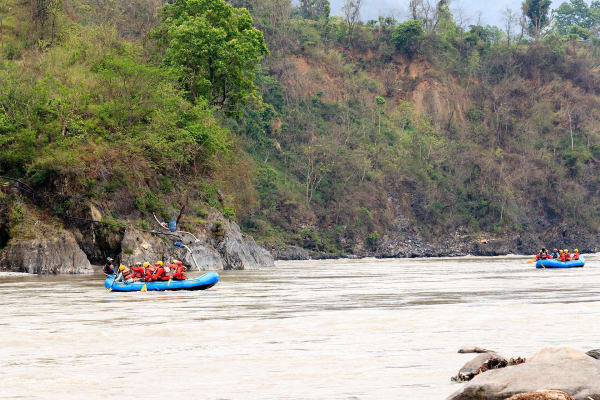
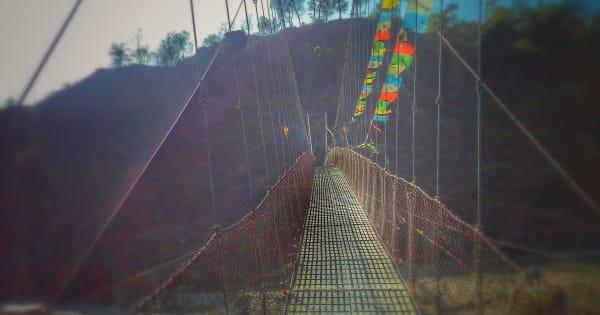
Two days on the Trishuli covers around 50 km of river and, more importantly, puts a night on a sand beach in the middle of it. Camping on the riverbank is what people remember — a fire, dinner cooked by the crew, and nothing but the sound of water and the highway lights far above on the gorge wall.
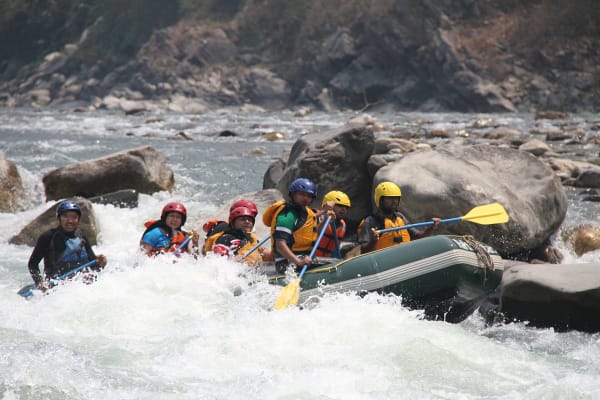
The first day runs the classic class III section from Charaudi through the named rapids. The second continues down to Kuringhat, where the gorge opens out and the water eases, with time for swimming, cliff jumping where the guides judge it safe, and a slow float into the take-out.
Because the Trishuli runs along the Kathmandu–Pokhara highway, it slots into a journey rather than needing its own days: groups usually continue to Chitwan or Pokhara from the take-out.

The Trip at a Glance
| Duration | 2 days, 1 night |
| Distance | Around 50 km |
| Grade | Class III on day one, easing on day two |
| Put-in / take-out | Charaudi to Kuringhat |
| Accommodation | Beach camping in two-person tents |
| Difficulty | Easy — no experience required |
| Best season | September to November, February to May |
| Price | From USD 145 per person |
We run it as a 2-day trip with beach camping, and a 1-day version without the camp. For a gentler river, see the Seti; for harder water, the Bhote Koshi.
The Two Days
Day one: Charaudi to the beach camp
A drive from Kathmandu or Pokhara to the put-in at Charaudi, then a safety briefing and paddle practice on flat water before launching. The classic class III section follows — a sequence of named rapids in a steep-sided gorge, with the highway visible high above on one side and jungle on the other.
The raft pulls onto a sand beach in the late afternoon. The crew set up camp and cook; you swim, sit by the fire, and sleep in a two-person tent a few metres from the water.
Day two: the beach to Kuringhat
An easier day. The gorge opens out and the water eases, so the paddling is relaxed and there is time for swimming and, where the guides judge the water and the rock safe, cliff jumping. The trip ends with a slow float into the take-out at Kuringhat and lunch on the bank.

Your luggage travels in the vehicle to the take-out, and the vehicle continues to wherever you are going next — Chitwan, Pokhara or back to Kathmandu.
Who It Suits and When to Go
No previous experience is needed. A certified river guide is in every raft, a safety kayaker accompanies the group, and the briefing covers everything before you get on the water.
| Season | The river |
|---|---|
| September to November | High water after the monsoon dropping steadily through autumn. The most exciting and the most popular window. |
| February to May | Lower, warmer and friendlier. The best choice for families and first-timers. |
| December to January | Runnable but cold, and the beach camp is a chilly night. Possible with warm kit. |
| June to August | Monsoon flood. Not run — the water is dangerous and the beaches are under it. |
For how the Trishuli compares with Nepal's other commercial rivers, see our rivers compared guide.
What It Costs
| Group size | Price per person |
|---|---|
| 1 traveller | USD 205 |
| 2 to 4 | USD 180 |
| 5 to 7 | USD 165 |
| 8 to 10 | USD 155 |
| 11 to 14 | USD 150 |
| 15 and over | USD 145 |
What Is Included
- Private transportation from Kathmandu or Pokhara to the Charaudi put-in, and onward from the take-out to your destination.
- Luggage carried in the vehicle to the take-out.
- One night camping on a river beach in two-person tents.
- All meals from lunch on day one to lunch on day two, cooked by the river crew.
- River permits and rafting fees.
- Certified river guides, a safety kayaker and a full camp and kitchen crew.
- Raft, paddle, helmet, life jacket and dry bag.
- Tents, sleeping mats and camp equipment.
- All government taxes and service charges.
What Is Not Included
- Travel insurance covering adventure activities — check the wording, as many policies exclude whitewater rafting or charge extra for it.
- Sleeping bag hire — bring your own or hire at the put-in.
- The photo and video package, shot by the crew on mounted cameras.
- Alcoholic drinks at camp.
- Meals not specified in the itinerary.
- Luxury vehicle upgrade — private transport is included as standard.
- Personal expenses such as laundry, phone calls and souvenirs.
- Tips for the guides, crew and driver.
- Any additional cost caused by weather, roadblocks or circumstances beyond our control.
The sleeping bag is the one people forget. Nights on the beach are mild in spring and autumn but not warm, and hire is straightforward if you ask at booking.
Practicalities
- Wear quick-drying clothes and secure your footwear — sandals with a heel strap or old trainers, not flip-flops.
- Bring a towel and a full change of clothes in your luggage, which travels to the take-out by road.
- You cannot take your phone on the water. Dry bags are provided for what must come with you, but the crew's mounted cameras are the practical way to get photos.
- Sunscreen and sunglasses with a strap — the gorge reflects and the day is long.
- Nobody is pushed. If you decide against it before launching, most operators refund a portion of the fee less fixed costs already incurred.