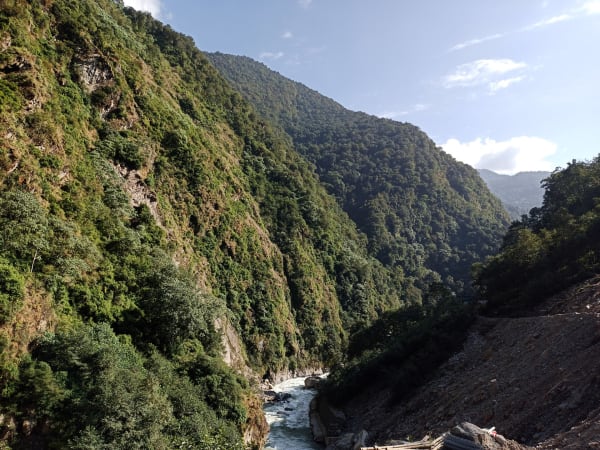
The Bhote Koshi is the steepest river commercially rafted in Nepal and the shortest trip we sell: two days, around twenty-six kilometres, and a gradient of roughly fifteen metres per kilometre.
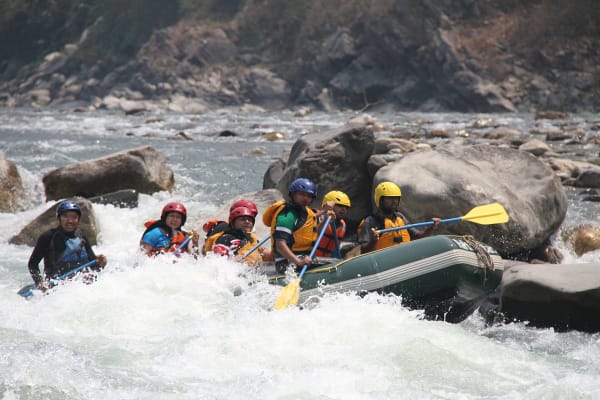
It drops out of the Tibetan border country north-east of Kathmandu in a continuous staircase of class IV and IV+ rapids, packed so tightly that a single day here has more whitewater than three days on an easier river.
It is also the most accessible hard river in the country — around three hours from Kathmandu on the Araniko Highway, with a riverside resort at the take-out rather than a beach camp. That combination makes it the standard choice for people who want serious whitewater without committing a week to it, and the reason it is usually packaged with the bungee jump that operates from the bridge over the same gorge.

The Trip at a Glance
| Duration | 2 days, 1 night |
| Distance | Around 26 km |
| Gradient | Roughly 15 m per kilometre — the steepest commercial run in Nepal |
| Grade | Class IV and IV+ |
| Accommodation | Riverside resort, permanent tent with private bathroom and hot shower |
| Difficulty | Challenging — not a first river |
| Best season | September to December, March to May |
| Price | From USD 195 per person |
We run it as a 2-day trip from Kathmandu. It is a step up from the Trishuli and a step down in length — though not in difficulty — from the Marsyangdi.
The Two Days
Day one: the upper gorge
A drive to the put-in above Barabise, then straight into it. The upper section is the steepest water on the trip — continuous class IV with short, hard pools between drops and very little time to reset. Significant rapids are scouted from the bank.
The night is at a riverside resort rather than a beach camp: a permanent tent with a private bathroom and a hot shower, which after a day on the Bhote Koshi is not a small thing.
Day two: the lower Bhote Koshi
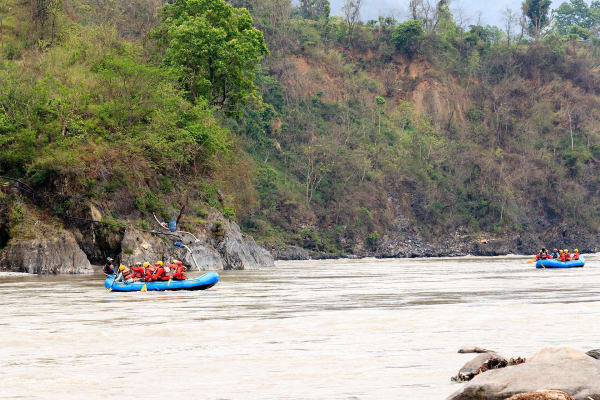
The lower section continues at grade before easing towards the take-out. The drive back to Kathmandu is short enough that you are in the city by evening.

Is It Too Hard for You?
Honest answer: this is not a beginner's river, but it is a realistic first hard river. The distinction matters.
- You should have rafted before, ideally class III. The Trishuli or the Seti is the right preparation.
- You must be a competent swimmer and comfortable in moving water. Swimmers happen on class IV+.
- Self-bailing rafts, a wetsuit or splash top and a safety kayaker throughout are all standard here rather than optional.
- Guides are Nepal Rafting Association certified and work this river specifically.
- The short length is the advantage. Two days of continuous class IV is intense but finite.
If you have never rafted, go to the rivers compared guide first and start on the Seti or Trishuli.
What It Costs
| Group size | Price per person |
|---|---|
| 1 traveller | USD 275 |
| 2 to 4 | USD 240 |
| 5 to 7 | USD 220 |
| 8 to 10 | USD 210 |
| 11 to 14 | USD 205 |
| 15 and over | USD 195 |
What Is Included
- Private vehicle from Kathmandu to the put-in above Barabise and back from the take-out.
- One night at a riverside resort in a permanent tent with a private bathroom and hot shower.
- All meals from the first day's lunch to the last day's breakfast.
- River permit and district rafting registration.
- Nepal Rafting Association certified river guides and a safety kayaker throughout.
- Self-bailing raft, paddle, helmet, life jacket and wetsuit or splash top.
- Waterproof dry bags for personal kit.
- Filtered and treated drinking water throughout.
- All government taxes and service charges.
What Is Not Included
- Travel insurance covering whitewater rafting — check the grade limits, as some policies cover rafting but exclude class IV and above.
- Meals in Kathmandu before and after the trip.
- The bungee jump at the gorge bridge, available as an add-on.
- Alcoholic drinks at the resort.
- The photo and video package.
- Personal expenses such as laundry, phone calls and souvenirs.
- Tips for the guides, crew and driver.
- Any additional cost caused by roadblocks, weather or circumstances beyond our control.
The grade limit on insurance is the one that catches people out. A policy that covers 'rafting' may still exclude class IV+, and the Bhote Koshi is class IV+ throughout.
When to Go
| Season | The river |
|---|---|
| September to October | Highest water of the year after the monsoon. The most demanding conditions, for experienced rafters. |
| November to December | Dropping and cleaning up. Excellent, technical, and the best all-round window. |
| March to May | Lower water, more technical rock-dodging, warmer. A good time for a first class IV trip. |
| June to August | Monsoon flood. Not run. |
The wetsuit or splash top is included for a reason — this is snowmelt out of Tibet and it is cold water in any season.