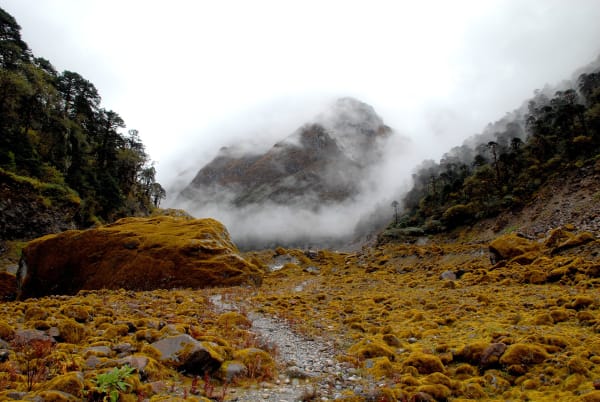
Pachermo (6,187 m) rises directly above the Tashi Lapcha, the 5,755 m pass that links the Rolwaling valley to the Khumbu, and it is climbed almost exclusively as part of that crossing.
The trip is a traverse rather than an out-and-back: in from the road at Charikot, up the Rolwaling gorge to Beding and Na, onto the glacier, up the peak, and then over the pass and down through Thame to Namche and Lukla.
The climbing is a clean AD- — a crevassed glacier, a snow and ice slope at 45 to 50 degrees on fixed rope, and a short corniced summit ridge. The pass itself is the other half of the undertaking: a genuinely serious glaciated col with fixed rope, loose ground and a long committing day.

The Climb at a Glance
| Summit | 6,187 m |
| Grade | AD- — crevassed glacier, 45–50° fixed slope, corniced crest |
| The other crux | The Tashi Lapcha at 5,755 m |
| Duration | 20 days, Charikot in and Lukla out |
| Base camp / high camp | 5,000 m / 5,500 m |
| Summit success rate | Around 65 to 75 percent |
| Best seasons | April to May, October to November |
| Price | From USD 4,450 per person |
We run it as a 20-day traverse. The Tsho Rolpa trek covers the same valley without the climb or the pass, and the Tashi Lapcha trek crosses without the summit.
The Route
Charikot to Na (1,400 m to 4,180 m)
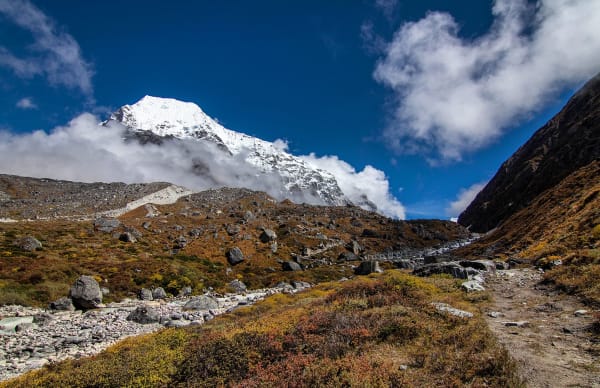
A drive to Chetchet via Charikot, then up the Rolwaling gorge through Simigaon and Dongang to Beding (3,690 m) and Na (4,180 m), with acclimatisation days at both. The valley is a beyul — a hidden valley in the Tibetan Buddhist tradition, a place set aside as a refuge and treated as sacred, where hunting has traditionally been prohibited.
Tsho Rolpa and base camp (4,580 m to 5,000 m)
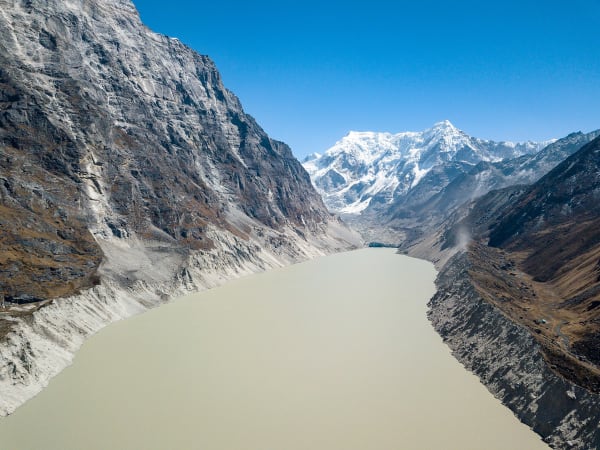
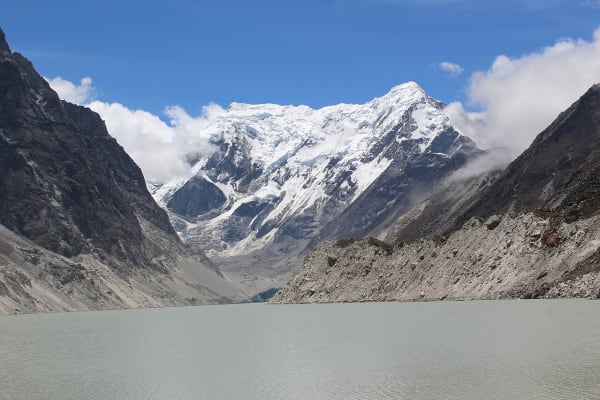
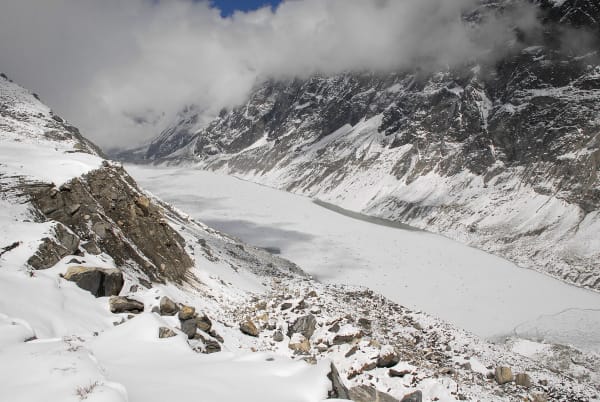
Past Tsho Rolpa, Nepal's largest glacial lake, held behind a moraine dam at the head of the valley and grown substantially since the 1950s as the Trakarding glacier has retreated. Then the Tashi Lapcha base camp at 5,000 m and a training and acclimatisation day.
The summit (5,500 m to 6,187 m)
High camp at 5,500 m on the glacier, then the summit day: the crevassed approach roped, the fixed 45 to 50 degree slope, and a short corniced crest. Back to base camp, with a reserve day.

The Tashi Lapcha and out (5,755 m to 2,840 m)
The crossing is the crux of the itinerary rather than the peak. The approach crosses loose moraine on the Trakarding glacier with rockfall in places, the col is fixed, and the day is long and committing. Beyond it: Thame, Namche, Lukla, and the flight to Kathmandu.
If the Pass Does Not Go
The group retreats down the Rolwaling to Charikot, which adds four or five days and means flying home from Kathmandu rather than Lukla. It happens perhaps one season in five.
That risk is why the climb is scheduled before the crossing rather than after: you get the summit regardless of what the pass does. Pachermo can also be climbed as an out-and-back down the Rolwaling and we will build it that way on request, though almost nobody does — the pass is what makes the trip.
What It Costs
| Group size | Price per person |
|---|---|
| 1 climber | USD 5,430 |
| 2 to 4 | USD 5,030 |
| 5 to 7 | USD 4,760 |
| 8 to 10 | USD 4,630 |
| 11 to 14 | USD 4,520 |
| 15 and over | USD 4,450 |
What Is Included
- Airport transfers, a climbing briefing, permit and equipment-check day in Kathmandu.
- Private transport Kathmandu to Chetchet via Charikot, and the Lukla–Kathmandu flight at the end.
- Hotel accommodation in Kathmandu with breakfast, and teahouses in Rolwaling and the Khumbu.
- Tented base camp (5,000 m) and high camp (5,500 m) with mess, kitchen and toilet tents, and a cook and kitchen crew.
- Three meals a day throughout.
- NMA climbing permit for Pachermo, the Gaurishankar and Sagarmatha permits and the Khumbu municipality fee.
- A government-licensed climbing guide and climbing Sherpas above base camp.
- Group climbing equipment and fixed rope for both the peak and the Tashi Lapcha crossing.
- A training and acclimatisation day at base camp, plus a reserve day.
- Porter transport of group equipment, NMA garbage deposit, summit certificate and all taxes.
What Is Not Included
- International flights and the Nepal entry visa fee.
- Travel insurance covering mountaineering to 6,187 m, with helicopter evacuation and repatriation.
- Personal climbing equipment, available to rent as an add-on.
- Personal clothing, double boots and a bag rated to -20 °C.
- Porter services for your personal duffel.
- Lunch and dinner in Kathmandu.
- Snacks, bottled water, hot showers, Wi-Fi, charging and drinks.
- Laundry, phone calls, souvenirs and personal expenses.
- Tips for the guide, climbing Sherpas, cook crew and porters.
- Extra accommodation or transport if the Tashi Lapcha cannot be crossed and the group retreats down the Rolwaling.