The Kathmandu Valley sits in a bowl at 1,400 m surrounded by hills between 2,000 m and 2,800 m, and from the top of those hills the Himalaya runs along the northern horizon. On a clear winter morning you can see a hundred kilometres of the range — Langtang, Dorje Lakpa, Gaurishankar, and on the best days a small triangle of Everest.
That last point needs stating honestly: Everest is 160 km away and appears as a small distant peak, not the dominant view. Anyone expecting the Kala Patthar experience from a valley-rim hotel will be disappointed. What you actually get is a long Himalayan skyline at dawn, an hour from your hotel, which is remarkable on its own terms.
The Viewpoints Compared
| Viewpoint | Altitude | From Kathmandu | What you see |
|---|---|---|---|
| Nagarkot | 2,175 m | 1.5 hours by road | The widest rim panorama — Langtang, Dorje Lakpa, Gaurishankar, sometimes Everest |
| Dhulikhel | 1,550 m | 1.5 hours | A Newar town with a good northern view and a quieter feel |
| Chandragiri | 2,551 m | 1 hour plus a cable car | The southern rim, looking north across the whole valley to the range |
| Phulchowki | 2,782 m | 1 hour plus a drive up | The highest rim point, best birding, good views on a clear day |
| Shivapuri | 2,732 m | 1 hour plus a 3-hour walk | The northern rim, closest to the mountains, reached on foot |
| Champadevi | 2,285 m | 45 min plus a 2-hour walk | The southern rim, a half-day walk from the city |
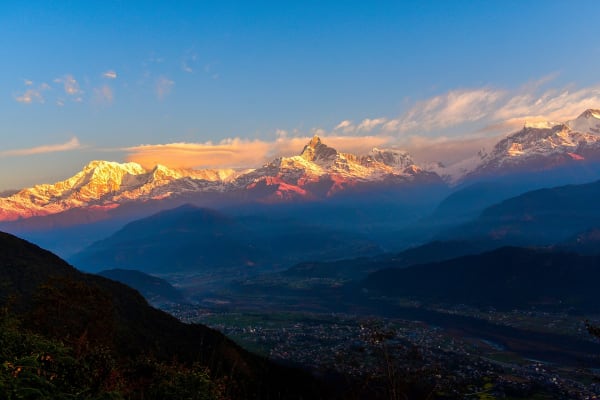
| Sarangkot, Pokhara | 1,592 m | Not from Kathmandu | Far closer mountains — Annapurna and Dhaulagiri at 30 km |
For a first-time visitor with one spare night, Nagarkot is the standard answer — the widest panorama, a range of hotels, and a good ridge walk the next morning. For the closest mountains in Nepal from a road, it is not Kathmandu at all but Sarangkot above Pokhara, where the Annapurnas are 30 km away rather than 100.
Nagarkot
A ridge at 2,175 m on the eastern rim, 32 km from Kathmandu, developed for exactly this purpose — a row of hotels facing north, with viewing towers and terraces. It is not a beautiful village and it does not pretend to be; it is a viewpoint with beds.
- The view runs from the Annapurnas in the far west on the clearest days, through Manaslu, Ganesh Himal, Langtang Lirung, Dorje Lakpa and the Jugal Himal, to Gaurishankar and Numbur in the east, with Everest occasionally visible as a small distant triangle.
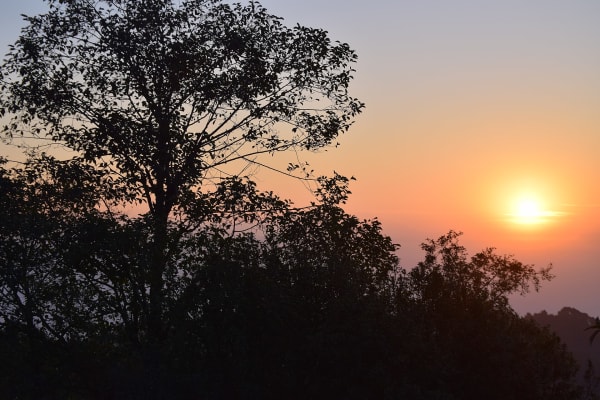
- Timing. Arrive the afternoon before, watch sunset, sleep, and be outside by 6 a.m. The mountains are clearest for the first hour after dawn and often gone by 9 a.m.
- Accommodation ranges from simple lodges to comfortable resorts, most with north-facing rooms. Book a north-facing room specifically.
- The morning after. The ridge walk from Nagarkot to Changu Narayan takes three to four hours downhill through pine forest and villages, ending at the oldest temple in Nepal. It is the best half-day walk near Kathmandu.
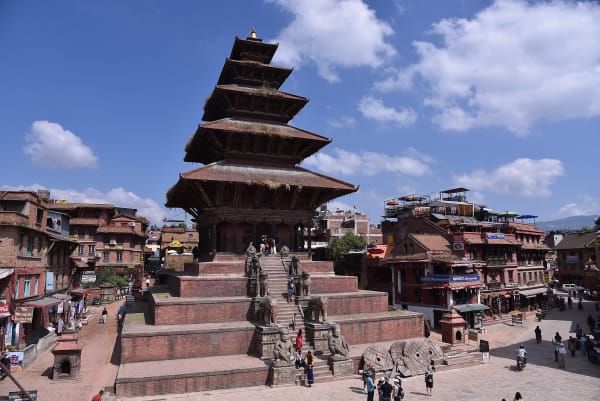
- Alternatively, walk or drive on to Dhulikhel, or return via Bhaktapur, which is directly below.
The combination we recommend: Bhaktapur in the afternoon, overnight at Nagarkot, the ridge walk to Changu Narayan the next morning. That is the best two-day cultural and scenic itinerary from Kathmandu — see our Bhaktapur guide.
When You Can Actually See the Mountains
| Season | Visibility | Notes |
|---|---|---|
| November – February | Best of the year | Cold, dry, clear air. Most mornings deliver. |
| October | Very good | Post-monsoon clarity, warmer |
| March | Good early, hazier late | Haze begins to build |
| April – May | Poor to moderate | Dust and pre-monsoon haze; mountains often invisible |
| June – September | Poor | Monsoon cloud. Green and beautiful, but no mountains |
Two honest caveats. First, even in winter, some mornings are hazy — the Kathmandu Valley has a genuine air quality problem in the dry months, and pollution sits in the bowl. Second, afternoon is almost always worse than morning, in every season. If you are going for the view, go for dawn.
If you have a single clear morning in Kathmandu and want the mountains guaranteed, a mountain flight climbs above the haze entirely.
The Walking Options
The rim hills are also the best day walks near the city, and none needs a trekking permit.
- Nagarkot to Changu Narayan — three to four hours, downhill, through pine forest and farming villages, ending at the oldest temple in Nepal.
- Nagarkot to Dhulikhel — a longer ridge walk of five to six hours between two viewpoint towns.
- Shivapuri — four to six hours return from Budhanilkantha through genuine forest inside the national park, with good birdlife and a Himalayan view from the top.
- Champadevi — four to five hours return from the southern edge of the city.
- Phulchowki — the highest rim point at 2,782 m and the best birding hill in the valley, with a road most of the way up. See our valley birding day.
- Chandragiri — a cable car to 2,551 m with a temple and a view, for anyone who wants the altitude without the walk.
For anything longer, our short treks near Kathmandu guide covers the multi-day options — Ama Yangri in Helambu being the standout at five days.
Practical Notes
- Book a north-facing room. The entire point of a Nagarkot hotel is the aspect, and rooms vary.
- Go up the afternoon before. A pre-dawn drive from Kathmandu is possible and means leaving at 4 a.m. and arriving stiff and cold.
- Dress warmly. At 2,175 m in December it is near freezing at dawn, and you will be standing still outdoors.
- Bring binoculars if you want to pick out individual peaks — much of the range is 100 km away.
- Do not expect Everest. It is visible on a small number of exceptionally clear mornings and it is a distant triangle. Langtang Lirung and Dorje Lakpa are the peaks that dominate.
- Combine with Bhaktapur, which is directly below and the natural pairing.
- Consider Sarangkot instead if you are going to Pokhara anyway — the mountains there are three times closer. See our Pokhara guide.