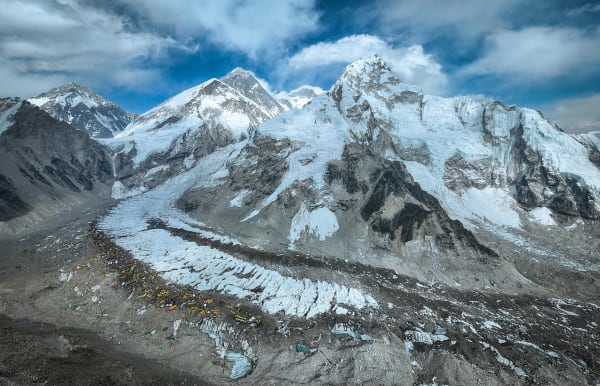
Makalu (8,485 m) is the fifth-highest mountain on earth and the hardest of Nepal's 8,000 m peaks by its normal route. It has a reputation among high-altitude climbers that its neighbours do not: a summit success rate well below Everest's, a final pyramid of steep mixed rock and ice above 8,000 m, and a base camp eight days' walk from the nearest road with no helicopter traffic, no trekker lodges and no other expeditions to share the fixing with.
It was first climbed in 1955 by a French team under Jean Franco, who put nine members on top — an extraordinary result for the period.
The approach up the Barun valley from Tumlingtar is one of the finest walks in Nepal and almost nobody does it, and the mountain at the end of it is a serious, committing proposition that we sell only to climbers with an 8,000 m summit already behind them.

The Expedition at a Glance
| Summit | 8,485 m — the fifth-highest mountain on earth |
| The crux | The final 400 m of steep mixed rock and ice above 8,000 m |
| Duration | 51 days Kathmandu to Kathmandu |
| Approach | Eight days on foot from the roadhead at Num |
| Oxygen | Seven 4-litre bottles per climber, plus a dedicated Sherpa's supply |
| Summit success rate | Roughly a third to a half of those who start the push |
| Who we take | Climbers with an 8,000 m summit already |
| Price | From USD 32,000 per person |
We run it as a 51-day expedition. The Makalu Base Camp trek covers the approach alone, and Lhotse is the more forgiving 8,000 m objective.
Why Makalu Is Harder Than Everest
Because of the summit pyramid. Everest's route above the South Col is long, cold and exposed but never technical; Makalu's final 400 m is steep mixed rock and ice climbed above 8,000 m, which is a different order of problem entirely.
Three other things compound it:
- The Makalu La at 7,400 m — a col between Makalu and Kangchungtse, and one of the windiest camps on any 8,000 m peak. Tents have been destroyed there in a night. It is a place to move through rather than linger.
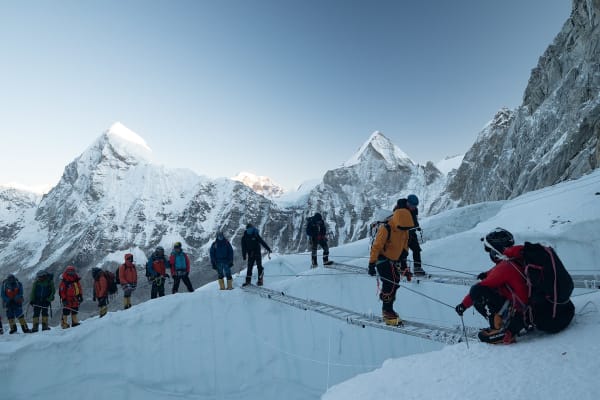
- Usually one or two other teams on the mountain, sometimes none. The route may need fixing largely by our own Sherpa team, and in an emergency there is unlikely to be anyone else to help.
- Evacuation is hard. Helicopter from base camp is possible in clear weather but expensive and not routine — the Barun sees very little air traffic. Below base camp, evacuation means being carried down the valley.
Across recent seasons roughly a third to a half of climbers who begin the summit push from Camp 4 reach the top, and there are years when nobody does.
The Approach
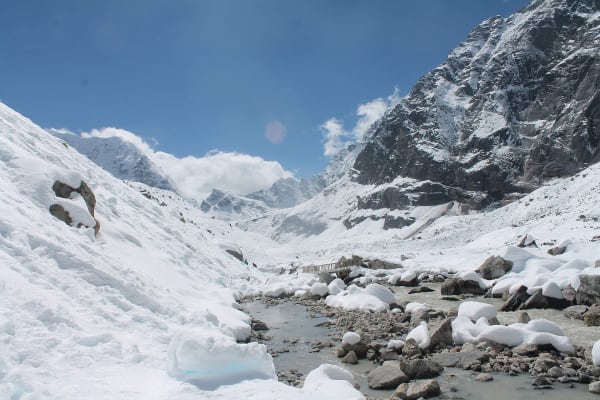
Eight days on foot from the roadhead at Num. There is no airstrip in the Barun and no established helicopter service, and in any case the walk is the acclimatisation.
Fly to Tumlingtar, drive to Num, then Seduwa, Tashigaon, Khongma Danda, over the Shipton La (4,220 m) to Dobato, and up the Barun through Yangle Kharka and Langmale Kharka to base camp at 4,870 m.
The valley is one of the finest walks in Nepal and almost unvisited: protected forest with red panda and snow leopard habitat, two-thousand-metre walls, and waterfalls falling off hanging glaciers.

The Climb
At base camp: settling in and a systems check, a puja, a technical training day and an acclimatisation day. Then rotations through Advance Base Camp (5,700 m), Camp 1 (6,400 m) and the camps above, with the Makalu La at 7,400 m as the last before the summit push.
A recovery descent to Yangle Kharka at 3,600 m is built in mid-expedition. Recovery does not happen at 4,870 m, and three days low down in thick air with the forest and the river does more for a climber than a week of sitting at base camp.
Seven 4-litre bottles per climber, a Summit mask and regulator, and a dedicated Sherpa carrying his own supply. Extra bottles can be added at booking and are refunded if unused.
What It Costs
| Group size | Price per person |
|---|---|
| 1 climber | USD 39,040 |
| 2 to 4 | USD 36,160 |
| 5 to 7 | USD 34,240 |
| 8 to 10 | USD 33,280 |
| 11 to 14 | USD 32,480 |
| 15 and over | USD 32,000 |
What Is Included
- Airport transfers, an expedition briefing, equipment inspection, Ministry briefing, permits and cargo dispatch in Kathmandu.
- Kathmandu–Tumlingtar flights and the jeep to Num, plus the full Barun approach.
- Base camp (4,870 m), Advance Base Camp (5,700 m) and the camps above, with full expedition infrastructure.
- A cook and kitchen crew, and all meals throughout the expedition.
- Makalu climbing royalty and permits, Makalu Barun National Park entry and liaison arrangements.
- An expedition leader, a dedicated climbing Sherpa per climber, and high-altitude staff.
- Seven 4-litre oxygen bottles per climber, plus a Summit mask and regulator, and the Sherpa's own supply.
- Rope fixing by our own Sherpa team where no other expedition is on the mountain.
- A puja, a technical training day, rotations, and a recovery descent to Yangle Kharka.
- Garbage deposit, summit certificate and all government taxes.
What Is Not Included
- International flights and the Nepal entry visa fee.
- Expedition insurance valid to 8,600 m with helicopter evacuation and repatriation — and note that evacuation from the Barun is expensive and weather-dependent.
- Personal climbing equipment, an 8,000 m down suit and double boots rated for the altitude.
- Additional oxygen bottles beyond the seven included.
- Meals in Kathmandu beyond breakfast.
- Personal expenses, laundry, Wi-Fi and charging at base camp.
- Summit bonus and tips for the climbing Sherpas and high-altitude staff.
- Extra accommodation or transport caused by flight delays at Tumlingtar, weather or an early descent.