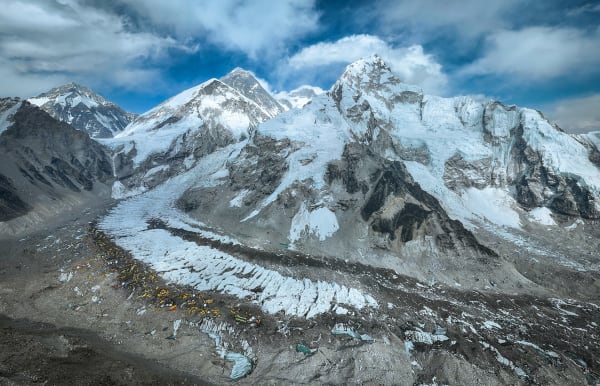
Lhotse (8,516 m) is the fourth-highest mountain on earth and, for most of the season, the quietest 8,000 m peak in Nepal.
It shares Everest's base camp, Everest's Icefall, Everest's Western Cwm and Everest's Lhotse Face — and then, at around 7,900 m, the two routes part. Everest traverses right to the South Col; Lhotse goes straight up into the Lhotse Couloir, a narrow gully of snow and ice that runs to a small rock summit.
That couloir is what makes it a genuinely different mountain. It is steeper than anything on Everest's normal route — 45 to 50 degrees, pinching to a few metres wide, with a rock band near the exit and no room to pass anyone. It was first climbed in May 1956 by Ernst Reiss and Fritz Luchsinger, and it still rewards a climber who wants an 8,000 m summit with real climbing on it and a fraction of the traffic on the ridge above the Col.

The Expedition at a Glance
| Summit | 8,516 m — the fourth-highest mountain on earth |
| The crux | The Lhotse Couloir: 45–50°, pinching to a few metres wide |
| Duration | 50 days Kathmandu to Kathmandu |
| Camp 4 | Around 7,900 m on the Lhotse Face, on cut platforms |
| Oxygen | Six 4-litre bottles per climber, plus a dedicated Sherpa's supply |
| Summit success rate | Roughly 60 to 70 percent of those who start the push |
| Season | April to May |
| Price | From USD 28,000 per person |
We run it as a 50-day expedition. The Everest expedition shares the route to Camp 3, and the Everest and Lhotse trip takes both summits from the same Camp 4.
The Route
Kathmandu to Everest Base Camp (1,400 m to 5,364 m)
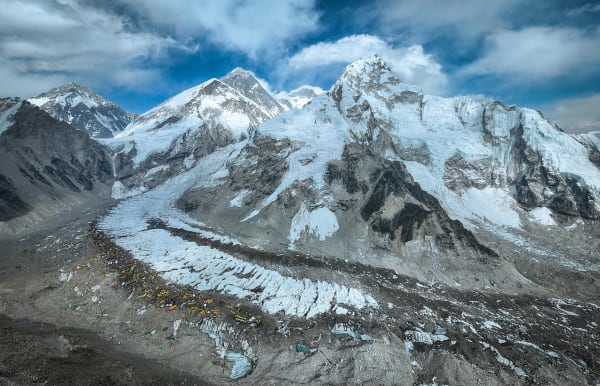
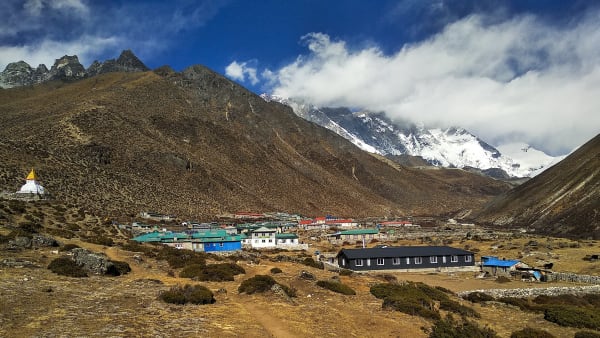
Three days in Kathmandu for the expedition briefing, equipment inspection, Ministry briefing and permits, then the Lukla flight and the standard Khumbu acclimatisation ladder through Namche, Tengboche, Dingboche and Lobuche to Everest Base Camp at 5,364 m.
At base camp: settling in and a systems check, a puja ceremony, and an Icefall ladder and fixed-rope training day before anyone goes up.
The rotations
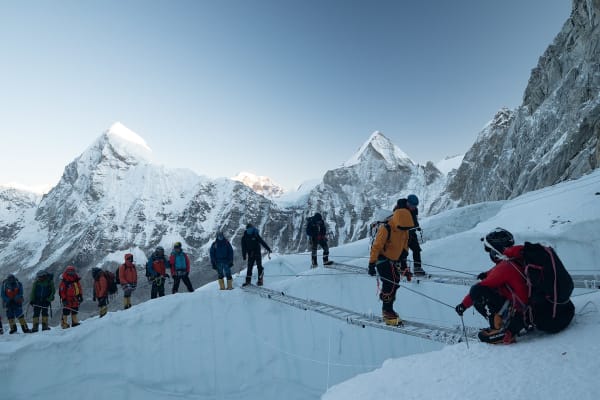
Through the Khumbu Icefall to Camp 1 (6,065 m) and Camp 2 (6,400 m), then the Lhotse Face to Camp 3. The Icefall is identical in risk to an Everest expedition and is the most objectively dangerous ground on the route: we cross it in the cold hours before dawn and keep the number of crossings to the minimum the rotation plan allows.
Camp 4 and the couloir (7,900 m to 8,516 m)
Camp 4 sits at around 7,900 m on the Lhotse Face itself, below the entrance to the couloir — a small, steep, exposed camp with tents on cut platforms, not a flat plateau like Everest's South Col. From there the summit day goes straight into the couloir and up to the small rock summit.

The Couloir
It pinches to a few metres across in places, with rock walls on both sides. That is what makes it committing: there is no room to pass, no shelter from anything coming down, and a party that arrives at the foot of it late has no way to make up time.
Time is consequently the commonest reason for turning back — not the climbing. Roughly 60 to 70 percent of our climbers who begin the summit push reach the top, and a party that reaches the couloir behind schedule is turned around rather than pushed through it.
| Everest | Lhotse | |
|---|---|---|
| Summit | 8,849 m | 8,516 m |
| Summit day | A long, cold, exposed ridge that is never steep | A sustained 45–50° couloir |
| Camp 4 | The South Col, a broad flat plateau | 7,900 m on the Face, tents on cut platforms |
| Traffic | Several hundred summits in a spring | A few dozen |
| Shared route | To Camp 3 | To Camp 3 |
Oxygen, Staffing and the Recovery Descent
- Six 4-litre bottles per climber, plus a Summit mask and regulator, and a dedicated Sherpa carrying his own supply. That covers a normal ascent from Camp 3 with margin, and extra bottles can be added at booking.
- A recovery descent mid-expedition to Pheriche at 4,371 m. Recovery does not happen at 5,364 m — three days with beds, hot food and thick air rebuilds a climber more effectively than a week sitting at base camp.
- Fixed rope on the Icefall, the Cwm, the Face and the couloir, shared with the Everest teams as far as Camp 3.
Read our guide to Nepal's 8,000 m peaks for how Lhotse sits against the others.
What It Costs
| Group size | Price per person |
|---|---|
| 1 climber | USD 34,160 |
| 2 to 4 | USD 31,640 |
| 5 to 7 | USD 29,960 |
| 8 to 10 | USD 29,120 |
| 11 to 14 | USD 28,420 |
| 15 and over | USD 28,000 |
What Is Included
- Airport transfers, an expedition briefing, equipment inspection, Ministry briefing and permits in Kathmandu.
- Kathmandu–Lukla return flights and the full Khumbu approach with teahouse accommodation.
- Everest Base Camp (5,364 m) with full expedition infrastructure, plus Camps 1, 2, 3 and 4.
- A cook and kitchen crew, and all meals throughout the expedition.
- Lhotse climbing royalty and permits, Sagarmatha National Park entry, the Khumbu municipality fee and liaison arrangements.
- An expedition leader, a dedicated climbing Sherpa per climber, and high-altitude staff.
- Six 4-litre oxygen bottles per climber, plus a Summit mask and regulator, and the Sherpa's own supply.
- Icefall ladder and fixed-rope training, a puja, and the Icefall Doctors' route fee.
- A recovery descent to Pheriche mid-expedition.
- Garbage deposit, summit certificate and all government taxes.
What Is Not Included
- International flights and the Nepal entry visa fee.
- Expedition insurance valid to 8,600 m with helicopter evacuation and repatriation.
- Personal climbing equipment, an 8,000 m down suit and double boots rated for the altitude.
- Additional oxygen bottles beyond the six included.
- Meals in Kathmandu beyond breakfast.
- Personal expenses, laundry, Wi-Fi and charging at base camp.
- Summit bonus and tips for the climbing Sherpas and high-altitude staff.
- Extra accommodation or transport caused by a cancelled Lukla flight, weather or an early descent.