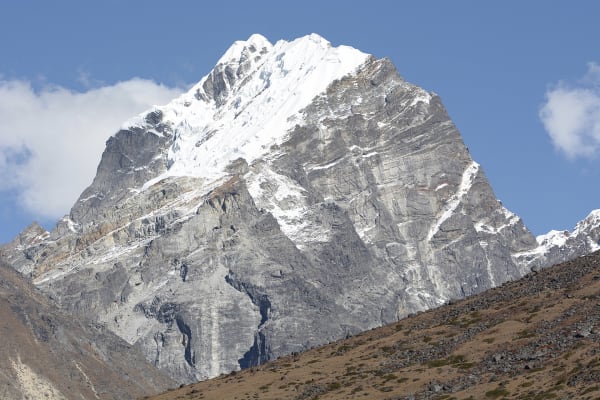
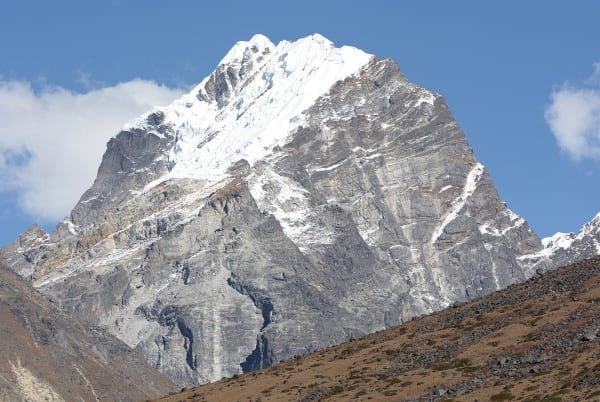
Lobuche East (6,119 m) stands directly above the Khumbu glacier opposite Everest Base Camp, and among the Khumbu's trekking peaks it is the climber's choice. It is lower than Mera and Island Peak, and harder than either: mixed rock and snow on the approach, a steeper and more sustained fixed-rope section, and a long corniced summit ridge.
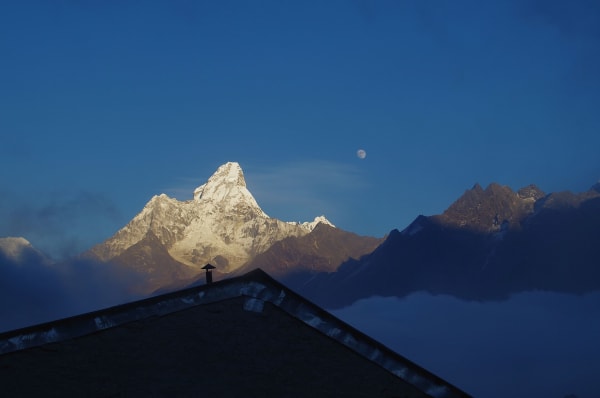
It is also the peak most commonly used as a warm-up for Ama Dablam, because the ground and the rope work are the closest available equivalent. If Island Peak felt straightforward, this is the next step.
The Climb at a Glance
| Summit | 6,119 m — Lobuche East. Lobuche West at 6,145 m is a separate, much harder objective |
| Duration | 18 days from Kathmandu |
| High camp | About 5,400 m |
| Summit day | 10–14 hours round trip |
| Technical grade | Alpine PD+/AD — mixed rock and ice, sustained fixed rope, corniced ridge |
| Skills needed | Confident crampon work, jumar, abseil, and comfort on exposed ground |
| Permits | NMA Group B, Sagarmatha National Park, Khumbu fee |
| Best seasons | April to mid May, October to November |
We run it as an 18-day itinerary, and in combination as Lobuche with Island Peak in 23 days, Pokalde, Island and Lobuche in 26 days, and Island, Lobuche and Kyajo Ri in 30 days.
The Route
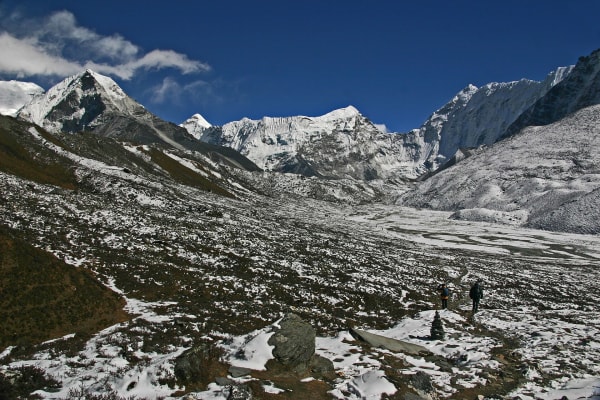
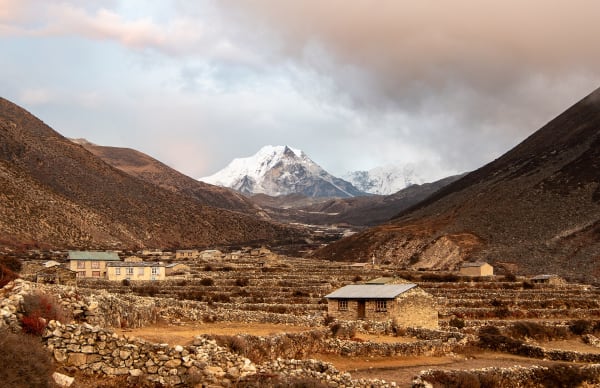
The approach follows the Everest Base Camp trail — Lukla, Namche, Tengboche, Dingboche with rest days — as far as Lobuche village (4,938 m), and most itineraries include Everest Base Camp and Kala Patthar before turning to the peak. Then:
- Base camp (about 4,900 m) on moraine below the peak's south-west flank, with a training day on the glacier.
- High camp (about 5,400 m) — a small, exposed rock ledge system reached by a steep two to three hour climb. Space is limited and it is a genuinely uncomfortable camp.
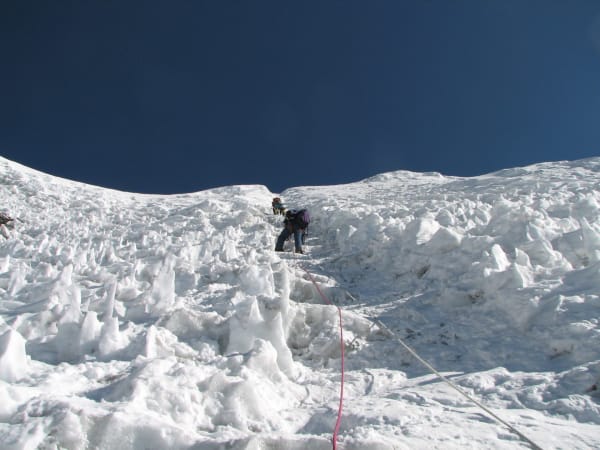
- Summit day — a 1 to 2 a.m. start on mixed rock and snow, then a sustained fixed-rope section on steepening ice, and finally the summit ridge: long, narrow, corniced, and the part of the climb that defines it.
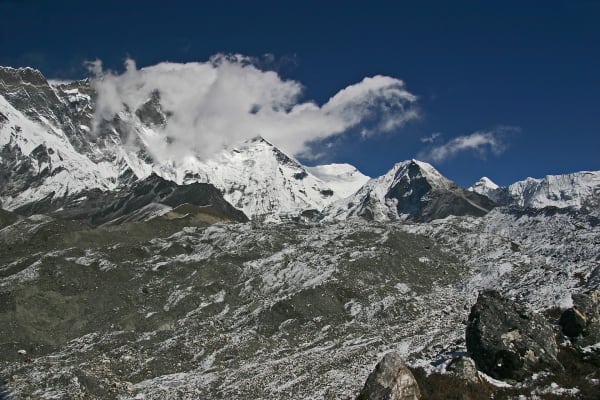
- The summit looks straight across the Khumbu glacier at Everest, Nuptse, Lhotse, Pumori and Ama Dablam — a closer and more dramatic Everest view than Kala Patthar gives.
- The descent reverses the ridge and abseils the fixed sections, which is where a slow party runs out of day.
Why It Is Harder Than Island Peak
| Lobuche East | Island Peak | |
|---|---|---|
| Summit | 6,119 m | 6,189 m |
| Ground | Mixed rock and ice throughout | Rock approach, then glacier and snow |
| Fixed rope | Longer and more sustained, on steeper ice | One headwall section |
| Summit ridge | Long, narrow and corniced | Short and exposed |
| High camp | Small, exposed rock ledges at 5,400 m | Sandy flat at 5,200 m |
| Route-finding | More complex | Straightforward |
| Crowds | Fewer | The busiest trekking peak in Nepal |
| Preparation for Ama Dablam | The standard warm-up | Useful but less directly transferable |
The cornices on the summit ridge deserve a specific mention: they overhang the eastern side and are not always obvious, which is why the rope stays on and why your guide dictates the line. This is a peak where following instructions precisely matters.
Who Should Climb It
- Climbers who have already done a trekking peak — Island Peak, Mera, or an alpine equivalent elsewhere.
- Anyone preparing for Ama Dablam or a bigger objective. This is the standard preparation and we often run them in sequence.
- Climbers who want a technical day rather than an altitude day. At 6,119 m it is the lowest of the three main Khumbu peaks.
- Anyone comfortable on exposed ground. The summit ridge is not the place to discover you are not.
Who should not: complete beginners. We would send a first-time climber to Yala Peak or Mera first, or to Island Peak if the Khumbu is the objective. Lobuche East is the second or third peak, not the first — see our beginner's guide for the progression.
Kit and conditions
Because the route is mixed rather than purely glaciated, boot choice matters more here than on Mera. A stiff double boot handles the ice well and is clumsy on the rock sections; a single B3 boot is better on rock and colder on the ice. Most climbers on this peak use a double boot and accept the rock awkwardness, and your guide will advise based on the conditions that season.
Beyond that, the list is the standard trekking peak one — harness, crampons, axe, jumar, belay device, helmet, and a -20 °C sleeping bag for high camp — with one addition worth making: a helmet is not optional on Lobuche East. The mixed ground above high camp drops loose rock, and with several parties on the route a helmet is the single most useful piece of personal protective equipment you will carry.
One practical note on the itinerary: because Lobuche East sits directly on the Everest Base Camp route, almost every trip includes Base Camp and Kala Patthar as acclimatisation. That makes it exceptionally good value in experience terms — you get the classic trek and a technical summit in one eighteen-day trip.