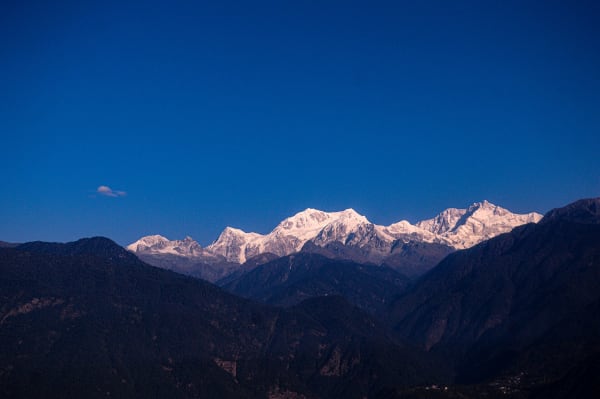
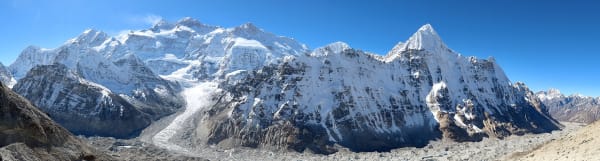
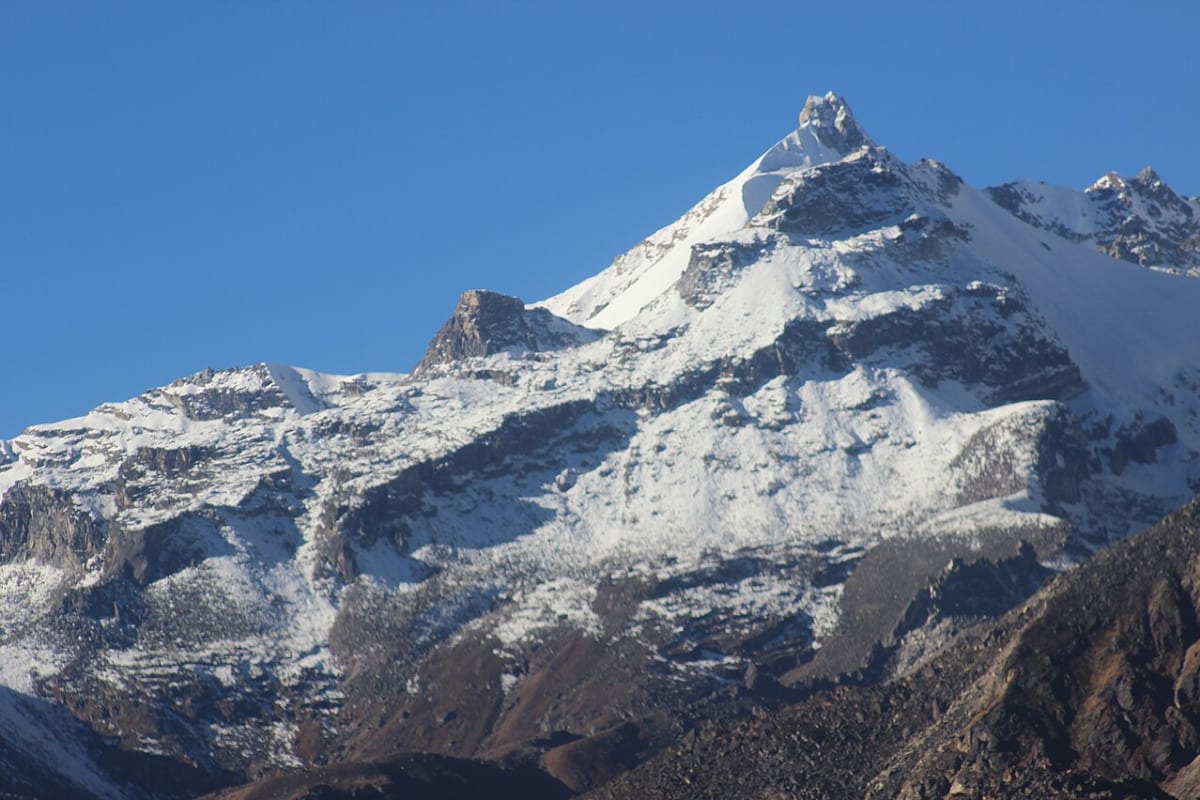
Pangpema (5,143 m) is the base camp under the north face of Kanchenjunga, and the face rises more than 3,000 m directly in front of you. It is one of the great sights in the Himalaya and one that very few people ever see — the whole region gets a fraction of the traffic that reaches Everest Base Camp in a single week.
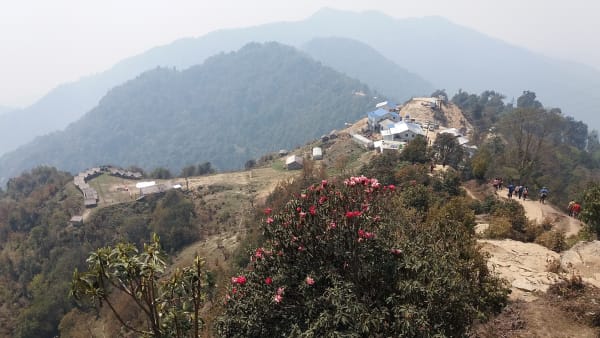
This itinerary takes the direct line: fly to Bhadrapur, drive up through the tea country of Ilam to Taplejung, then follow the Tamor and Ghunsa rivers north through subtropical gorge, dense rhododendron forest and high glacial valleys. The Sherpa village of Ghunsa (3,415 m) gets an acclimatisation day and there is a second at Khambachen (4,050 m), which makes this unusually well judged for altitude.
Every night is spent in a lodge. There is no camping anywhere on the route.

The Trek at a Glance
| Duration | 14 days Kathmandu to Kathmandu |
| Highest point | Pangpema, 5,143 m |
| Highest night | Lhonak, 4,792 m |
| Difficulty | Moderate — long days, well-spaced altitude gain |
| Best seasons | April to May, October to November |
| Accommodation | Teahouses and village lodges throughout — no camping |
| Access | Flight to Bhadrapur, then road to Taplejung and Sekathum |
| Permits | Kanchenjunga Restricted Area and Conservation Area permits |
| Price | From USD 1,375 per person |
We run it as a 14-day trek. The South Base Camp trek is the shorter, lower alternative, and the full circuit links both sides over the Sele La.
The Route
Bhadrapur to Sekathum (91 m to 1,650 m)
A flight to the Terai and then a long drive north through the tea gardens of Ilam to Taplejung (1,820 m), and a second drive to the roadhead at Sekathum. The approach is a genuine part of the trip — eastern Nepal is green, warm and agricultural in a way the rest of the trekking country is not.
Sekathum to Ghunsa (1,650 m to 3,415 m)
Two days up the Tamor and Ghunsa gorges to Amjilosa and then Ghunsa. This is dense, steep, subtropical-into-temperate country — waterfalls, cardamom, then rhododendron forest — and the Amjilosa to Ghunsa stage is a long day of steady climbing. Ghunsa is a Sherpa village with a gompa and the best lodges on the route, and it gets a full acclimatisation day.
Ghunsa to Lhonak (3,415 m to 4,792 m)
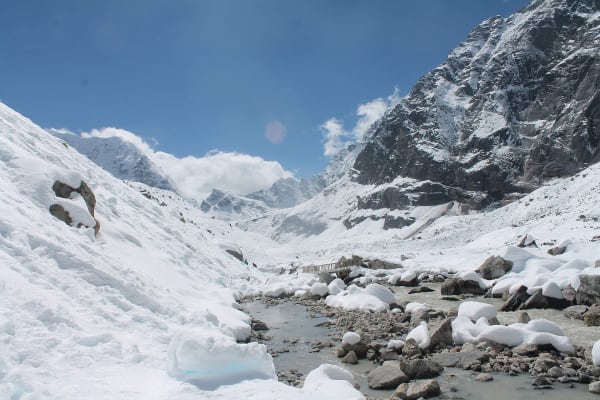
Into high glacial country. Khambachen (4,050 m) sits below Jannu, which is worth the stop on its own, and gets the second acclimatisation day. Then a steady climb along the Kanchenjunga Glacier's moraine to Lhonak at 4,792 m — a handful of basic lodges in a wide, bleak, spectacular valley.
Pangpema (5,143 m)
An early-morning out-and-back from Lhonak, eight to ten hours from a pre-dawn start. The walk up the moraine is not hard, but it is long and it is at altitude. The reward at the top is the north face, and the scale of it takes a while to register — there is nothing to give it perspective except the glacier at your feet.
Difficulty and Altitude
Graded moderate, and the two rest days are what earn it that grade rather than something harder. The profile is one of the better-judged ones in Nepal.
- Six to eight hours a day on most days.
- The Pangpema day is the longest at eight to ten hours from a pre-dawn start, returning to Lhonak the same evening.
- Two full acclimatisation days, at Ghunsa and Khambachen, before any night above 4,000 m.
- -10 °C to -20 °C at Khambachen and Lhonak in the main seasons, with minimal lodge heating.
- Basic lodges above Ghunsa, but permanent accommodation at every stop.
A sleeping bag rated to -20 °C plus a liner is the right specification here. The Pangpema morning is colder still. See the altitude guide for how to use the rest days properly.
North or South? Choosing Between the Kanchenjunga Routes
| North Base Camp | South Base Camp | Full Circuit | |
|---|---|---|---|
| Days | 14 | 11 | 21 |
| Highest point | Pangpema, 5,143 m | Oktang, 4,730 m | Sele La and both base camps |
| The view | A 3,000 m face directly overhead | A broad wall of Kanchenjunga, Kabru, Rathong and Talung | Both |
| Accommodation | Lodges throughout | Lodges throughout | Lodges, with harder stages |
| From | USD 1,375 | USD 1,125 | See the circuit guide |
If you want the single most dramatic view, go north. If you have less time or want a gentler altitude profile, go south. If you want both and have three weeks, read our Kanchenjunga Circuit guide.
What It Costs
At USD 1,375 this is remarkable value for a fourteen-day restricted-area trek with flights included — the teahouse infrastructure means no camp crew is needed.
| Group size | Price per person |
|---|---|
| 1 trekker | USD 1,500 |
| 2 to 4 | USD 1,475 |
| 5 to 7 | USD 1,450 |
| 8 to 10 | USD 1,425 |
| 11 to 14 | USD 1,400 |
| 15 and over | USD 1,375 |
Restricted-area rules require a minimum of two trekkers on a permit. Taplejung has the last reliable ATM — carry all your rupees from there or from Kathmandu.
What Is Included
- Airport pickup and drop-off in Kathmandu.
- Kathmandu–Bhadrapur return domestic flights.
- Ground transport between Bhadrapur, Taplejung and Sekathum.
- Hotel accommodation in Kathmandu and Taplejung with breakfast.
- Teahouse accommodation throughout the trek.
- Three meals a day during the trek.
- Kanchenjunga Restricted Area Permit and Kanchenjunga Conservation Area Permit.
- A licensed English-speaking trekking guide.
- Group trekking map, first aid kit carried by the guide, and all government taxes, permit fees and service charges.
What Is Not Included
- International flights and the Nepal entry visa fee.
- Travel insurance including emergency helicopter evacuation above 5,000 m.
- Personal trekking equipment and clothing, including a bag rated to -20 °C and a liner.
- Porter services, available at additional cost.
- Lunch and dinner in Kathmandu.
- Snacks, bottled water, hot showers, Wi-Fi, charging and drinks.
- Laundry, phone calls, souvenirs and personal expenses.
- Tips for guides, drivers and support staff.
- Extra accommodation or transport caused by flight delays, weather or anything outside the itinerary.
Charging above Ghunsa is solar, limited and usually charged for. Bring a large power bank and spare batteries, and keep them warm overnight.