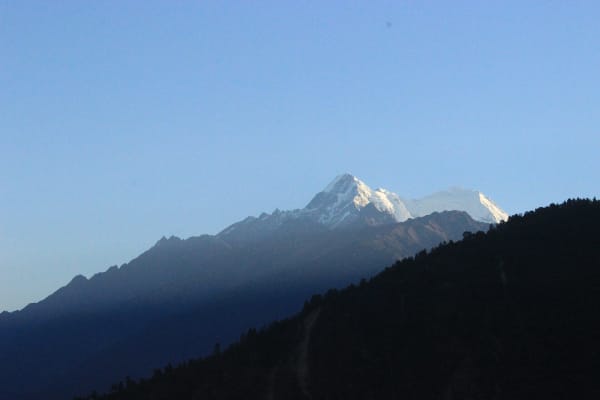
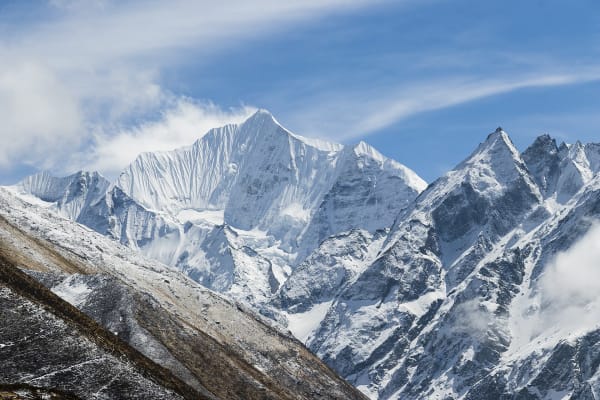
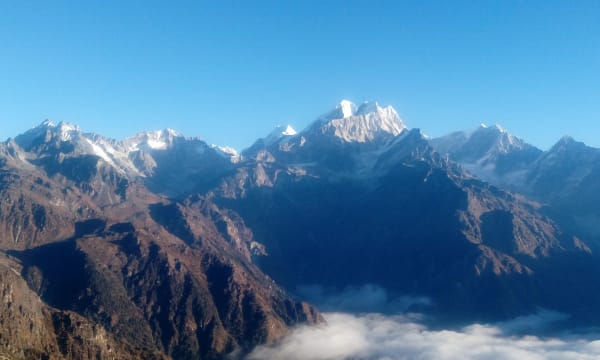
Dorje Lakpa (6,966 m) is the sharp triple-summited peak that closes the southern side of the Langtang valley, and on a clear winter morning it is visible from the ridges above Kathmandu.
It was first climbed in 1981 by a Japanese team and it has been attempted very seldom since — the mountain has no easy line, the approach beyond the Langshisha Kharka has no trail, and the valley between it and the Jugal Himal sees essentially nobody.
The route is graded D: a crevassed glacier approach, sustained ice at 50 to 55 degrees, and a long corniced ridge to a summit that drops away on every side. It is a serious, quiet, technically satisfying 7,000 m objective within a week of Kathmandu — the sort of mountain experienced alpinists seek out precisely because nobody else has been on it.

The Expedition at a Glance
| Summit | 6,966 m |
| Grade | D — crevassed glacier, 50–55° ice, long corniced ridge |
| Duration | 28 days Kathmandu to Kathmandu — no flight |
| Camps | Base camp 4,700 m, Camp 1 5,500 m, Camp 2 6,100 m, high camp 6,500 m |
| Summit success rate | Around 35 to 50 percent |
| First ascent | 1981, Japanese team |
| Best seasons | April to May, October to November |
| Price | From USD 19,500 per person |
We run it as a 28-day expedition. Langtang Lirung is the harder objective in the same valley, and Langshisha Ri is the grade below.
The Route
Kathmandu to Kyanjin Gompa (1,400 m to 3,870 m)
Two days of briefing, permits, a Ministry briefing and cargo dispatch in Kathmandu, then the drive to Syabrubesi and three days up the Langtang valley. An acclimatisation day at Kyanjin Gompa climbing Tserko Ri (4,984 m).
Beyond the Langshisha Kharka to base camp (4,100 m to 4,700 m)
East past the Langshisha Kharka, where the trail ends, to base camp at 4,700 m on the moraine on the southern side of the upper valley. A puja, a technical assessment and training day, and an acclimatisation day.
Rotation and summit push (5,500 m to 6,966 m)
An acclimatisation rotation to Camp 1 (5,500 m) and back to base, a rest day, then the push through Camp 1, Camp 2 at 6,100 m and a high camp at 6,500 m. The Sherpas fix the route in stages ahead of the team.
The summit ridge is longer than it looks from the valley — it runs over subsidiary tops to the main summit and takes several hours, corniced and exposed throughout, taken one at a time. That length, and the time it consumes, is the usual reason for turning back.
Dorje Lakpa or Langtang Lirung?
| Dorje Lakpa | Langtang Lirung | |
|---|---|---|
| Summit | 6,966 m | 7,227 m |
| Grade | D | TD- |
| Main hazard | Sustained ice and the long ridge | Serac fall on the lower and middle route |
| Departures run | More | Few |
| Success rate | 35–50% | Lower still |
| From | USD 19,500 | USD 21,000 |
A grade easier and considerably less exposed to serac fall, which is the main reason we run more departures on Dorje Lakpa. Its difficulty is the sustained ice and the long committing crest — hard, but hazard you can climb rather than hazard you can only time.
What It Costs
| Group size | Price per person |
|---|---|
| 1 climber | USD 23,790 |
| 2 to 4 | USD 22,030 |
| 5 to 7 | USD 20,870 |
| 8 to 10 | USD 20,280 |
| 11 to 14 | USD 19,790 |
| 15 and over | USD 19,500 |
What Is Included
- Airport transfers, an expedition briefing, permits, a Ministry briefing and cargo dispatch in Kathmandu.
- Private transport Kathmandu to Syabrubesi and back — no flight.
- Hotel accommodation in Kathmandu with breakfast, and teahouses in the Langtang valley.
- Full expedition base camp (4,700 m) plus Camp 1, Camp 2 and a high camp, with mess, kitchen, storage and toilet tents.
- A cook and kitchen crew, and all meals throughout.
- Expedition climbing permit, Langtang National Park entry and liaison arrangements.
- An expedition leader, climbing Sherpas and high-altitude staff, with equipment, wages and insurance.
- Progressive rope fixing of the glacier, the ice and the summit ridge.
- A puja, a technical assessment and training day, an acclimatisation rotation and reserve days.
- Emergency oxygen with masks and regulators, garbage deposit, summit certificate and all taxes.
What Is Not Included
- International flights and the Nepal entry visa fee.
- Expedition insurance valid to 7,000 m with helicopter evacuation and repatriation.
- Personal climbing equipment and high-altitude clothing, including double boots and a bag rated to -30 °C.
- Personal porter services.
- Meals in Kathmandu beyond breakfast.
- Snacks, bottled water, hot showers, Wi-Fi, charging and drinks.
- Laundry, phone calls, souvenirs and personal expenses.
- Summit bonus and tips for the climbing Sherpas and high-altitude staff.
- Extra accommodation or transport caused by weather, road conditions or an early descent.
No supplementary oxygen is used for climbing — 6,966 m is within range for a fit acclimatised climber, and the difficulty here is technical rather than altitude-related.