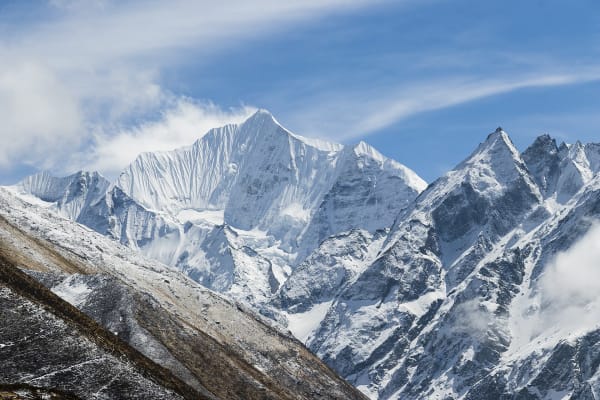
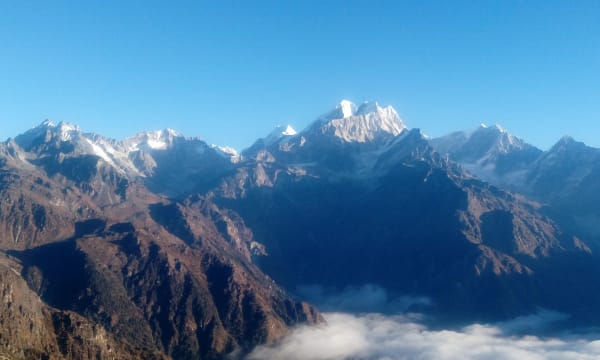
Langshisha Ri (6,427 m) stands at the head of the Langtang valley, at the point where the glaciers turn east toward the Tibetan border.
It is the most climbable of the Langtang peaks and still very seldom attempted — the valley gets a good number of trekkers to Kyanjin Gompa and almost none of them go any further, and beyond the Langshisha Kharka there is no trail, no lodge and usually nobody at all.
The route is graded AD: a long walk up the Langtang glacier, a crevassed approach, sustained snow and ice at 45 to 50 degrees on fixed rope, and a corniced summit ridge. What makes it worth doing is the combination of a real climb with the shortest approach in Nepal — you can be at base camp five days after landing in Kathmandu, on a mountain that sees a handful of parties a decade.

The Expedition at a Glance
| Summit | 6,427 m |
| Grade | AD — crevassed glacier, 45–50° ice, corniced summit ridge |
| Duration | 17 days Kathmandu to Kathmandu — no flight |
| Base camp / high camp | 4,600 m / 5,400 m |
| Approach | Six days from the airport to base camp |
| Summit success rate | Around 55 to 65 percent |
| Traffic | A handful of parties a decade |
| Price | From USD 4,850 per person |
We run it as a 17-day expedition. Naya Kanga in the same valley is the grade below, and Tilman's Pass crosses the same glacier system.
The Route
Syabrubesi to Kyanjin Gompa (1,460 m to 3,870 m)
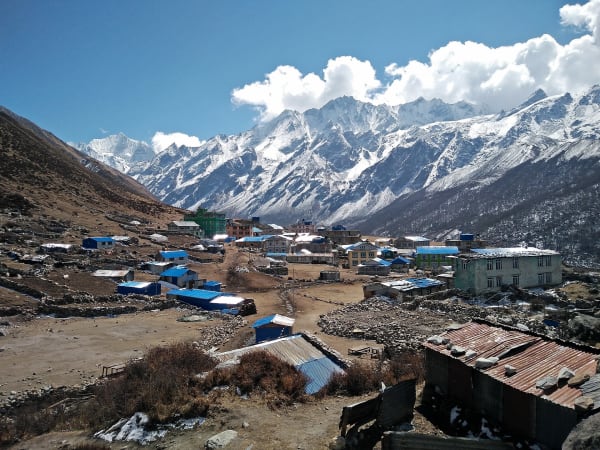
A day's drive from Kathmandu to Syabrubesi, then three days walking up the Langtang valley. An acclimatisation day at Kyanjin Gompa climbing Tserko Ri (4,984 m), which is the single most useful day in the itinerary.
The trail passes the site of old Langtang village. On 25 April 2015 the earthquake brought a section of hillside and hanging glacier down onto it, killing most of the inhabitants and the visitors staying there. The memorial and the rebuilt village are on the route, and your guide gives the site the time it deserves.
Base camp and training (4,600 m)
East past the Langshisha Kharka — the last grazing ground, and the point beyond which almost nobody walks — to base camp at 4,600 m on the moraine. A training and acclimatisation day covering glacier travel and fixed-line technique.
High camp and the summit (5,400 m to 6,427 m)
High camp at 5,400 m on the glacier below the face. Summit day crosses the crevassed approach roped, climbs the fixed 45 to 50 degree slopes, and finishes on the corniced ridge. Porters do not go beyond base camp; everything above is carried by the climbing Sherpas and the team.

The Short Approach: Advantage and Risk
Six days from the airport to a 4,600 m base camp is remarkably quick by Himalayan standards. That is the trip's main selling point and its main hazard, and we build against it deliberately.
- Two nights at Kyanjin Gompa with the Tserko Ri climb to 4,984 m.
- Two nights at base camp at 4,600 m before moving up.
- One night at 5,400 m before the summit push.
- A reserve day at base camp.
It is a reasonable profile for a climber who has already been high, and it is not a first Himalayan climb. For someone with a 6,000 m summit already this is an excellent short expedition; for a first-ever Himalayan objective the acclimatisation is too compressed. Read the altitude guide before booking.
What It Costs
| Group size | Price per person |
|---|---|
| 1 climber | USD 5,920 |
| 2 to 4 | USD 5,480 |
| 5 to 7 | USD 5,190 |
| 8 to 10 | USD 5,040 |
| 11 to 14 | USD 4,920 |
| 15 and over | USD 4,850 |
What Is Included
- Airport transfers, a briefing, permit and equipment-check day in Kathmandu.
- Private transport Kathmandu to Syabrubesi and back — no flight.
- Hotel accommodation in Kathmandu with breakfast, and teahouses in the Langtang valley.
- Tented base camp (4,600 m) and high camp (5,400 m) with mess, kitchen and toilet tents, and a cook and kitchen crew.
- Three meals a day throughout.
- Climbing permit for Langshisha Ri and the Langtang National Park entry permit.
- A government-licensed climbing guide and climbing Sherpas above base camp.
- Group climbing equipment and fixing of the glacier line and the steep slopes.
- A training and acclimatisation day at base camp, plus a reserve day.
- Porter and pack-animal transport as far as base camp, garbage deposit, summit certificate and all taxes.
What Is Not Included
- International flights and the Nepal entry visa fee.
- Travel insurance covering mountaineering to 6,427 m, with helicopter evacuation and repatriation.
- Personal climbing equipment, available to rent as an add-on.
- Personal clothing, double boots and a bag rated to -25 °C.
- Porter services for your personal duffel.
- Lunch and dinner in Kathmandu.
- Snacks, bottled water, hot showers, Wi-Fi, charging and drinks.
- Laundry, phone calls, souvenirs and personal expenses.
- Tips for the guide, climbing Sherpas, cook crew and porters.
- Extra costs caused by weather, road conditions or an early descent.