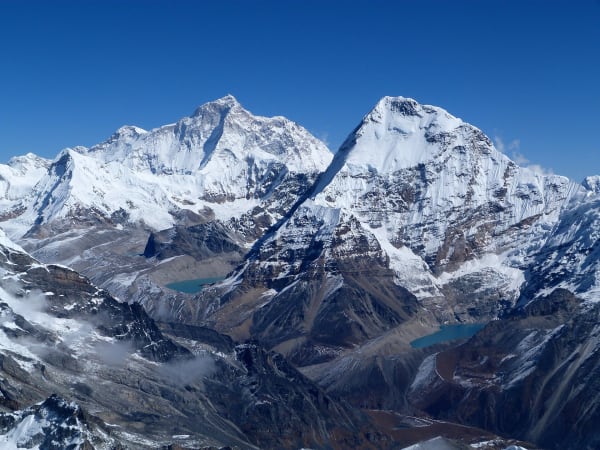
Chamlang (7,321 m) is the long white wall that closes the western side of the Barun valley, and it is one of the least-climbed 7,000 m peaks in Nepal.
It was first ascended in 1962 by Soh Anma and Pasang Phutar on a Japanese expedition, and in the sixty years since it has seen a handful of successful parties — some decades almost none.
The reason is the mountain itself. Chamlang is a long ridge rather than a summit pyramid, with a grade D route on steep snow and ice, a corniced crest that runs for hours, and a base camp in the upper Barun that is eight days' walk from the nearest road.
It is not harder than Ama Dablam in any single move; it is harder as a whole, because there is more of it, nobody has fixed it for you, and there is no one else in the valley.

The Expedition at a Glance
| Summit | 7,321 m |
| Grade | D — steep snow and ice, with a corniced crest that runs for hours |
| Duration | 33 days Kathmandu to Kathmandu |
| Camps | Base camp 5,000 m, Camp 1 5,800 m, Camp 2 6,500 m, high camp 6,900 m |
| Approach | Eight days on foot up the Barun from Num |
| Summit success rate | Well under half of attempts |
| First ascent | 1962, Soh Anma and Pasang Phutar |
| Price | From USD 18,500 per person |
We run it as a 33-day expedition. Makalu shares the Barun approach, and Baruntse is the gentler 7,000 m objective in the same region.
The Summit Ridge
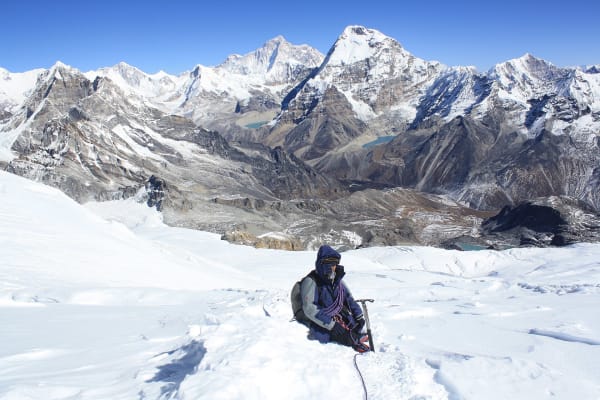
What makes Chamlang difficult is the length of its summit ridge and its cornices. It is narrow, drops away on both sides, and goes on for hours, so it has to be taken one at a time with the Sherpas probing the crest ahead.
That length is also why the success rate is what it is. Well under half of the expeditions that attempt it summit, and there are seasons when none do — weather on the ridge and the sheer time it consumes are the two reasons, in that order.
There is no trodden line, no established camp platforms and no fixed rope from other teams. Your expedition does all of it.
The Route
Tumlingtar to base camp (405 m to 5,000 m)
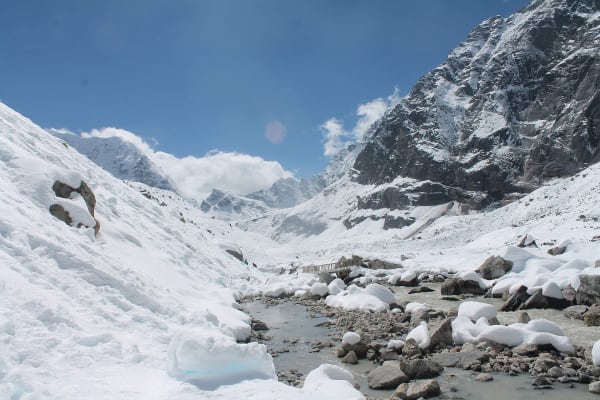
Fly to Tumlingtar, drive to Num, then eight days up the Barun: Seduwa, Tashigaon, Khongma Danda, over the Shipton La (4,220 m) to Dobato, then Yangle Kharka and Langmale Kharka to base camp at 5,000 m, roughly a day's walk short of Makalu base camp.
The Barun is one of the finest walks in Nepal and almost unvisited: protected forest with red panda and snow leopard habitat, two-thousand-metre walls, and waterfalls falling off hanging glaciers.
Rotation and summit push (5,800 m to 7,321 m)
A puja, a technical assessment and training day, an acclimatisation day, and a full rotation to Camp 1 (5,800 m) and back. Then the push through Camp 1, Camp 2 (6,500 m) and a high camp at 6,900 m, with the Sherpas fixing in stages ahead of the team.

Chamlang or Baruntse?
| Baruntse | Chamlang | |
|---|---|---|
| Summit | 7,129 m | 7,321 m |
| Grade | AD+ | D |
| Summit ridge | Long, with a corniced section near the top | Long and corniced for hours |
| Fixed rope from others | Sometimes | Never |
| Success rate | 50–65% | Well under half |
| As preparation | The standard 8,000 m warm-up | An objective in itself |
Considerably harder. Baruntse is an AD+ snow route with a corniced section near the top; Chamlang is grade D with a long corniced ridge and steeper ground below it. Baruntse is the right preparation for Chamlang, not an alternative to it.
What It Costs
| Group size | Price per person |
|---|---|
| 1 climber | USD 22,570 |
| 2 to 4 | USD 20,900 |
| 5 to 7 | USD 19,800 |
| 8 to 10 | USD 19,240 |
| 11 to 14 | USD 18,780 |
| 15 and over | USD 18,500 |
What Is Included
- Airport transfers, an expedition briefing, equipment inspection, Ministry briefing, permits and cargo dispatch in Kathmandu.
- Kathmandu–Tumlingtar flights, the jeep to Num, and the full eight-day Barun approach.
- Teahouses on the lower approach and full camping support above.
- Base camp (5,000 m), Camp 1, Camp 2 and a high camp, with mess, kitchen, storage and toilet tents.
- A cook and kitchen crew, and all meals throughout the expedition.
- Chamlang royalty permit, Makalu Barun National Park entry and liaison arrangements.
- An expedition leader, climbing Sherpas and high-altitude staff.
- Progressive rope fixing of the whole route by our own Sherpa team.
- A puja, a technical assessment and training day, an acclimatisation rotation and reserve days.
- Emergency oxygen with masks and regulators at the high camps and base camp, garbage deposit, summit certificate and all taxes.
What Is Not Included
- International flights and the Nepal entry visa fee.
- Expedition insurance valid to 7,400 m with helicopter evacuation and repatriation — and note that evacuation from the Barun is expensive and weather-dependent.
- Personal climbing equipment, double boots and a bag rated to -30 °C.
- Personal porter services.
- Meals in Kathmandu beyond breakfast.
- Snacks, bottled water, hot showers, Wi-Fi, charging and drinks.
- Laundry, phone calls, souvenirs and personal expenses.
- Summit bonus and tips for the climbing Sherpas and high-altitude staff.
- Extra accommodation or transport caused by flight delays at Tumlingtar, weather or an early descent.