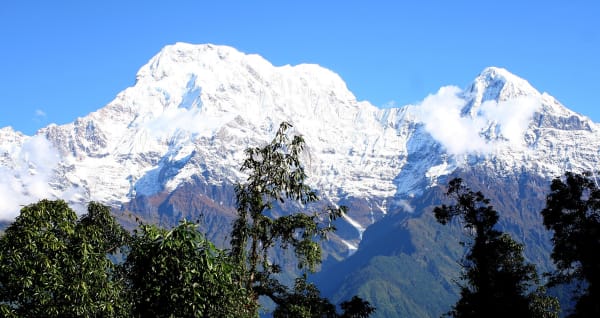
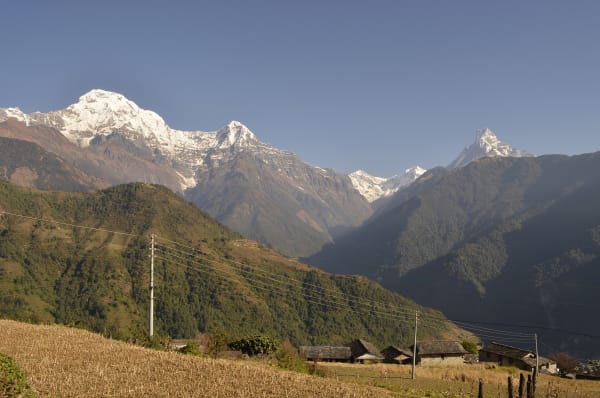
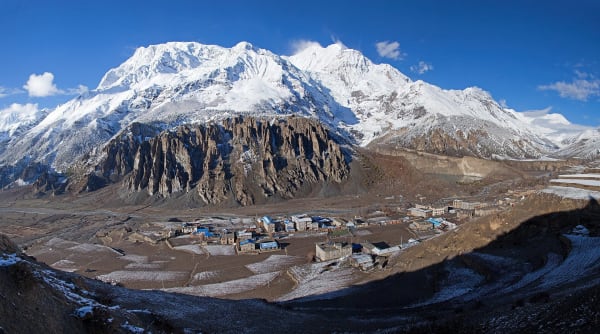
Annapurna South (7,219 m) is the mountain that closes the western side of the Annapurna Sanctuary, and the one that fills the view from Ghandruk and Pokhara on a clear morning.
It was first climbed in 1964 by a Japanese team, and it has been climbed remarkably little since — a handful of expeditions in most decades, and long stretches with none at all.
The route is graded D: a heavily crevassed glacier, sustained ice at 50 to 55 degrees, and a long corniced summit ridge, with base camp inside the Sanctuary beneath the three-thousand-metre south face of Annapurna I. It is a hard, quiet, seldom-attempted 7,000 m peak in a place that thousands of trekkers walk through every season without ever looking up at it as an objective.

The Expedition at a Glance
| Summit | 7,219 m |
| Grade | D — crevassed glacier, 50–55° ice, long corniced summit ridge |
| Duration | 30 days Kathmandu to Kathmandu |
| Camps | Base camp 4,200 m, Camp 1 5,300 m, Camp 2 6,100 m, high camp 6,600 m |
| Summit success rate | Under half of attempts |
| Departures | At most one a season |
| First ascent | 1964, Japanese team |
| Price | From USD 21,500 per person |
We run it as a 30-day expedition. Singu Chuli is the hard trekking peak in the same Sanctuary, and Gangapurna the comparable objective on the northern side.
The Route
The Sanctuary approach (1,940 m to 4,130 m)
Drive to Pokhara and Siwai, then the classic Annapurna Base Camp walk: Ghandruk, Chomrong, Bamboo, Deurali, Machhapuchhre Base Camp and Annapurna Base Camp (4,130 m).
The section between Dovan and Deurali is genuine avalanche terrain after heavy snow, and there are two or three places your guide will cross quickly and without stopping. Conditions are checked with lodges higher up the valley each day.
Base camp, assessment and rotation (4,200 m to 5,300 m)
Base camp at 4,200 m a short distance beyond ABC, a puja, a technical assessment and training day, an acclimatisation day, and a full rotation to Camp 1 (5,300 m) and back with two rest days.
The summit push (5,300 m to 7,219 m)
Base camp to Camp 1, Camp 1 to Camp 2 (6,100 m), Camp 2 to a high camp at 6,600 m, and then the summit day on the crevassed glacier, the sustained ice and the long corniced crest.

Who We Take, and How Often We Go
At most one departure a season, and we are willing to cancel it if conditions are wrong or if the party that assembles is not strong enough. On a grade D route with no other team in the Sanctuary, an under-strength party is a safety problem.
The success rate is low and hard to quote meaningfully given how few attempts there are — under half of the expeditions that go for it summit. Conditions on the face and time on the ridge account for the rest.
If you want a hard objective in the Sanctuary but not a full expedition, Singu Chuli is grade D on an NMA permit and 718 m lower.
What It Costs
| Group size | Price per person |
|---|---|
| 1 climber | USD 26,230 |
| 2 to 4 | USD 24,290 |
| 5 to 7 | USD 23,010 |
| 8 to 10 | USD 22,360 |
| 11 to 14 | USD 21,820 |
| 15 and over | USD 21,500 |
What Is Included
- Airport transfers, a climbing briefing, permits and an equipment check in Kathmandu.
- Transport Kathmandu–Pokhara–Siwai and back.
- Hotel accommodation in Kathmandu and Pokhara with breakfast, and teahouses on the Sanctuary approach.
- Base camp (4,200 m), Camp 1, Camp 2 and a high camp, with mess, kitchen, storage and toilet tents.
- A cook and kitchen crew, and all meals throughout the expedition.
- Annapurna South royalty permit and the Annapurna Conservation Area Permit, plus liaison arrangements.
- An expedition leader, climbing Sherpas and high-altitude staff.
- Progressive rope fixing of the whole route by our own Sherpa team.
- A puja, a technical assessment and training day, an acclimatisation rotation and reserve days.
- Emergency oxygen with masks and regulators at the high camps and base camp, garbage deposit, summit certificate and all taxes.
What Is Not Included
- International flights and the Nepal entry visa fee.
- Expedition insurance valid to 7,300 m with helicopter evacuation and repatriation.
- Personal climbing equipment, double boots and a bag rated to -30 °C.
- Personal porter services.
- Meals in Kathmandu and Pokhara beyond breakfast.
- Snacks, bottled water, hot showers, Wi-Fi, charging and drinks.
- Laundry, phone calls, souvenirs and personal expenses.
- Summit bonus and tips for the climbing Sherpas and high-altitude staff.
- Extra costs arising from a cancelled departure, weather or an early descent.