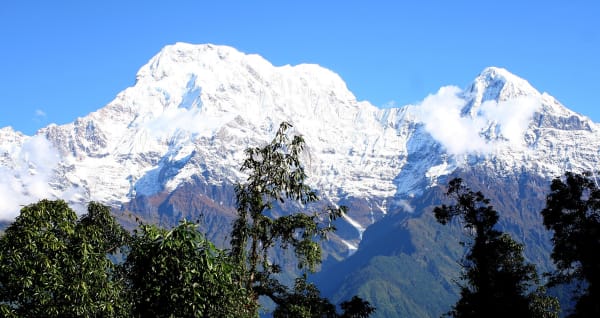
Annapurna I (8,091 m) was the first 8,000 m peak ever climbed — Maurice Herzog and Louis Lachenal, 3 June 1950, with no oxygen, no fixed rope and no map worth the name.
It is also, by a wide margin, the most dangerous of the fourteen. The north face is swept by avalanche and serac fall, the route changes from season to season, and the ratio of deaths to summits has historically been the worst in high-altitude mountaineering.
We say all of that first because anyone considering this expedition deserves to hear it before the marketing. What follows is the mountain as it is: a grade D route on a face where objective hazard, not technical difficulty, is the governing problem; a forty-four day expedition with two rotations, a dedicated 1:1 Sherpa and a full oxygen allocation; and a leader whose willingness to abandon a season is the single most valuable thing in the package.

The Expedition at a Glance
| Summit | 8,091 m — the first 8,000 m peak ever climbed |
| Route | The north face |
| Grade | D, with objective hazard as the governing problem |
| Duration | 44 days Kathmandu to Kathmandu |
| Base camp | Annapurna North Base Camp, 4,190 m |
| Oxygen | Seven 4-litre bottles per climber, plus a dedicated Sherpa's supply |
| Summit success rate | Roughly a third to a half of those who start a push |
| Price | From USD 38,000 per person |
We run it as a 44-day expedition. For the other 8,000 m objectives, see Lhotse, Makalu and Everest.
The Hazard, Stated First
The serac hazard on the north face cannot be eliminated, only managed. We cross the exposed sections in the cold hours, never stop in them, and design the rotation plan to minimise the number of passages through them.
That is the whole of the honest answer. It is not a technique that makes the face safe; it is a way of reducing exposure to something that remains real.
If we decide the face is unsafe, we stop, and the expedition ends without a summit. Our leader has absolute authority to make that call, and no member of our staff receives a summit-contingent bonus that could bias it. That arrangement is deliberate and it is the most important line in this page.
The Approach: The Miristi Khola
We do not fly clients to base camp. Several operators now do, and it saves six days, but it also removes the acclimatisation the walk provides and leaves a climber sitting at 4,190 m feeling ill. We walk in.
The route leaves the Kali Gandaki at Lete and follows the Miristi Khola — a gorge with no villages, no lodges and no maintained trail, with river crossings and steep forested sidewalls. It takes three days from Lete to Annapurna North Base Camp at 4,190 m, and it is wild country by any standard.

Why Forty-Four Days
- The walk in takes six days, and it is the acclimatisation.
- The acclimatisation programme needs two rotations — Camp 1 at 5,100 m, Camp 2 at 5,700 m, and back to base each time.
- The summit window may not appear until the second half of May.
- Reserve days are built in and, on this mountain, are used.
Shortening any of those is how an expedition ends up on the face at the wrong hour of the day, which is precisely the failure mode this mountain punishes.
What It Costs, and the Refund Position
| Group size | Price per person |
|---|---|
| 1 climber | USD 46,360 |
| 2 to 4 | USD 42,940 |
| 5 to 7 | USD 40,660 |
| 8 to 10 | USD 39,520 |
| 11 to 14 | USD 38,570 |
| 15 and over | USD 38,000 |
If the season is cancelled: the Department of Tourism royalty and permit fees are paid in advance and are non-refundable to us, so they are non-refundable to you. Everything else — staff, food, oxygen and logistics not yet consumed — is refunded. We set that out in writing at booking rather than in the small print.
What Is Included
- Airport transfers, an expedition briefing, equipment check, Ministry briefing, permits and cargo dispatch in Kathmandu.
- Transport Kathmandu–Pokhara–Lete, and the full Miristi Khola approach with a camping crew.
- Annapurna North Base Camp (4,190 m) with full expedition infrastructure, plus Camps 1, 2 and above.
- A cook and kitchen crew, and all meals throughout the expedition.
- Annapurna climbing royalty and permits, the Annapurna Conservation Area Permit and liaison arrangements.
- An expedition leader, a dedicated 1:1 climbing Sherpa, and high-altitude staff.
- Seven 4-litre oxygen bottles per climber, plus a Summit mask and regulator, and the Sherpa's own supply.
- Rope fixing, shared with other teams where possible.
- A puja, a technical training day, two acclimatisation rotations and reserve days.
- Garbage deposit, summit certificate and all government taxes.
What Is Not Included
- International flights and the Nepal entry visa fee.
- Expedition insurance valid to 8,200 m with helicopter evacuation and repatriation.
- Personal climbing equipment, an 8,000 m down suit and double boots rated for the altitude.
- Additional oxygen bottles beyond the seven included.
- Meals in Kathmandu and Pokhara beyond breakfast.
- Personal expenses, laundry, Wi-Fi and charging at base camp.
- Summit bonus and tips for the climbing Sherpas and high-altitude staff.
- The Department of Tourism royalty in the event of a cancelled season, which is non-refundable.