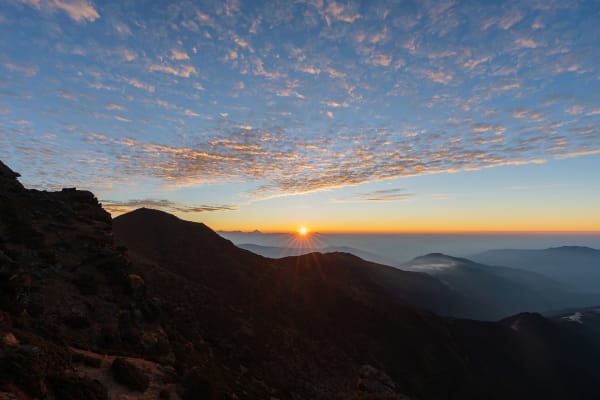
Pikey Peak sits in lower Solukhumbu, south of the Everest region proper, and from its 4,065 m summit you can see Everest, Lhotse, Makalu, Kanchenjunga, Dhaulagiri, Annapurna and the Numbur range in a single sweep — eight of the world's fourteen highest mountains among them. Edmund Hillary is widely reported to have called it his favourite view of Everest.
It is reached by road from Kathmandu, which means no Lukla flight and no weather lottery. It works superbly in winter. And almost nobody walks it: you will share the trail with Sherpa villagers and yak herds rather than with trekking groups.
The Trek at a Glance
| Duration | 8 days from Kathmandu |
| Highest point | Pikey Peak summit, 4,065 m |
| Difficulty | Moderate — ridge walking, one steep summit morning |
| Access | Road from Kathmandu to Dhap, 8–9 hours. No flight needed |
| Permits | Trekking registration; no national park entry on the standard route |
| Best seasons | October to December and March to May — and excellent in winter |
| Accommodation | Teahouses and village lodges |
We run it as an 8-day Pikey Peak trek.
The Route
Kathmandu to Dhap
A long drive east through Jiri and Shivalaya — the old walk-in route to Everest that Hillary and Tenzing used in 1953 — to the roadhead at Dhap at around 2,900 m. Eight to nine hours, and the only difficult part of the trip.
Dhap to Pikey Base Camp (2,900 m to 3,640 m)
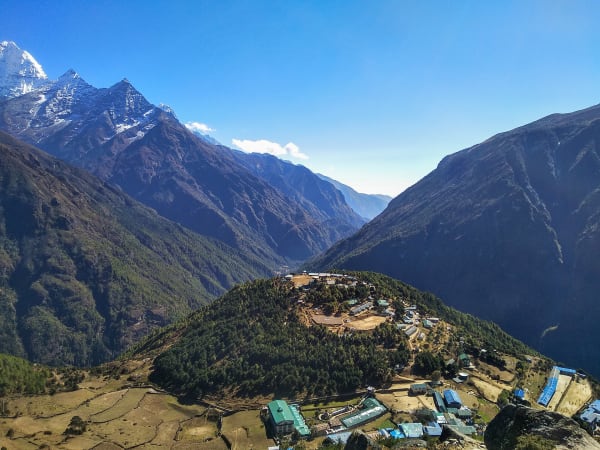
Into rhododendron and oak forest with mani walls and chortens, through yak pasture and past the first views north. Pikey Base Camp is a handful of simple lodges on the ridge below the summit.
The summit morning (4,065 m)
A pre-dawn start for 400 m of climbing to the summit, arriving for sunrise. The panorama is the reason for the trek: Everest, Lhotse, Makalu, Kanchenjunga, Dhaulagiri, Annapurna, Gaurishankar, Numbur and the Rolwaling peaks, in an uninterrupted sweep with nothing in the foreground. Unlike Kala Patthar, you are far enough back to see the whole range rather than one face.
Down through Junbesi and the monasteries
The descent goes through the old Everest approach country: Junbesi, a beautiful Sherpa village with a 17th-century gompa; Thuptenchholing, a large Tibetan monastery and nunnery founded by refugees from Tibet; and Taksindu, another working Sherpa monastery. This stretch is as good as the summit.
Out from Phaplu
To the airstrip at Phaplu for a short flight to Kathmandu, or back by road. Phaplu flights are considerably more reliable than Lukla.
Why It Is Underrated
- No Lukla flight. Road access removes the single biggest risk in any Everest-region trip.
- Superb in winter. At 4,065 m for a day walk and nothing above 3,640 m to sleep at, December and January give the clearest air of the year with manageable cold.
- Eight days, not fourteen. The whole trip fits inside a short holiday.
- Low altitude risk. The highest night is 3,640 m, and the summit is a day walk.
- Real Sherpa culture without the crowd. Junbesi, Thuptenchholing and Taksindu are working religious communities on the historic Everest approach.
- Almost empty. A fraction of the Khumbu's traffic, even in October.
- Cheap. No flight, no national park fee, no restricted permit.
It is the trek we recommend most often to people who want to see Everest but have only a week, or who would rather not fly to Lukla. See our short Everest treks guide for the full range of alternatives.
Pikey Peak or the Khumbu?
| Pikey Peak | Everest Base Camp | Everest View Trek | |
|---|---|---|---|
| Days | 8 | 14 | 9 |
| Flight | None required | Lukla, weather-dependent | Lukla |
| Highest point | 4,065 m | 5,545 m | 3,880 m |
| Everest view | Whole range from a distance | Close-range south-west face | Close-range, from the Everest View Hotel trail |
| Altitude risk | Minimal | Significant | Low |
| Crowds | Almost none | The busiest trail in Nepal | Moderate |
| Winter | Excellent | Hard | Good |
| Cost | Lowest | Highest | Moderate |
Practical notes
The drive to Dhap is the only genuinely tiring part of the trip — eight to nine hours on the Jiri road, which is winding and slow. We break it where the group prefers, and some itineraries return by air from Phaplu instead, which turns the second transfer into a 30-minute flight. Phaplu is a considerably more reliable airstrip than Lukla, sitting lower and in an open valley.
On kit: because the highest night is 3,640 m this is a lighter packing list than a Khumbu trek. A sleeping bag rated to -10 °C covers the main seasons and -15 °C is ample for December, and you need no technical equipment at all. What you do want is a headlamp for the pre-dawn summit walk, a warm layer for the top where it is windy at any time of year, and proper sunglasses — the snow glare on the summit ridge in winter is stronger than the altitude suggests.
They are complementary rather than competing. Pikey gives you the scale of the Himalaya; the Khumbu gives you the intimacy of one valley. Several of our guests have done Pikey as a first Everest-region trek and gone back for Base Camp later.