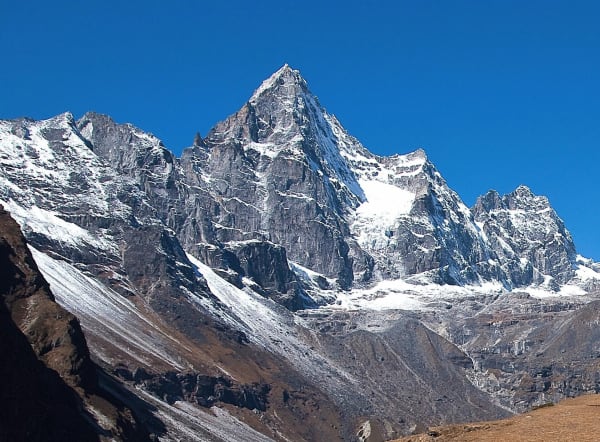
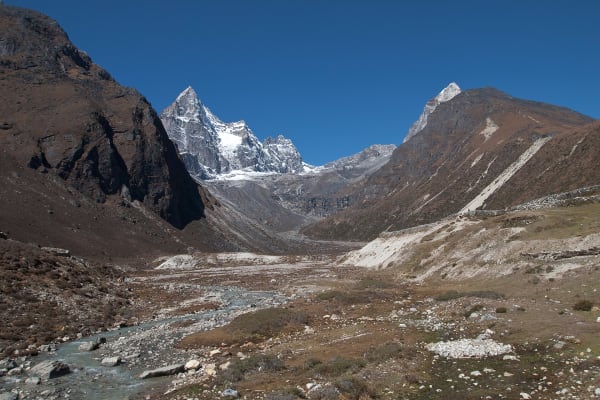
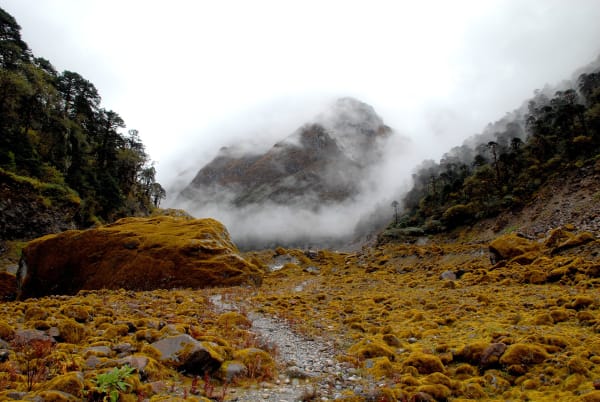
Kyajo Ri (6,186 m) is the climb to book when you have done Island Peak and found it too crowded and too easy.
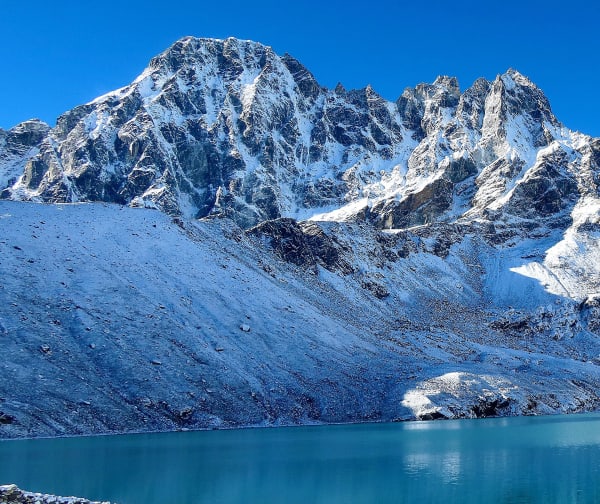
It stands at the head of the Kyajo Drangka, a hanging side valley between Namche and Thame that has no lodges, no trekking route and no reason for anyone to walk up it except this mountain. It was only opened to climbing in 2002, and in a busy season it might see a dozen parties.
The climbing is the real attraction. The south-west ridge is a genuine mixed route — rock, snow and ice — with fixed rope on the steep sections, a sharp summit ridge, and a final pyramid that looks improbable from base camp and turns out to go. It is graded AD+, a clear category above the trekking peaks most people start on, and it demands that you arrive already able to climb rather than expecting to learn on the mountain.

The Climb at a Glance
| Summit | 6,186 m |
| Grade | AD+ — mixed rock, snow and ice with a sharp summit ridge |
| Duration | 16 days Kathmandu to Kathmandu |
| Base camp / high camp | 4,550 m / 5,300 m |
| Staffing | One climbing Sherpa per climber above base camp |
| Summit success rate | Around 55 to 65 percent |
| Opened to climbing | 2002 |
| Price | From USD 3,650 per person |
We run it as a 16-day expedition. Kwangde is its closest equivalent in grade, and Phari Lapcha is the gentler introduction to technical ground.
The Route
Why the itinerary goes via Thame
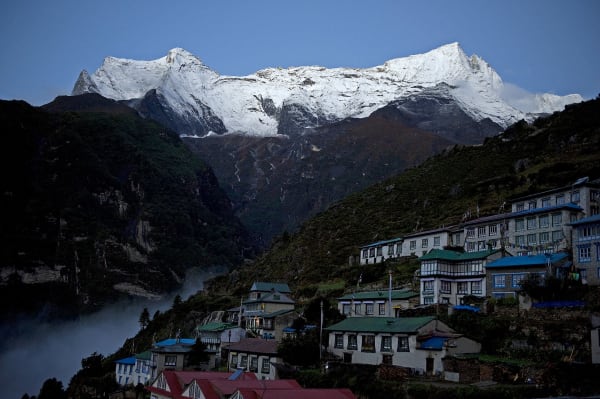
Partly for acclimatisation and partly because it is a better valley than the Everest trail. Thame sits on the old salt route to Tibet, has a monastery cut into the cliff above it, and carries a fraction of the traffic of the Dudh Koshi route to Base Camp.
Into the Kyajo Drangka (3,800 m to 4,550 m)
From Thame into the hanging valley — no lodges, no trail markers, no other parties — to base camp at 4,550 m on a yak pasture. A training and skills day follows, which on an AD+ route is an assessment as much as a refresher.
High camp and the summit (5,300 m to 6,186 m)
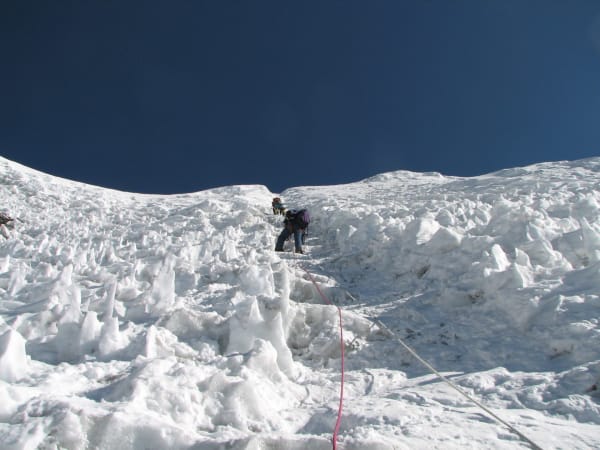
Four to five hours to high camp at 5,300 m on a shoulder below the route — north-facing, exposed, and -15 °C to -20 °C overnight. Summit day takes in the rock buttress, the main ice slopes and the exposed arête, all fixed by our Sherpas the day before, with the easier connecting ground climbed on a short rope.

The descent is in many ways the harder half. Abseiling a mixed route on loose ground at the end of a twelve-hour day is where mistakes happen, and it is slow — often four to five hours from the summit.
Why One Sherpa Per Climber
On most trekking peaks we staff one climbing Sherpa per two climbers. Here it is one per climber, and the reason is technical rather than commercial.
Mixed ground does not allow a rope team to move at the pace of its slowest member the way a snow slope does. On the buttress and the arête each climber needs someone with them — for sequencing, for protection, and because a stuck climber on a rock step holds up everyone behind them on a route with a hard turnaround time.
That staffing is the single biggest line item in the price, and it is not something we will reduce for a cheaper quote.
Who We Take
- A previous 6,000 m peak, or strong alpine experience elsewhere — a season of AD routes in the Alps, or comparable ground in the Andes.
- We will not take someone whose only mountain experience is trekking. The skills day at base camp is an assessment, not a course.
- Comfort on exposed ground, including abseiling on loose rock while tired.
- A climbing CV at the booking stage.
If you want technical ground but the above reads as a stretch, Phari Lapcha is the peak we recommend for that step. Read the fixed rope and jumar guide first either way.
What It Costs
| Group size | Price per person |
|---|---|
| 1 climber | USD 4,450 |
| 2 to 4 | USD 4,120 |
| 5 to 7 | USD 3,910 |
| 8 to 10 | USD 3,800 |
| 11 to 14 | USD 3,700 |
| 15 and over | USD 3,650 |
What Is Included
- Airport transfers, a climbing briefing, permit and equipment-check day in Kathmandu.
- Kathmandu–Lukla return flights.
- Hotel accommodation in Kathmandu with breakfast, and teahouses on the approach and walk out.
- Tented base camp (4,550 m) and high camp (5,300 m) with mess, kitchen and toilet tents, and a cook and kitchen crew.
- Three meals a day throughout.
- NMA climbing permit for Kyajo Ri, Sagarmatha National Park entry and the Khumbu municipality fee.
- A government-licensed climbing guide and one climbing Sherpa per climber above base camp.
- Group climbing equipment and fixing of the rock buttress, the ice slopes and the exposed ridge.
- A training and skills assessment day at base camp, plus a reserve day.
- Porter transport of group equipment, NMA garbage deposit, summit certificate and all taxes.
What Is Not Included
- International flights and the Nepal entry visa fee.
- Travel insurance covering technical mountaineering to 6,186 m, with helicopter evacuation and repatriation.
- Personal climbing equipment, including technical tools appropriate to mixed ground.
- Personal trekking equipment and clothing, including double boots and a bag rated to -20 °C.
- Porter services for your personal duffel.
- Lunch and dinner in Kathmandu.
- Snacks, bottled water, hot showers, Wi-Fi, charging and drinks.
- Laundry, phone calls, souvenirs and personal expenses.
- Tips for the guide, climbing Sherpas, porters and support staff.
- Extra accommodation or transport caused by a cancelled Lukla flight, weather or an early descent.