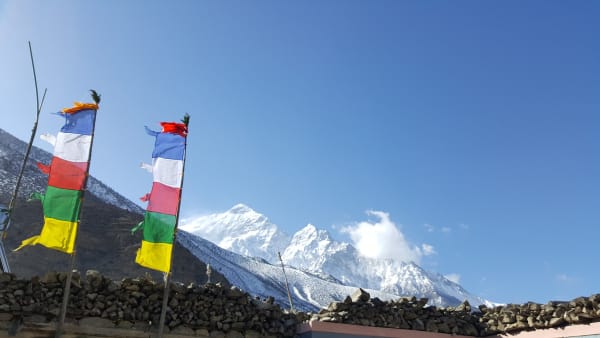
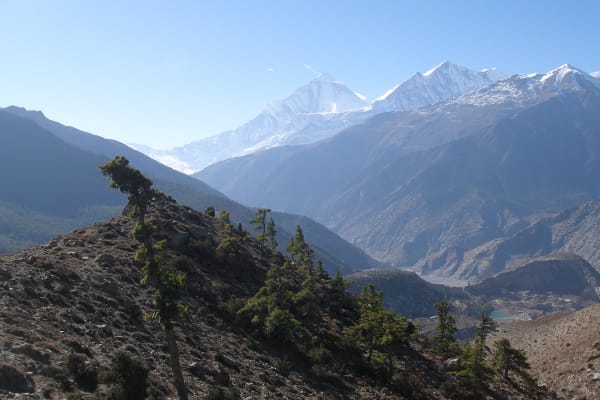
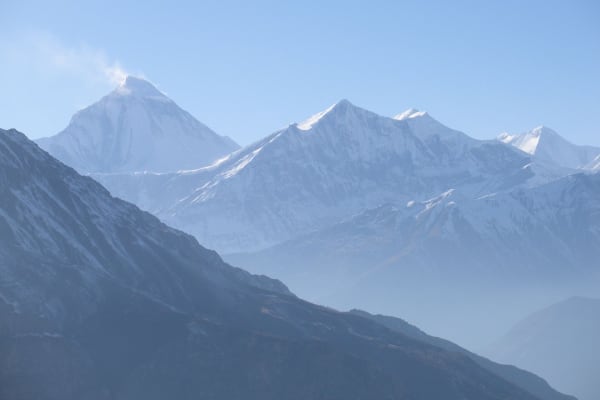
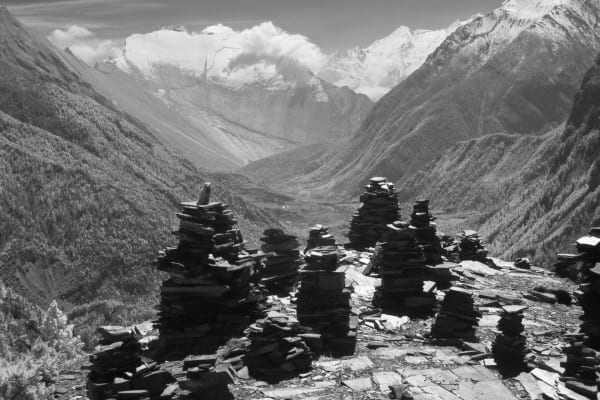
Dhampus Peak (6,012 m) sits on the eastern rim of Hidden Valley, the high basin behind Dhaulagiri, and it gives one of the best summit views in Nepal for a peak of its modest grade. From the top, Dhaulagiri I stands across the valley at close range, the Annapurnas fill the eastern horizon beyond the Kali Gandaki, and the brown plateau of Mustang runs north.
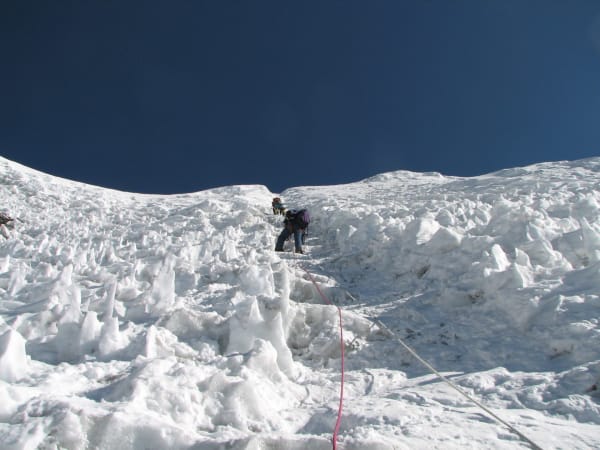
The climb is a straightforward PD — a snow slope of 35 to 40 degrees with a short fixed section and a broad summit. The approach is unusual for Nepal: a twenty-minute flight into the deepest gorge on earth, a night among the apple orchards of Marpha, and then two days climbing west out of the Kali Gandaki onto the flank of Dhaulagiri.
It is one of the most accessible 6,000 m summits in the country and one of the least visited.

The Climb at a Glance
| Summit | 6,012 m |
| Grade | PD — 35–40° snow slope, short fixed section, broad summit |
| Duration | 16 days Kathmandu to Kathmandu |
| Base camp / high camp | 4,600 m / 5,200 m |
| Summit success rate | Around 80 to 85 percent on our departures |
| Best seasons | March to May, September to November |
| Permits | NMA climbing permit and ACAP — included |
| Price | From USD 3,350 per person |
We run it as a 16-day expedition. It shares its approach with the much harder Tukuche Peak expedition, and the two combine well.
The Route
Jomsom to Yak Kharka (2,720 m to 3,680 m)
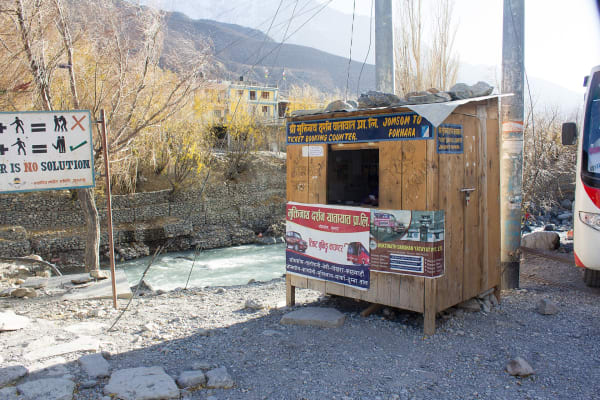
Drive to Pokhara and fly to Jomsom — twenty minutes into the Kali Gandaki, the deepest gorge on earth measured between Annapurna and Dhaulagiri. A night at Marpha among the apple orchards, then west out of the valley to Yak Kharka at 3,680 m with an acclimatisation day.
Base camp and training (4,600 m)
Up to base camp at 4,600 m below the Dhampus Pass, with a full training and acclimatisation day: crampons, ice axe, fixed-line ascent, abseiling and rope-team travel.
High camp and the summit (5,200 m to 6,012 m)
High camp at 5,200 m on the rim of Hidden Valley, then a pre-dawn start. A short glacier, a 35 to 40 degree slope, a brief fixed section and a broad summit with no exposure problem. The view is the whole reason to come.

Hidden Valley and the Wind
Hidden Valley is a high basin at around 5,000 m behind the Dhaulagiri massif, enclosed on all sides and reached over the Dhampus Pass. It is a strange, flat, wind-scoured place with no vegetation and no permanent inhabitants, and it is the defining feature of this climb.
The wind is the thing to plan around. The Kali Gandaki is one of the windiest valleys in Nepal — a thermal wind funnels up it from late morning every day of the year, carrying dust — and Hidden Valley behind the massif takes the same airflow with nothing to break it.
- Summit days start early and aim to be off the top well before midday.
- Wind is the main reason for turn-backs on this peak rather than the climbing itself.
- Jomsom flights are morning-only. Afternoon flying is impossible and cloud closes the window entirely.
- Tents are guyed and weighted at both camps, without exception.
What It Costs
| Group size | Price per person |
|---|---|
| 1 climber | USD 4,090 |
| 2 to 4 | USD 3,790 |
| 5 to 7 | USD 3,580 |
| 8 to 10 | USD 3,480 |
| 11 to 14 | USD 3,400 |
| 15 and over | USD 3,350 |
What Is Included
- Airport transfers in Kathmandu, plus a climbing briefing, permit and equipment-check day.
- Transport Kathmandu to Pokhara and back, and the Pokhara–Jomsom return flights.
- Hotel accommodation in Kathmandu and Pokhara with breakfast, and teahouses on the approach.
- Tented base camp (4,600 m) and high camp (5,200 m) with mess, kitchen and toilet tents, and a cook and kitchen crew.
- Three meals a day throughout.
- NMA climbing permit for Dhampus Peak and the Annapurna Conservation Area Permit.
- A government-licensed climbing guide and one climbing Sherpa per two climbers above base camp.
- Group climbing equipment — ropes, snow bars, ice screws and anchors — and fixing of the steep section.
- A full training and acclimatisation day at base camp.
- Porter and pack-animal transport of group equipment, NMA garbage deposit, summit certificate and all taxes.
What Is Not Included
- International flights and the Nepal entry visa fee.
- Travel insurance covering mountaineering to 6,012 m, with helicopter evacuation and repatriation.
- Personal climbing equipment — harness, crampons, ice axe, ascender, descender, helmet and carabiners. Available to rent.
- Personal trekking equipment and clothing, including boots and a sleeping bag.
- Porter services for your personal duffel.
- Lunch and dinner in Kathmandu and Pokhara.
- Snacks, bottled water, hot showers, Wi-Fi, charging and drinks.
- Laundry, phone calls, souvenirs and personal expenses.
- Tips for the guide, climbing Sherpas, porters and support staff.
- Extra accommodation or transport caused by a cancelled Jomsom flight, weather or an early descent.
Double boots are recommended but not essential here, since high camp is 5,200 m rather than 5,500 m or more. A warm four-season boot taking a semi-automatic crampon will do.