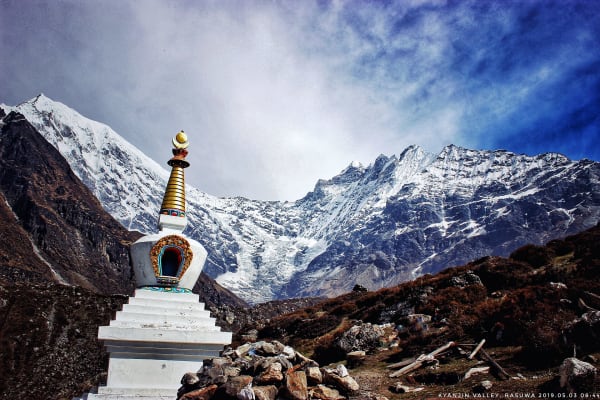
The Lower Manaslu trek walks the Gorkha foothills below the restricted area, through the Gurung villages of Barpak, Laprak and Gumda on trails that carried salt and grain long before anyone came here to trek. It stays between 600 m and 2,700 m, needs no restricted-area permit, and delivers the full northern skyline — Manaslu (8,163 m), Himalchuli (7,893 m), Ganesh Himal and Buddha Himal — from ridges rather than from the floor of a gorge.
This is also the country at the epicentre of the April 2015 earthquake. Barpak and Laprak lost almost every house and have been rebuilt by their own communities in stone and slate, and the villages talk about it openly.
It is a homestay route rather than a lodge one: you sleep in family houses, eat what the household eats, and the money stays where you are walking.

The Trek at a Glance
| Duration | 10 days Kathmandu to Kathmandu, 6 of them walking |
| Highest point | Gupsi Pakha, 2,700 m |
| Difficulty | Moderate — real hill walking, no altitude risk |
| Best seasons | October to December, February to May |
| Accommodation | Village homestays in family houses |
| Access | Jeep from Kathmandu to Barpak — no flight |
| Permits | Trekking registration and conservation entry — no restricted permit |
| Price | From USD 825 per person |
We run it as a 10-day homestay trek. It ends at Machha Khola, which is where the Manaslu Circuit begins, so the two can be walked back to back.
The Route
Barpak and the exploration day (1,960 m)
A jeep from Kathmandu via Gorkha to Barpak, then a full day in the village. Barpak is one of the largest and best-organised Gurung settlements in the middle hills, with a long military history — it is the home village of a great many Gurkha soldiers — and it was the epicentre of the 7.8 magnitude earthquake of 25 April 2015. The rebuilding is the story people tell, and they tell it directly.
Barpak to Laprak and Gupsi Pakha (1,960 m to 2,700 m)
A ridge day to Laprak, which was similarly destroyed and part of which was resettled higher on the ridge. From there a day hike to Gupsi Pakha at 2,700 m, the high point of the trek and the best viewpoint: Manaslu, Himalchuli, Buddha Himal and the Ganesh range across the northern horizon.

Laprak to Gumda and out (2,100 m to 870 m)
North-west over Singla to Gumda, then a long descent to Machha Khola on the Budhi Gandaki and the jeep back to Kathmandu. The walking throughout follows old village trails on the ridges rather than the new road corridors — where a track and a trail run in parallel, your guide takes the trail.
Homestays: What to Expect
This is not teahouse trekking, and the difference is the point. You stay in family houses rather than lodges, which means:
- A bed with blankets in a family house, simple and clean.
- A shared outside toilet, and washing from a tap or a bucket of hot water. There are no showers as such.
- No heated dining rooms — you eat in the family kitchen, which is warmer anyway.
- What the household eats, rather than a menu. Dal bhat, and it is usually excellent.
- An evening with the family, which is the part people remember.
Homestay costs are paid through your package rather than in cash, so the money reaches the households directly. See our responsible trekking guide for why this model matters.
Difficulty and Who It Suits
Graded moderate, and it is one of the best first treks in Nepal for anyone whose interest is as much cultural as alpine.
- Six walking days, five to seven hours each on ridge and village trails.
- No altitude risk at all — the maximum is 2,700 m and you sleep well below it.
- Real hill walking, with sustained ascent and descent between ridges.
- No flights, which removes the main source of delay on Nepal itineraries.
- Mobile signal most days, which is unusual on a trek this quiet.
The trade-off is that you never get above the treeline. If you want glaciers and 5,000 m passes, this is not the trek — read the Manaslu Circuit guide instead.
What It Costs
| Group size | Price per person |
|---|---|
| 1 trekker | USD 950 |
| 2 to 4 | USD 925 |
| 5 to 7 | USD 900 |
| 8 to 10 | USD 875 |
| 11 to 14 | USD 850 |
| 15 and over | USD 825 |
There are ATMs in Gorkha and Arughat but nothing dependable on the trail. Draw what you need in Kathmandu in small denominations for drinks, snacks and tips.
What Is Included
- Airport pickup and drop-off in Kathmandu.
- Private jeep transport Kathmandu to Barpak and Machha Khola back to Kathmandu.
- Hotel accommodation in Kathmandu with breakfast.
- Homestay accommodation in family houses throughout the trek.
- Three meals a day during the trek.
- Manaslu Conservation Area entry and trekking registration.
- A licensed English-speaking trekking guide.
- Group trekking map, first aid kit carried by the guide, and all government taxes, permit fees and service charges.
What Is Not Included
- International flights and the Nepal entry visa fee.
- Travel insurance including emergency helicopter evacuation.
- Personal trekking equipment and clothing.
- Porter services, available at additional cost.
- Lunch and dinner in Kathmandu.
- Snacks, bottled water, hot water for washing, Wi-Fi, charging and drinks.
- Laundry, phone calls, souvenirs and personal expenses.
- Tips for guides, drivers and support staff.
- Extra accommodation or transport caused by weather, road conditions or anything outside the itinerary.
No restricted-area permit is needed because the route stays south of the Manaslu boundary at Jagat, which also means there is no minimum group size and no fixed itinerary requirement.