On the morning of Sunday 11 October 2026 the Budhi Gandaki came down through northern Gorkha in a flood that took houses and bridges along the first days of the Manaslu Circuit. The Department of Hydrology and Meteorology had no record of rain in the upper catchment. The monsoon was over. People in the villages said the river had been quiet.
It was at least the fourth damaging flood in Nepal's central Himalaya in under seven weeks, and in each of them a river was blocked or struck by debris rather than simply rising with the rain. This article explains the kind of flood they were, because the usual instinct — check the forecast, avoid the wet season — does not protect anyone from it. The habits that do are simple and are set out below. The news itself is in our report on the Budhi Gandaki flood.
Four Events in Seven Weeks
| Date | River | What has been said about the trigger |
|---|---|---|
| 26 August 2026 | Bhote Koshi and Trishuli, Rasuwa | Glacial ice and rock collapsed into the river system, in the words of UN agencies. The exact sequence is still being studied |
| 6 September 2026 | Therang Khola at Namrung, upper Budhi Gandaki | Debris dammed the stream near its source and then burst, officials said |
| 26–27 September 2026 | Marsyangdi at Chame, Manang | During heavy rain, debris from the Ghatte Khola side stream dammed the main river and submerged the road bridge |
| 11 October 2026 | Budhi Gandaki, Gorkha | Not confirmed. A landslide dam on the Syar Khola or Ungilung Khola, or an ice avalanche above. No rain recorded |
The first of these was a catastrophe on a different scale from the others: at least 1,400 people killed and nearly 5,300 missing, according to UN agencies on 9 October. The others were far smaller. What the four have in common is the mechanism. In each, something solid — ice, rock, or the rubble of a landslide — got into a river or across it.
How a River Floods With No Rain
A landslide dams the valley
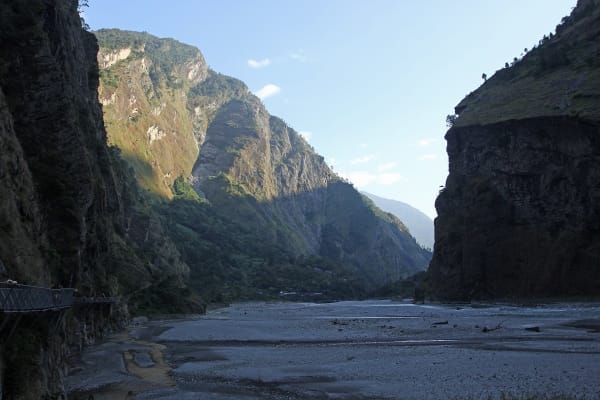
Himalayan valleys are narrow and their sides are steep and young. When a slope fails into a gorge, the debris can block the river completely. Water ponds behind the blockage; below it, the river drops or stops. The dam is loose rubble, and when the water reaches its top it cuts through in minutes, releasing the whole pond at once. Some of these dams last hours, some days. The flood that follows arrives as a wall carrying the dam with it, and if the slope keeps moving the cycle can repeat. That is what residents of Lokpa described on Sunday: a river that seemed to stop and start in the dark, and water that fell and came again in at least three surges.
Ice or rock falls from high above
A hanging glacier or a rock face can collapse without warning, in any season, by day or night. The falling mass picks up snow, meltwater and loose sediment and becomes a fast flow of slurry and boulders that can run far down a valley. It may also do the work of a landslide and dam the river where it lands. The head of Nepal's disaster authority suggested on Sunday that an ice avalanche in the high north was one possible origin of the Budhi Gandaki flood.
A glacial lake overflows or bursts
Lakes held behind moraine or ice sit below many Himalayan glaciers. An avalanche landing in one can throw a wave over the dam, or the dam itself can fail. This valley has a recent example. In April 2024 ice avalanches from the Manaslu Glacier fell into Birendra Tal, the lake near Samagaun, and the overflow flooded down the Budhi Gandaki. The mountain research centre ICIMOD, which studied it, noted that the moraine dam itself was not breached.

A side stream blocks the main river
The smallest version is the commonest. A side stream in spate brings down more rubble than the main river can carry away, and builds its own dam across it. That is what the Ghatte Khola did to the Marsyangdi at Chame in September. It needs rain, but it does not need the main river to be high.
All four share the features that make them dangerous to people on a valley floor. They start out of sight. They arrive suddenly. They carry rock, not just water. And they travel: on Sunday the flood began high in Chumnubri at about 04:00 and its first surge passed Arughat, far down the valley, at about 06:30.
The Signs
There is rarely much warning, but there is usually some, and on Sunday it was enough. People in Lokpa and Chumling heard the streams roaring at about four in the morning and left their houses before they knew what was happening.
- A roar from up the valley, like a train or continuous thunder, sometimes with the ground trembling.
- The river going quiet or dropping when it should not. This is the most important sign and the least obvious: it means the water is being held back somewhere above you.
- A sudden change of colour to brown or black, or branches and debris appearing in clear water.
- A sudden rise with no rain to explain it.
- A blast of wind or a smell of wet earth coming down the valley, sometimes ahead of the water.
- Local people moving uphill quickly. They know their river. Go with them and ask later.
A river that falls after a surge has not finished. Several of the residents quoted on Sunday said the water dropped and then came back without warning, and the Flood Forecasting Division was still reporting the flow rising and falling hours after the first wave.
What to Do in the First Minutes
- Go uphill, straight away. Up the valley side, at right angles to the river, not along the trail up or down the valley. Height above the water is what counts, and a few dozen metres of climb is worth more than a kilometre of running along the bank.
- Do not cross a bridge to reach the side you think is safer. Bridges are the first things to go.
- Leave your pack. Take what is on you. The chair of one ward said on Sunday that people could not even take their belongings out, and they are alive.
- Wake everyone on your way. Shout. At four in the morning most people are asleep.
- Stay up. Do not go back down when the water drops. Wait for daylight and for someone who knows the valley to say it is over, which may be many hours.
- Keep out of the riverbed afterwards. Do not go down to look, to film or to cross on what is left. A dam that failed once can form again.
- Then make contact: your guide's agency, the police, your family. In Nepal the emergency numbers are 100 for the police and 1234 for the Ministry of Home Affairs.
Before You Sleep: Where You Stay Matters
Most of what a trekker can do about this hazard is done at four in the afternoon, not four in the morning.
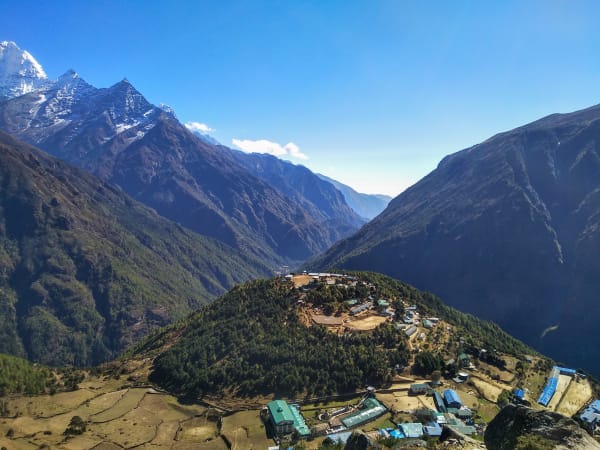
- Sleep above the river, not beside it. Many gorge villages have an older part on a terrace and a newer strip on the gravel flat by the water, where the road or the trail runs. In Nepali that flat is the bagar, and it is in the place names: Jagat Bagar, Yaru Bagar. The houses reported lost at Jagat on Sunday were the ones on the riverbed. Given the choice, take the lodge on the terrace.
- Know the way uphill from your room before dark. Where is the path, and where does it start?
- Keep a grab bag by the bed: head torch, shoes, warm jacket, phone, passport, permits and money. Everything else can be replaced.
- Camp on high ground. A flat sandy bench by a river is flat and sandy because the river made it.
- Notice the bridges. On a day when you will cross the river several times, ask your guide which side has the villages and the way out.
- Tell someone your plan. An agency that knows which lodge you are in tonight can tell a rescue team where to look.

Alerts and Information
Nepal's Flood Forecasting Division sends warnings by SMS to phones in the area at risk. On Sunday one went out at 06:40 telling people along the Budhi Gandaki to stay away from the river as far down as the Trishuli confluence, and another at 09:25 gave risk levels for the stretch below. The division also gives flood information by phone on 1155.
- Carry a Nepali SIM and keep the phone charged and switched on at night in a valley with signal. A power bank is safety equipment.
- Trek with a guide in gorge country. A guide hears the warning in Nepali, knows who to ring in the next village up, and knows which lodge is on the terrace. In restricted areas such as Manaslu a guide is required anyway.
- Ask at each lodge what the river has been doing. Lodge owners talk to each other up and down the valley all day.
- Check your insurance covers natural disasters, curtailment and helicopter evacuation. Our insurance guide explains the wording to look for.
Signal is the limit of all this. In the upper Budhi Gandaki there are long stretches without it, and the first warning on Sunday was a sound, not a message.
Does This Mean Gorge Treks Are Unsafe?
It means they carry a risk that cannot be forecast, which is not the same thing. On any given night in any given valley the chance of an event like Sunday's is very small. Tens of thousands of people walk these gorges every season, and the villages in them have stood for generations. But the consequences are severe, the trigger is invisible from below, and this season has shown that such events are not confined to the monsoon.
There is also a trend to be honest about. Speaking after the August flood, UNICEF's spokesperson James Elder said the Himalaya are warming about twice as fast as the global average and warned of returning to the same valleys after the next flood. Retreating glaciers leave behind lakes and unsupported slopes. Nobody can say that Sunday's flood was caused by warming, and its trigger is not even established yet. What can be said is that the high ground above these valleys is changing, and that planning for it is now part of trekking here.
For a trekker that planning is modest. Sleep high, know the way up, keep your phone on, walk with someone who knows the valley, and move the moment the river sounds wrong. For which routes are open now, see our route-by-route status.
Sources
- The Kathmandu Post — residents' accounts of the Budhi Gandaki flood and the Marsyangdi dammed at Chame
- OnlineKhabar English — what triggered the flood
- Nagarik News (Nepali) — the three surges and the timing at Arughat
- ICIMOD — the 2024 Birendra Tal flood on the Budhi Gandaki
- UN News — the August flood and the warming of the Himalaya
- OnlineKhabar English — the Namrung flood of 6 September