
Nepal's trekking peaks — summits of about 5,500 to 6,500 metres that can be climbed in two or three weeks with basic mountaineering skills — have two seasons. Spring is warmer and cloudier. Autumn is colder and clearer, and its second half, from late October to the end of November, is the clearest and coldest of all.
For a climber that is a fair exchange up to a point. Settled weather is the single biggest factor in whether a summit day succeeds, and November has it. But summit day starts at one or two in the morning, at around 5,600 metres, and in late November the temperature at that hour is not a detail. The difference between a good trip and a bad one this month is almost entirely equipment and timing.
November Conditions Up High
| Early November | Late November | |
|---|---|---|
| Weather | Very stable; clear nights and mornings | Stable, with the first winter systems possible |
| Summit temperature at dawn | Around −15 to −20°C | Around −20 to −28°C |
| Wind | Usually moderate | Strengthening as the winter jet stream descends |
| Snow | Firm and well consolidated | Hard, icy in places; fresh snow after any storm |
| Other teams | Many, especially on Island Peak | Few |
| Daylight | About 10.5 hours | About 10 hours |
Firm snow is the season's gift: cramponing is secure and progress is quick. Its cost is that the fixed-rope sections can be hard ice by late in the month, which is more strenuous to climb and less forgiving of poor technique.
The Three Main Peaks Compared
| Island Peak | Mera Peak | Lobuche East | |
|---|---|---|---|
| Height | 6,189 m | 6,476 m | 6,119 m |
| Character | A short, steep, technical finish | A long, high glacier walk | The most technical of the three |
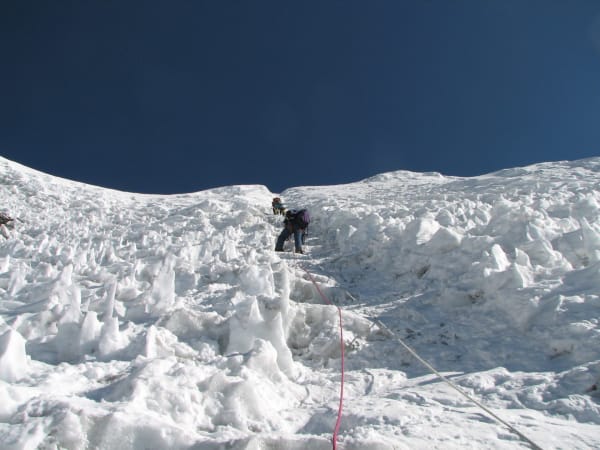
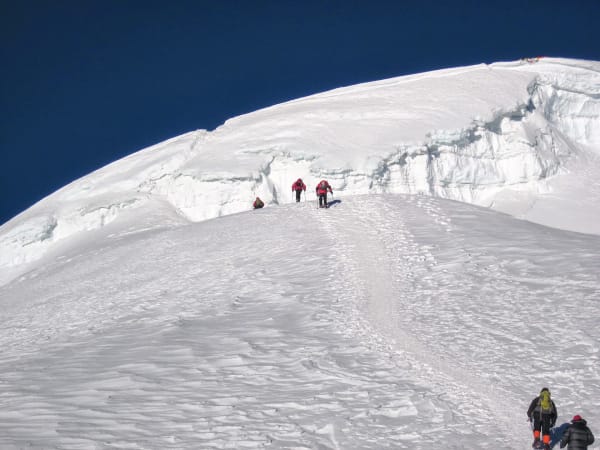
| Crux | A headwall of fixed rope to the summit ridge; crevasses crossed by ladder | Altitude and cold; a final short steep dome | Rock slabs and a steep, exposed snow ridge |
| In November | Good conditions; headwall icier late in the month; crevasses at their widest | The coldest and windiest of the three — it is the highest and most exposed | Good early in the month; rock sections hold ice later |
| Suits | Fit trekkers with basic rope skills | Strong walkers with good cold tolerance | Those with some previous climbing |
Mera's reputation as the easy one misleads people every year. It is technically the simplest, and it is also nearly 300 metres higher than Island Peak, with a high camp at about 5,800 metres on an open glacier. In November that is the coldest place most clients will ever sleep. A fuller comparison is in Mera Peak vs Island Peak.
What the Cold Demands
Frostbite, not falling, is the characteristic injury of a November climb, and it happens to toes and fingers on summit morning. The kit that prevents it is not optional.
| Item | November standard |
|---|---|
| Boots | Double or triple mountaineering boots rated for 6,000 m. Single leather boots are not enough this month. |
| Hands | A three-layer system: liner gloves, insulated gloves, and expedition mittens to go over both. |
| Body | An expedition-weight down jacket with a hood, worn on the climb, not just in camp. |
| Legs | Thermal base layer, softshell or fleece trousers, and a windproof shell; insulated trousers for high camp. |
| Sleeping bag | Comfort rating of −25°C or lower for high camp. |
| Face | Balaclava or buff, goggles as well as glacier glasses. |
| Extras | Chemical hand and toe warmers, an insulated bottle cover, a flask. |
Most of this can be hired in Kathmandu or in Chhukung and Khare, the villages below Island Peak and Mera. Boots are the item to check hardest: a hired pair that does not fit is how toes are lost. The complete list is in our peak climbing gear list.
- Start later if you can. In deep cold, guides often delay the summit start by an hour or two, so that the coldest part of the climb is nearer sunrise.
- Keep moving your toes and fingers, and say so at once if you lose feeling. Numbness that does not return with movement means stopping to rewarm.
- Eat and drink on the climb even though you will not want to. A cold, dehydrated climber is a slow one.
How Late Is Too Late?
| Summit date | Verdict |
|---|---|
| 1 – 15 November | Prime. Stable, cold but manageable, good snow. |
| 16 – 25 November | Good for well-equipped climbers. Noticeably colder; fewer teams and quieter camps. |
| 26 November – 5 December | Marginal. Possible in a settled spell, with a real chance of wind stopping the summit. |
| Mid-December onwards | Winter climbing — a different undertaking, with its own permit season. |
Count back from the summit to find your start date. A standard Island Peak trip is about eighteen days from Kathmandu and reaches the summit around day twelve or thirteen, so the last sensible departure is about 10 November. For Mera, with a similar schedule and a colder summit, we would not leave later than about 7 November.
In 2026 mind the Tihar holiday of 8 to 11 November: climbing permits for these peaks are issued by the Nepal Mountaineering Association, whose office closes for the festival. Trips departing in that week need their permits arranged beforehand. Fees and the process are in NMA peak permits and fees.
Acclimatisation Is Still the Main Thing
Cold takes the attention in November, but more summit attempts fail on altitude than on temperature. The itineraries that work are the ones that do not hurry.
- Island Peak is best approached after going to Everest Base Camp and Kala Patthar first, so that you arrive at Chhukung already acclimatised to 5,500 metres. Our Island Peak climb is built that way; the version from Chhukung is for those who have done the trek recently.
- Mera Peak needs a slow walk-in. The itineraries that cross the Zatrwa La on day two gain height too quickly; the longer approach through the Hinku valley is far kinder. The Mera Peak climb takes eighteen days for that reason.
- Lobuche East fits the same pattern as Island Peak, climbed after Base Camp on the Lobuche East trip.
Every trip should include a training day at base camp — fitting crampons, climbing a fixed rope with an ascender, abseiling, crossing a ladder. If you have never done these, read fixed-rope skills for Nepal peaks before you come.
An Easier Summit for Late November
If your dates fall in the last ten days of the month, or the cold of a 6,000-metre summit is more than you want to take on, there are lower objectives that give the experience of roping up without the extremes.
- Yala Peak, 5,520 m, above the Langtang valley. A non-technical glacier summit with a view into Tibet, reached by road from Kathmandu.
- Pokalde Peak, 5,806 m, near Everest. A short rock scramble to finish, usually done from the Kongma La.
- Kala Patthar and Chhukung Ri. Not climbs at all, but high walking summits at around 5,550 metres that you can do in trekking boots.
New to all of this? Start with our beginner's guide to peak climbing in Nepal, then the individual guides to Island Peak and Mera Peak.