
On the last morning of Tihar the streets of Nepal are empty and the houses are full. Brothers have travelled across the country, and in many cases across the world, to sit on a mat in front of their sisters. What follows takes about an hour, has changed very little in centuries, and ends with every man and boy in the country wearing a vertical stripe of colours down his forehead.
Bhai Tika — bhai means younger brother, though it applies to all of them — is the emotional centre of the festival, the day people would least want to miss. In 2026 it falls on Wednesday 11 November. It is a family occasion, but visitors are drawn into it more often than you might expect, and it helps to know what is happening.
The Story Behind It
The five days of Tihar belong to Yama, the god of death, and the last belongs to his sister, the river goddess Yamuna. She had not seen her brother for a long time and sent for him — by crow, by dog and by cow, which is one explanation for the days that come before. At last he came. She welcomed him with a tika and a garland and fed him the best meal he had ever eaten, and he was so pleased that he offered her a gift. She asked that any brother who received tika from his sister on that day should be safe from an early death.
A second telling is more pointed. Yama's messengers came for a young man whose time was up, and found his sister in the middle of honouring him. She asked them to wait until she had finished: until the circle of oil she had drawn round him dried, and the garland she had given him withered. The oil does not dry. The flowers — purple globe amaranth, makhamali — do not wither. They are waiting still.
Every element of the ritual comes from that story. It is a sister putting herself between her brother and death.
The Ritual, Step by Step
- The seat. Brothers sit cross-legged in a row on mats or cushions, eldest first, usually facing east.
- The circle. The sister walks round them three times, pouring a thin line of water and oil from a copper jug onto the floor — the boundary Yama cannot cross.
- The oil. She touches oil to each brother's hair.
- The base. A vertical stripe of white rice paste is drawn down the centre of the forehead.
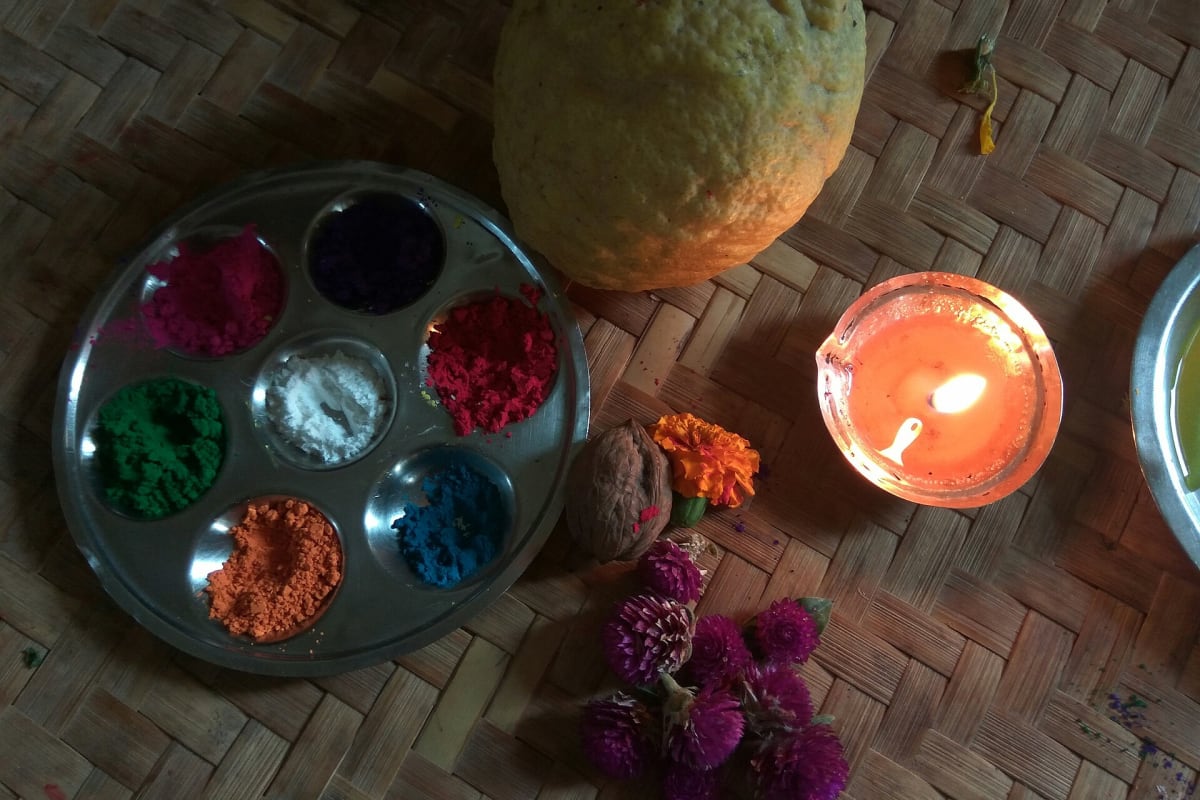
- The seven colours. On that white ground she places seven dots of coloured powder, one above the other. This is the saptarangi tika, found only on this day.
- The garlands. One of purple makhamali, which keeps its colour for months, and often a second of marigolds and one of sacred dubo grass.
- The walnut. At the threshold she cracks a walnut with a stone, breaking whatever obstacles lie in his way.
- The plate. She gives him a tray of sweets, sel roti, fruit, nuts and dried fruit — the sagun — and often a new cap.
- The return. The brother gives his sister a tika in turn, touches her feet if she is older, and hands her his gift: money, clothing, jewellery.
- The meal. Long, and eaten together.
Sisters traditionally fast until it is done. In households with many siblings, and cousins who count as siblings, the ceremony can run from late morning until mid-afternoon.
The Seven Colours and the Garland
The colours are bought as a set in the markets in the week before — small paper twists or a tray of seven wells — and typically run through red, yellow, green, blue, white, orange and purple or pink. Families differ on the order and on what each stands for. What matters is that there are seven, and that they are different from the single red tika of every other occasion in the year.

The makhamali garland is the other emblem of the day. Globe amaranth is a small, papery, clover-shaped flower in deep magenta that dries without fading. Families grow it for the purpose or buy it by the garland; in the days before Bhai Tika the flower markets of Kathmandu turn from orange to purple. A garland given this year will still be hanging on a mirror or a doorframe when the next one arrives.
Bhai Tika in 2026
| Wednesday 11 November 2026 | |
|---|---|
| Auspicious time | Announced a few days ahead by the national calendar committee; normally late morning. The tika may be given at any time that day. |
| Morning | Streets almost deserted. Local shops closed. Families gathering. |
| Late morning to mid-afternoon | The ceremony and the meal. |
| Afternoon and evening | People out visiting, every man with a striped forehead and a purple garland. Shops begin to reopen. |
| Offices and banks | Closed. They reopen on Thursday 12 November. |
| Transport | Very few buses and taxis until evening. Do not plan to travel far. |
The day before, Tuesday the 10th, is the heaviest travel day of the festival, as people make their way to wherever their sisters live. If you need to move between Kathmandu and Pokhara that week, do it by Monday or wait until Thursday. The whole calendar is in the Tihar dates guide.
The Temple That Opens Once a Year
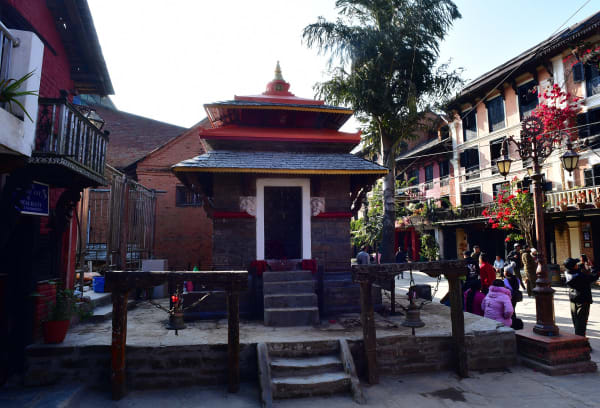
In the centre of Kathmandu, beside the old clock tower, there is a large square pond called Rani Pokhari, the Queen's Pond, built in the seventeenth century by a king to console his wife after the death of their son. A white temple stands on an island in the middle of it, reached by a causeway behind a locked gate.
The gate is opened on one day of the year: Bhai Tika. The temple is for those who have no brother or sister to give or receive tika. They come to worship there instead, and often to exchange tika with others in the same position. The queue runs along the causeway from early morning.
It is one of the more affecting sights of the festival and, because it is public, one of the few parts of Bhai Tika a visitor can simply go and see. Go before eleven, dress modestly, and be discreet with a camera: people are there because someone is missing.
If You Are Invited
It happens often. A guide you have just spent two weeks with says his sisters would like to give you tika. A guesthouse owner seats you with her sons. A homestay family will not hear of you eating alone. To be made a brother or sister for the day is a real compliment, and the only wrong answer is no.
- Dress neatly. Clean clothes with shoulders and knees covered. You will be photographed.
- Take off your shoes at the door and sit cross-legged where you are shown. If that is difficult, say so; a stool will be found.
- Bring a gift for the sister. Money in an envelope is entirely proper and is what her brothers give. For a visitor, 1,000 to 2,000 rupees is generous without being awkward; add chocolates or something from your own country if you have it.
- Sit still for the tika. Close your eyes when the powder goes on. Do not touch your forehead afterwards.
- Receive with your right hand, or both.
- Keep the garland on for the rest of the day, and the tika until it falls off by itself.
- Eat. The plate is large and will be refilled. Leaving a little is the signal that you have had enough.
- If you are a woman, you may be asked to give tika to the sons of the house, or receive one from them, or both. Follow the family's lead.
Afterwards you are, in a small way, family. People take that seriously. A message at next year's festival will be remembered.
Planning Around the Day
- Treat it as a rest day. Museums and offices are closed and transport is thin. Stay somewhere pleasant and walk.
- Eat at your hotel or in the tourist district at lunchtime; neighbourhood restaurants are shut.
- End a trek the day before. Guides and porters want very much to be home for this. A trek finishing on 9 or 10 November is a kindness; one finishing on the 11th is an imposition.
- On the trail, expect lodge staff to disappear for an hour mid-morning, and to return with coloured foreheads.
- Go out in the late afternoon. The streets fill with families in their best clothes, and the light on all that purple and orange is the last good photograph of the festival.
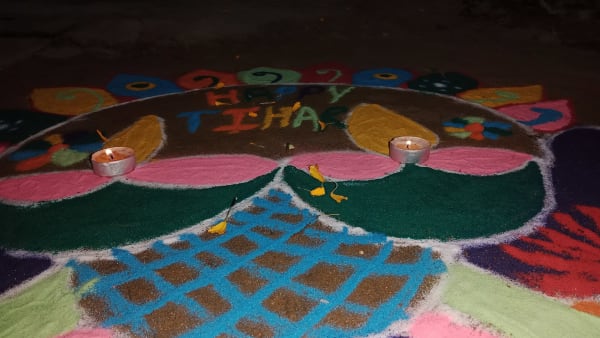
The Newar community keeps the day as Kija Puja, with mandalas on the floor as on the evening before; see Mha Puja and Nepal Sambat. What is on the plate is in the Tihar food guide, and the festival as a whole in our Tihar travel guide. If you would like to spend the day with a family, a homestay such as Sirubari is the surest way.